
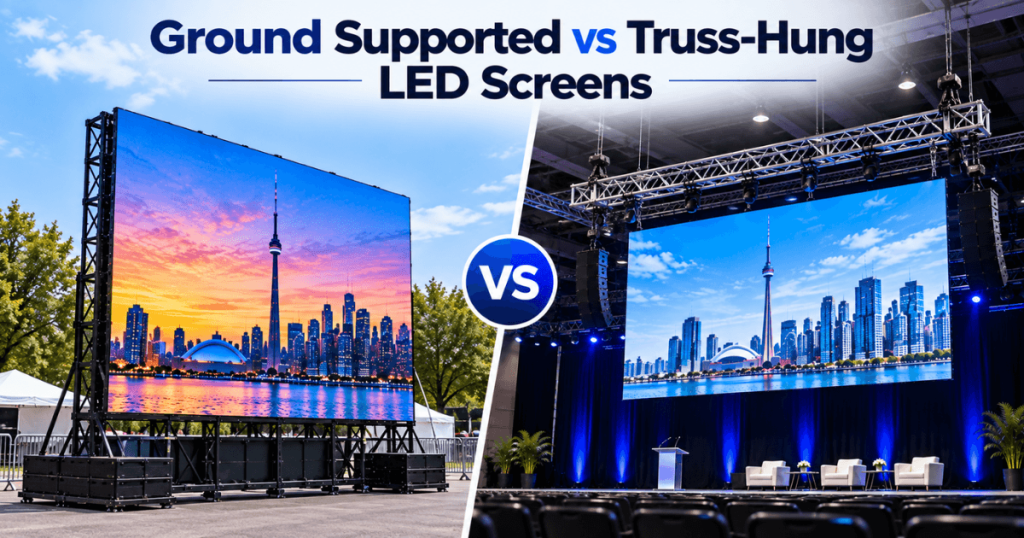
Choosing between a ground-supported LED screen and a truss-hung LED screen affects much more than how the display is installed. The decision can influence screen position, audience sightlines, stage space, installation time, venue coordination, rigging requirements, labour, and the overall event design.
A ground-supported LED wall transfers its load through a purpose-designed support system to the floor or stage. A truss-hung, or flown, LED wall is suspended overhead from an approved rigging system and suitable structural points.
Neither method is automatically better. Ground support can be efficient for conferences, corporate events, trade shows, and many ballroom productions. Truss-hung LED can be valuable when the screen needs greater elevation, unobstructed floor space, or integration into a larger production rig.
With 23+ years of event production experience, our Toronto LED screen rental team plans display systems around the venue, audience, screen dimensions, sightlines, production design, and approved installation conditions.
What Is a Ground-Supported LED Screen?
A ground-supported LED screen is installed on a professional structure that transfers the display load to the floor, stage, or another approved supporting surface.
The LED cabinets are assembled into the required dimensions and secured to a support system engineered or configured for the application.
Ground-supported systems are commonly used for:
- Conferences
- Corporate meetings
- Trade shows
- Exhibitions
- Product launches
- Galas
- Award ceremonies
- Weddings
- Indoor presentations
They can be particularly practical where an appropriate floor position is available behind or around the stage.
How Does a Ground-Supported LED Wall Work?
A modular LED wall is assembled from individual cabinets.
The support system keeps the completed display:
- Properly positioned
- Level
- Stable
- Aligned
- Supported according to system requirements
The exact structure depends on factors such as:
- Screen dimensions
- Screen weight
- Indoor or outdoor environment
- Stage design
- Available footprint
- Manufacturer requirements
- Site conditions
Ground support does not mean simply placing LED cabinets on the floor. Large event displays require professional installation and an appropriate support solution.
What Is a Truss-Hung LED Screen?
A truss-hung LED screen is suspended above the stage or event floor using a professional rigging system.
It may also be described as:
- Flown LED wall
- Suspended LED wall
- Rigged LED screen
- Hanging LED wall
The LED load is transferred through the rigging system to approved structural points or another professionally designed overhead structure.
This approach is common where the production requires:
- Elevated screens
- Clear stage space
- Improved sightlines
- Large scenic designs
- Multiple suspended displays
- Integration with lighting and production truss
Is Truss-Hung the Same as Flown LED?
In event-production language, flown LED generally refers to an LED display suspended from an overhead rigging system.
“Truss-hung” describes a common arrangement where truss forms part of that system.
The exact rigging design varies by venue and production.
For event planners, the important distinction is:
Ground Supported = load carried from below
Truss-Hung / Flown = load suspended from above
Ground Supported vs Truss-Hung LED Screens: Quick Comparison
| Factor | Ground Supported | Truss-Hung |
|---|---|---|
| Load Direction | Supported from below | Suspended overhead |
| Floor Footprint | Requires support space | Can free floor/stage space |
| Screen Elevation | Structure-dependent | Greater positioning flexibility |
| Rigging Points | Often not required | Typically required |
| Venue Coordination | Moderate | Usually more extensive |
| Installation Complexity | Often lower | Usually higher |
| Sightline Flexibility | Good | Excellent for many large rooms |
| Labour Requirements | Usually lower | Often higher |
| Cost | Often more economical | Often more expensive |
| Best Use | Ballrooms, conferences, booths | Large stages, concerts, major productions |
The final decision must still be based on the specific venue and system.
When Should You Choose a Ground-Supported LED Wall?
Ground support can be an excellent choice when:
- The venue has limited rigging options
- Screen elevation requirements are moderate
- Sufficient floor or stage space is available
- The screen is positioned behind the stage
- Installation efficiency is important
- The production does not require the display to be flown
For many Toronto corporate and conference events, ground support can provide a clean and practical installation.
What Are the Advantages of Ground-Supported LED Screens?
Simpler Venue Coordination
Ground-supported systems may avoid some of the overhead rigging coordination required for flown displays.
Potentially Lower Cost
Fewer specialized rigging requirements can reduce some labour and equipment costs.
Efficient Installation
For suitable applications, the structure can be assembled and the LED wall built directly in its intended location.
Flexible Screen Dimensions
Ground support can accommodate many standard and custom LED configurations when sufficient space is available.
Suitable for Fine-Pitch LED
It can work particularly well for close-view conference and corporate LED walls using P1.9, P2, P2.6, or similar fine-pitch systems.
What Are the Limitations of Ground-Supported LED Walls?
Ground support is not ideal for every production.
It Requires Physical Space
The supporting system needs an appropriate footprint.
This can reduce usable stage or backstage space.
Screen Height Can Be Limited
A large ground-supported system cannot simply be made arbitrarily tall.
Screen dimensions and elevation must remain within the safe capabilities of the selected support system and site conditions.
Sightlines May Become Difficult
For very deep audiences, the screen may need greater elevation than a practical ground-supported configuration can provide.
Scenic Design May Be Restricted
Support components need to be incorporated into the stage or scenic layout.
When Should You Choose a Truss-Hung LED Screen?
A flown LED screen becomes particularly useful when:
- The display needs substantial elevation
- Floor space needs to remain clear
- The stage is already crowded
- The audience is very deep
- The production uses an extensive overhead truss system
- Multiple screens need strategic positioning
- The LED display is part of a large concert or entertainment design
Truss-hung LED is common in larger productions where the visual system needs to integrate with lighting, audio, staging, and scenic elements.
What Are the Advantages of Truss-Hung LED Screens?
Better Screen Elevation
Suspension can position the LED wall higher for large or deep audiences.
Improved Sightlines
Raising the screen can reduce the chance that attendees, furniture, staging, or other equipment block important content.
More Available Stage Space
Removing ground-support structures can free valuable space around the stage.
Clean Production Design
A flown wall can create a clean visual appearance, especially on large conference, concert, and awards stages.
Flexible Display Placement
Approved rigging systems can support creative placement of multiple screens where the venue and engineering allow.
What Are the Limitations of Truss-Hung LED Screens?
More Venue Coordination
Rigging plans may need to be coordinated with:
- Venue production teams
- Rigging providers
- Structural professionals
- Event producers
- Other production departments
Higher Labour Requirements
Qualified rigging professionals are required for overhead work.
Additional Equipment
The production may require appropriate:
- Truss
- Hoists
- Rigging hardware
- Control systems
- Access equipment
Higher Cost
Additional equipment, labour, planning, and venue services can make a flown LED installation more expensive.
Structural Restrictions
Not every venue or location can support every proposed configuration.
Is Ground Supported LED Cheaper Than Truss-Hung LED?
Ground-supported LED is often more economical when it can satisfy the production requirements.
A flown system can add costs related to:
- Rigging labour
- Truss
- Hoists
- Rigging hardware
- Lift access
- Venue rigging services
- Structural review
- Additional installation time
However, the lowest-cost installation is not automatically the correct installation.
If ground support creates poor sightlines or consumes critical stage space, truss-hung LED may provide better overall production value.
How Do Audience Sightlines Affect the Decision?
Sightlines are one of the strongest reasons to compare the two methods.
Consider a large ballroom with a deep seated audience.
If the LED wall starts too close to stage level, attendees in the first rows may partially obstruct the display for people behind them.
Elevating the screen can improve visibility.
For smaller and medium-sized audiences, a properly designed ground-supported screen may provide sufficient elevation.
For deeper audiences, a flown configuration—or another appropriately elevated display solution—may be preferable.
Does Screen Size Affect Ground Support vs Rigging?
Yes.
As an LED wall becomes:
- Wider
- Taller
- Heavier
- More complex
the supporting system becomes increasingly important.
A relatively small conference wall may be straightforward to ground support.
A very large concert display may require a completely different structural approach.
Screen size should therefore be finalized alongside installation planning—not before it.
Does Pixel Pitch Affect the Installation Method?
Pixel pitch does not directly determine whether a screen must be ground-supported or flown.
However, the LED product itself matters.
Different cabinets have different:
- Dimensions
- Weights
- Locking systems
- Hanging capabilities
- Structural limits
A fine-pitch corporate LED product may be optimized for certain indoor configurations, while a touring LED cabinet may be designed for rapid assembly and larger flown systems.
Always evaluate the actual LED product, not pixel pitch alone.
Which Is Better for Conferences?
For many conferences, ground-supported LED walls can be highly practical.
They can work well for:
- Keynote presentations
- PowerPoint
- Corporate video
- IMAG
- Panel discussions
- Sponsor content
A flown wall becomes worth considering when:
- The ballroom is very deep
- The display needs greater elevation
- Stage space is limited
- Scenic design requires a suspended screen
- Multiple large displays are being used
The audience and room layout should determine the approach.
Which Is Better for Trade Shows?
Ground-supported LED is commonly practical for trade show booths because the display can be integrated directly into the booth structure or designated display area, subject to show and venue requirements.
Common uses include:
- Product videos
- Brand graphics
- Demonstrations
- Motion graphics
- Presentations
Flown LED can also be used in suitable exhibition environments, but overhead installations generally require additional coordination and approval.
For many booths, a fine-pitch ground-supported LED wall provides a simpler solution.
Which Is Better for Product Launches?
Either can work.
Ground Supported
Useful for:
- Central stage backdrops
- Fine-pitch product visuals
- Close-view presentations
- Standard corporate stages
Truss-Hung
Useful when:
- The stage requires a clean floor
- The LED needs greater elevation
- Large scenic elements occupy the stage
- Multiple screens are part of the show design
Product launches should prioritize both visual impact and product detail.
Which Is Better for Concerts?
Large concert productions frequently use flown LED because:
- Screens can be positioned higher
- Audiences may be very deep
- Stage floor space is valuable
- LED needs to integrate with production truss
- Multiple displays may be required
However, ground-supported LED is still used for many entertainment applications.
The appropriate system depends on the stage, audience, venue, screen dimensions, and production design.
Which Is Better for Outdoor Events?
Both methods can be used in appropriate professionally engineered outdoor systems, but outdoor conditions add major considerations.
These can include:
- Wind
- Weather
- Ballast
- Ground conditions
- Structural design
- Screen dimensions
- Site access
- Power
Outdoor LED structures should be designed and installed by qualified professionals according to applicable engineering, manufacturer, venue, and local requirements.
A standard indoor ground-support or rigging approach should never simply be transferred outdoors without proper planning.
How Does Stage Space Affect the Choice?
Stage space can make the decision straightforward.
Suppose the stage must accommodate:
- Large panel discussion
- Performers
- Product display
- Scenic elements
- Cameras
- Lectern
- Confidence monitors
A large ground-support structure could compete for valuable space.
A properly designed flown wall can help preserve the stage footprint.
On a simpler corporate stage with plenty of space, ground support may be more efficient.
How Does Ceiling Height Affect the Decision?
Ceiling height can limit both options.
A flown LED wall requires sufficient overhead space for:
- Rigging system
- Hoists
- Truss
- LED wall
- Required clearances
A ground-supported wall also requires enough height for the display and supporting system.
For hotel ballrooms and other lower-ceiling environments, the available height should be confirmed before screen dimensions are finalized.
What Venue Information Is Needed Before Choosing?
Before deciding between ground support and truss-hung LED, the production team should understand:
- Event room
- Stage dimensions
- Ceiling height
- Audience layout
- Available floor space
- Approved rigging possibilities
- Loading access
- Installation schedule
- Venue production rules
- Screen dimensions and weight
For rigged systems, the appropriate venue and rigging professionals determine whether the proposed load and placement can be supported.
How Does Load-In Affect the Installation?
Both systems require sufficient time for:
- Equipment delivery
- Structure preparation
- LED assembly
- Cabling
- Processing configuration
- Signal testing
- Content testing
- Final inspection
A flown system may require additional coordination with rigging and other overhead production departments.
For large events, LED, lighting, audio, staging, and rigging schedules should be planned together.
Ground Supported vs Truss-Hung LED Cost Factors
| Cost Factor | Ground Supported | Truss-Hung |
|---|---|---|
| LED Panels | Required | Required |
| Video Processing | Required | Required |
| Support Structure | Required | Required |
| Rigging Labour | Usually Limited/None | Typically Required |
| Hoists | Usually No | Often Required |
| Truss | System-dependent | Common |
| Lift Equipment | Sometimes | Often |
| Venue Rigging Charges | Usually Lower | Can Be Significant |
| Installation Labour | Moderate | Often Higher |
| Engineering/Approval | Application-dependent | More likely for complex systems |
This is why equipment-only LED pricing does not provide the complete installation cost.
Which Option Provides Better Image Quality?
If the same LED product, processor, content, and viewing distance are used, installation method alone does not inherently improve resolution or image quality.
Image quality is more directly influenced by:
- Pixel pitch
- Panel quality
- Calibration
- Processing
- Content
- Brightness
- Viewing distance
Ground support versus rigging primarily affects positioning, sightlines, structure, stage design, logistics, and cost.
Can a Ground-Supported LED Wall Look Seamless?
Yes.
A properly installed ground-supported modular LED wall can create the same continuous visual appearance expected from a professional LED display.
Seamlessness depends on:
- Accurate cabinet alignment
- Consistent modules
- Calibration
- Correct assembly
- Professional processing
It does not depend on whether the wall is supported from below or suspended from above.
Can a Truss-Hung LED Screen Display PowerPoint and IMAG?
Yes.
Installation method does not restrict normal content.
A flown LED wall can display:
- PowerPoint
- Videos
- IMAG
- Sponsor graphics
- Event branding
- Remote speakers
- Motion graphics
The video processing and content system determines how these sources appear on the LED canvas.
Common Ground-Supported LED Mistakes
Not Allowing Enough Structural Footprint
The support system requires physical space.
Ignoring Stage Depth
A structure can reduce usable performance or presentation space.
Building the Screen Too Low
Poor elevation can reduce visibility for the back rows.
Choosing Screen Dimensions Before Reviewing the Room
The venue should be considered first.
Treating Ground Support as a DIY Installation
Professional LED structures still require appropriate equipment, planning, and qualified installation.
Common Truss-Hung LED Mistakes
Assuming Any Ceiling Can Support LED
Suspension must use approved structural systems and rigging points.
Planning Rigging Too Late
Rigging can affect production schedules, venue coordination, and budget.
Ignoring Total System Weight
LED panels are only part of the suspended system.
Forgetting Venue Rigging Costs
Some venues have specific rigging providers, policies, or service requirements.
Choosing Rigging Only for Appearance
The additional complexity should provide a genuine production or sightline benefit.
How We Choose Between Ground Supported and Truss-Hung LED
For Toronto events, our planning process starts with the production rather than selecting an installation method in advance.
1. Review the Venue
We consider the room, stage, ceiling, audience layout, and available installation area.
2. Determine Screen Size
Screen dimensions are based on audience visibility and content.
3. Review Sightlines
We evaluate whether the screen can be positioned effectively from the floor or stage.
4. Review Stage Space
We determine whether ground support would interfere with the production layout.
5. Review Rigging Options
Where a flown system is being considered, approved rigging conditions are coordinated with the appropriate venue and production professionals.
6. Select the LED System
Pixel pitch, cabinet type, screen dimensions, and processing are matched to the event.
7. Coordinate Production
LED requirements are integrated with staging, cameras, lighting, audio, and other production systems.
8. Install and Test
The complete LED system is professionally installed, configured, aligned, and tested before the event.
Ground Supported vs Truss-Hung LED Screens
The main difference is simple:
Ground Supported LED → Supported from below
Truss-Hung LED → Suspended from an approved overhead rigging system
Ground support can be a strong option when:
- Floor space is available
- Moderate screen elevation works
- Simpler production logistics are preferred
- Venue rigging is unnecessary
Truss-hung LED can be valuable when:
- Greater elevation is needed
- Audience sightlines are challenging
- Stage space needs to remain clear
- The LED wall must integrate into a larger overhead production design
The decision should be based on:
Screen Size + Weight + Audience Sightlines + Stage Space + Venue Conditions + Rigging Capability + Installation Schedule + Budget
How Do Sightlines Affect Ground Supported vs Truss-Hung LED Screens?
Sightlines are often the deciding factor between a ground-supported and truss-hung LED wall.
The question is not simply:
“Can the screen fit in the room?”
The better question is:
“Can every important audience area comfortably see the screen?”
For a small conference with a relatively shallow audience, a properly elevated ground-supported LED wall may provide excellent visibility.
For a large general session with hundreds or thousands of attendees, greater screen elevation may be necessary. In that situation, a professionally rigged LED wall or additional side screens may provide better coverage.
Important sightline factors include:
- Stage height
- Screen height
- Bottom edge of the display
- Audience depth
- Seating arrangement
- Closest viewer
- Farthest viewer
- Camera positions
- Scenic elements
- Ceiling height
Screen elevation should therefore be planned together with screen dimensions.
Ground Supported LED for a Small Ballroom
Consider a corporate conference with:
- 100–200 attendees
- Moderate room depth
- 12–16 ft wide LED wall
- PowerPoint presentations
- Occasional IMAG
- Standard conference stage
A ground-supported fine-pitch LED wall may be an efficient solution.
The system can be positioned behind the stage while providing enough elevation for the audience.
Advantages can include:
- Efficient installation
- Lower rigging complexity
- Fine-pitch screen options
- Good presentation visibility
- Straightforward processing
- Lower structural overhead requirements
In this type of environment, flying the screen may add complexity without providing a meaningful audience benefit.
Ground Supported LED for a Large Ballroom
Ground support can also work for larger ballrooms, but screen height and audience depth need closer attention.
Consider:
- 400–600 attendees
- 18–24 ft wide LED wall
- PowerPoint
- Videos
- IMAG
- Award presentations
A larger ground-supported display may still work if:
- Sufficient structural footprint is available
- The screen can be elevated appropriately
- Stage depth is adequate
- Audience sightlines remain clear
If those conditions cannot be achieved, a flown display may become more practical.
When Does a Ballroom Benefit From Truss-Hung LED?
A ballroom may benefit from a flown LED wall when the production requires:
- Greater display elevation
- More usable stage depth
- Large audience sightlines
- Extensive scenic elements
- Multiple displays
- Integrated overhead production
For example, an awards show may need space for:
- Presenters
- Performers
- Scenic pieces
- Lecterns
- Cameras
- Confidence monitors
Removing a large ground-support structure from the stage area can create additional flexibility.
However, the venue’s approved rigging capabilities must be established before designing the flown system.
Ground Supported vs Truss-Hung for Deep Audiences
Audience depth becomes increasingly important as the room gets larger.
Imagine the farthest attendee is approximately 100 feet from the stage.
A screen that begins only a few feet above the stage may be partially blocked by:
- Attendees
- Cameras
- Speakers
- Scenic elements
- Other production equipment
Increasing screen elevation can improve visibility.
Possible solutions include:
- Elevating a suitable ground-supported wall
- Flying the LED wall
- Adding side LED screens
- Adding supporting projection or display systems
- Reconfiguring the audience layout
The correct solution is not automatically to fly the main screen. Sometimes additional side screens provide better coverage.
What Happens When the Audience Is Very Wide?
A high central screen does not necessarily solve viewing problems for attendees sitting far to the left or right.
For wide rooms, consider:
Side LED | Main Stage | Side LED
or:
Side IMAG | Main LED Wall | Side IMAG
This can improve viewing angles while allowing the main display to handle:
- PowerPoint
- Videos
- Branding
- Scenic content
The side displays can concentrate on live camera feeds.
Screen placement and audience geometry should therefore be considered before deciding how the main LED wall will be supported.
How Does Stage Depth Affect Ground Support?
Ground-supported structures consume physical space.
That may be insignificant on a large stage but important in a shallow ballroom.
Suppose the stage must accommodate:
- Six-person panel
- Lectern
- Product demonstration
- Scenic furniture
- Confidence monitors
- Cameras
Using significant space behind the presenters for an LED support system may restrict the production layout.
If suitable approved rigging is available, flying the screen may help preserve stage depth.
For a simple keynote stage, however, ground support may still provide the more efficient solution.
How Does Ceiling Height Affect Truss-Hung LED?
Available ceiling height is not the same as usable screen height.
A flown system may need vertical space for:
- Approved rigging points
- Rigging hardware
- Hoists
- Truss
- LED suspension hardware
- LED cabinets
- Required clearances
This means a room with a stated ceiling height does not necessarily allow an LED wall to occupy the entire vertical dimension.
The proposed screen and rigging configuration should be reviewed with the appropriate venue and rigging professionals before final dimensions are confirmed.
Can Truss-Hung LED Be Installed in Any Ballroom?
No.
A venue must have appropriate conditions for the proposed suspended system.
The production team may need information about:
- Approved rigging locations
- Permitted loads
- Venue rigging procedures
- Required rigging provider
- Ceiling conditions
- Access equipment
- Installation schedule
Some venues may restrict outside rigging services or require coordination through an approved provider.
Therefore, a flown LED design should never be assumed before venue requirements are confirmed.
How Does Installation Time Compare?
Ground-supported installations are often less complex when the screen is moderate in size and the support location is easily accessible.
A typical production workflow includes:
- Delivery
- Support-system installation
- LED cabinet assembly
- Power and data distribution
- Processor configuration
- Alignment and calibration checks
- Signal testing
- Content testing
A flown system adds rigging coordination to this process.
Depending on the production, that can involve:
- Rigging preparation
- Truss assembly
- Hoist installation
- LED assembly
- Controlled lifting
- Positioning
- Inspection
The exact sequence depends on the equipment, venue, and approved production plan.
Does Truss-Hung LED Always Take Longer to Install?
Not necessarily.
Experienced production teams can install large flown LED systems efficiently when the venue, equipment, rigging plan, and schedule have been properly coordinated.
However, flown installations generally involve more dependencies.
For example, the LED department may need to coordinate with:
- Rigging
- Lighting
- Audio
- Staging
- Scenic
- Venue operations
Poor scheduling between these departments can create delays.
For larger productions, a coordinated load-in schedule is therefore essential.
Which System Is Better for Fast Load-Ins?
For a straightforward corporate event with a moderate LED wall, ground support can often provide a simpler path.
This may be useful when:
- Venue access is limited
- Setup time is short
- Event opens the same day
- Overnight rigging is undesirable
- Screen elevation requirements are moderate
However, the actual installation schedule depends on screen size, venue access, crew size, and other production systems.
Fast load-in should never come at the expense of structural safety or proper testing.
How Do Venue Rigging Charges Affect the Budget?
Truss-hung LED can introduce costs that do not appear in a basic LED equipment rate.
Depending on the venue and production, additional budget categories may include:
- Rigging labour
- Truss
- Hoists
- Rigging hardware
- Lift equipment
- Venue services
- Structural or engineering requirements
- Additional installation hours
This is one reason two LED rental quotes can differ significantly even when the screen dimensions are identical.
Always compare the complete installed scope.
Ground Supported vs Truss-Hung Cost Comparison
| Cost Area | Ground Supported | Truss-Hung |
|---|---|---|
| LED Equipment | Similar if same screen | Similar if same screen |
| Video Processor | Required | Required |
| Support Equipment | Ground system | Rigging system |
| Specialized Rigging Labour | Usually less | Usually higher |
| Hoists | Usually unnecessary | Often required |
| Truss | System-dependent | Common |
| Venue Coordination | Moderate | Higher |
| Installation Complexity | Usually lower | Usually higher |
| Stage Footprint | Higher | Lower |
| Overall Cost | Often lower | Often higher |
The table describes general tendencies rather than fixed pricing.
Is the Extra Cost of Truss-Hung LED Worth It?
It can be when rigging solves an actual production problem.
For example, additional cost may be justified if flying the display:
- Improves audience sightlines
- Frees essential stage space
- Allows appropriate screen elevation
- Supports the scenic design
- Integrates with a larger production system
If a ground-supported wall already provides excellent visibility and fits comfortably behind the stage, the additional rigging expense may provide little practical benefit.
Ground Supported vs Truss-Hung for Conferences
For many conferences, start by evaluating ground support.
It can work particularly well for:
- Keynotes
- PowerPoint
- Panel discussions
- Corporate video
- Sponsor content
- Moderate IMAG requirements
Consider a flown configuration when:
- Audience depth is substantial
- The main wall must be positioned higher
- Stage space is restricted
- Large scenic elements are involved
- Multiple screens need overhead positioning
The choice should be made after reviewing the actual room and audience plan.
Ground Supported vs Truss-Hung for Trade Shows
Ground-supported LED is highly practical for many exhibition booths because attendees usually view the display from relatively close distances.
Common configurations include:
- 8–10 ft booth wall
- 10–12 ft LED display
- 16 ft brand backdrop
- Larger custom LED wall
Fine-pitch LED can be especially useful because visitors may stand only a few feet away.
Truss-hung LED may be appropriate for larger exhibits where approved overhead rigging is available and the booth design benefits from elevated displays.
Exhibitor and show rules must be confirmed before planning overhead installation.
Ground Supported vs Truss-Hung for Product Launches
Product launches often use LED as part of the scenic design.
Ground support works well for:
- Fine-pitch product presentations
- Standard stage backdrops
- Product demonstrations
- Close-view audiences
Truss-hung LED may be preferable for:
- Large launch stages
- Ultra-wide LED backdrops
- Scenic reveals
- Complex production designs
- Stages requiring maximum usable floor space
The content, product, audience, and stage design should be developed together.
Ground Supported vs Truss-Hung for Galas and Awards
Galas and awards ceremonies often require a clean stage.
The production may include:
- Presenters
- Awards
- Performers
- Scenic décor
- Cameras
- IMAG
- Sponsor content
Ground support remains practical when sufficient stage space exists.
A flown wall can provide greater scenic flexibility when the stage needs to remain open.
The visual benefit should be balanced against additional rigging requirements.
Ground Supported vs Truss-Hung for Concerts
Concerts often benefit from flown LED because screens may need to be:
- Large
- Elevated
- Integrated with production truss
- Visible from long distances
- Positioned around performance areas
Common concert configurations can include:
- Large centre LED wall
- Side IMAG screens
- Multiple scenic LED surfaces
Ground-supported systems can still work for smaller concerts or suitable stage configurations.
The final design depends on audience distance, stage structure, venue, and production scale.
Ground Supported vs Truss-Hung for Outdoor Events
Outdoor installations require additional structural planning regardless of the support method.
Important factors include:
- Wind conditions
- Weather
- Screen area
- Structural loading
- Ballast or anchoring requirements
- Ground conditions
- Stage structure
- Local requirements
- Manufacturer limits
Outdoor installations should be planned by qualified production and structural professionals.
For some outdoor applications, a Mobile LED Trailer can provide another option where appropriate because the screen and support system are integrated into a mobile platform.
Ground Supported vs Mobile LED Trailer
A Mobile LED Trailer can be useful for:
- Fan zones
- Sporting events
- Festivals
- Community events
- Outdoor screenings
Compared with a conventional ground-supported LED wall, a trailer can offer:
- Fast deployment
- Integrated support
- Elevated screen position
- Outdoor event suitability
A modular ground-supported LED wall provides greater flexibility in:
- Screen dimensions
- Pixel pitch
- Stage integration
- Custom configurations
The site and audience should determine the better solution.
Does Ground Support Limit Screen Size?
Every structural system has limits.
The maximum appropriate size depends on factors such as:
- LED cabinet type
- Total screen weight
- Screen height
- Support-system design
- Indoor/outdoor environment
- Floor or stage capacity
- Manufacturer requirements
There is no universal maximum ground-supported LED size.
Large configurations require project-specific structural planning.
Does Rigging Allow Unlimited Screen Size?
No.
A flown LED wall is limited by:
- LED system specifications
- Rigging equipment
- Approved loads
- Structural capacity
- Screen dimensions
- Venue conditions
- Engineering requirements
Rigging does not remove structural limits. It changes how the loads are transferred.
What About Ultra-Wide LED Walls?
Ultra-wide LED backdrops are popular for conferences, product launches, awards ceremonies, and corporate events.
For example:
30 ft × 8 ft
or another custom modular configuration.
A ground-supported ultra-wide wall can work well when:
- Sufficient footprint exists
- Height requirements are moderate
- Stage depth is adequate
A flown ultra-wide wall may be considered when:
- Stage space must remain clear
- Greater elevation is required
- The scenic design benefits from suspension
Ultra-wide screens also require careful content mapping.
Does the Installation Method Affect PowerPoint?
No.
Both ground-supported and truss-hung LED screens can display:
- PowerPoint
- Keynote
- Videos
- IMAG
- Sponsor graphics
- Motion graphics
- Remote speakers
Presentation quality depends more on:
- Pixel pitch
- Screen size
- Processing
- Native resolution
- Content design
- Viewing distance
The installation method primarily affects physical positioning.
Does the Installation Method Affect Cameras?
Not directly, but screen position can affect the overall camera design.
A higher screen may change:
- Camera framing
- Presenter positioning
- Stage composition
- Lighting balance
For IMAG productions, LED, cameras, lighting, and stage design should therefore be planned as one system.
Final Ground Supported vs Truss-Hung Selection Matrix
| Event Requirement | Ground Supported | Truss-Hung |
|---|---|---|
| Small Corporate Meeting | Excellent | Usually unnecessary |
| Conference | Excellent | Good for larger rooms |
| Trade Show Booth | Excellent | Application-dependent |
| Product Launch | Excellent | Excellent |
| Gala | Excellent | Excellent |
| Award Ceremony | Excellent | Excellent |
| Large General Session | Good | Excellent |
| Concert | Application-dependent | Excellent |
| Festival | Engineered system required | Engineered system required |
| Limited Stage Space | Less ideal | Strong option |
| Deep Audience | Depends on elevation | Strong option |
| Fast Simple Setup | Often strong | More coordination |
| Minimal Rigging Budget | Strong option | Less suitable |
| Scenic Overhead Design | Limited | Strong option |
How to Make the Final Decision
Use this decision process:
Choose Ground Supported LED When:
- Floor or stage space is available
- Screen elevation is sufficient
- Audience sightlines are good
- Venue rigging is unnecessary
- Installation simplicity matters
- Budget efficiency is important
Consider Truss-Hung LED When:
- Greater screen elevation is needed
- Stage space must remain clear
- The audience is large or deep
- Scenic design requires overhead integration
- Suitable approved rigging is available
If both approaches work, compare them based on:
Sightlines + Stage Space + Installation Time + Venue Requirements + Total Cost
Frequently Asked Questions About Ground Supported vs Truss-Hung LED Screens
What is a ground-supported LED screen?
It is a modular LED wall supported from below by an appropriate professional structure rather than suspended from overhead rigging.
What is a truss-hung LED screen?
A truss-hung or flown LED screen is suspended using a professionally designed rigging system connected to approved structural support.
Is ground-supported LED cheaper than truss-hung LED?
Often, yes. Ground support can require less specialized rigging equipment and labour. However, screen size, venue, structure, and installation conditions determine the final cost.
Is a truss-hung LED screen better?
Not automatically. It can provide better elevation and preserve stage space, but a ground-supported screen may deliver identical visual quality when the room and sightlines allow it.
Can a large LED wall be ground supported?
Potentially, but the appropriate size depends on the LED product, structure, total weight, screen height, environment, and site conditions. Large walls require professional structural planning.
Can any venue support a flown LED wall?
No. Approved rigging capability, structural limits, venue procedures, and the proposed system load must be confirmed.
Which installation is better for conferences?
Ground support works very well for many conferences. Flown LED becomes useful where greater elevation, improved sightlines, or additional stage space is required.
Which option is better for concerts?
Large concerts frequently use flown LED because it supports elevated screens and complex stage designs. Ground support can still be appropriate for smaller or differently configured productions.
Can outdoor LED screens be ground supported?
Yes, when an appropriate professionally engineered outdoor structure is used. Wind, weather, screen area, ballast or anchoring, site conditions, and applicable requirements must be considered.
How do I know which installation method my event needs?
Provide the production team with the venue, room, stage dimensions, audience layout, desired screen size, content requirements, and event schedule. These details allow the support method to be evaluated against actual sightline, structural, logistical, and budget requirements.
Why Choose Our Toronto LED Screen Rental Team?
Ground support and truss-hung installation should not be selected simply because one looks more impressive.
The correct system needs to work with the LED wall, audience, venue, stage, sightlines, content, cameras, and overall production.
Our Toronto LED screen rental capabilities include:
- Ground-supported LED video walls
- Fine-pitch indoor LED displays
- Large-format LED screens
- Outdoor LED displays
- Mobile LED Trailers
- Ultra-wide LED walls
- Creative LED configurations
- Video processors
- Presentation switching
- Cameras and IMAG
- Media playback
- Signal distribution
- Content testing
- Rigging coordination
- Rehearsal support
- Live technical operation
- Professional installation and removal
With 23+ years of event production experience, we support conferences, corporate meetings, trade shows, exhibitions, product launches, galas, award ceremonies, concerts, festivals, sporting events, fan zones, weddings, and other productions throughout Toronto and the GTA.
The final choice can be simplified to four questions:
Can a ground-supported screen provide the required elevation and sightlines?
Is enough stage or floor space available for its support system?
Would flying the screen provide a meaningful production advantage?
Does the venue have suitable approved rigging conditions for the proposed system?
If ground support satisfies the first two requirements, it can provide an efficient solution. If greater elevation, clear stage space, or overhead production integration is necessary, a professionally planned truss-hung LED system may be the more appropriate configuration.