
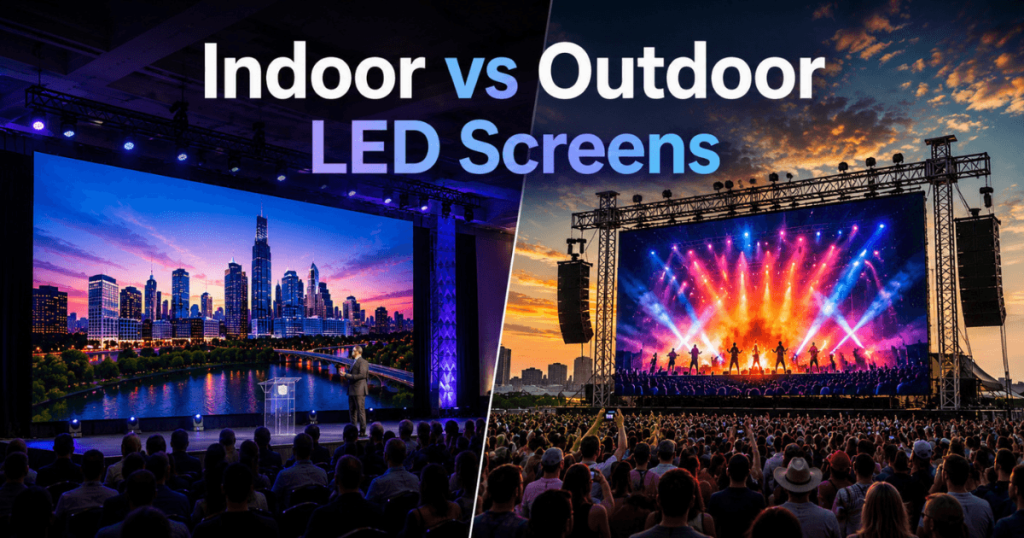
The main difference between indoor and outdoor LED screens is not simply where they are installed. The two systems are designed for different brightness levels, viewing distances, environmental conditions, pixel pitches, structural requirements, and event-production environments.
Indoor LED screens usually prioritize fine pixel pitch, close viewing, detailed presentation content, and controlled brightness. Outdoor LED screens generally require much higher brightness, weather-resistant construction, greater environmental protection, and installation systems designed for outdoor conditions.
For event planners, choosing the wrong display can affect image quality, visibility, cameras, installation, and production cost. An indoor conference LED wall does not need the brightness of an outdoor festival screen, while an LED panel designed only for controlled indoor environments should not be assumed suitable for rain, wind, or other outdoor exposure.
Our Toronto LED screen rental team provides LED display solutions for conferences, corporate events, trade shows, exhibitions, product launches, concerts, festivals, sporting events, weddings, community events, and other productions across Toronto and the GTA. With 23+ years of event production experience, we configure each system around the actual venue, audience, content, and environment.
This guide explains indoor vs outdoor LED screens, their major technical differences, and how to determine which type your event needs.
What Is an Indoor LED Screen?
An indoor LED screen is designed primarily for controlled interior environments such as:
- Convention centres
- Conference rooms
- Hotel ballrooms
- Trade show halls
- Corporate venues
- Meeting spaces
- Exhibition booths
- Indoor arenas
- Event studios
Because indoor audiences are often relatively close to the screen, indoor LED products commonly prioritize higher pixel density and finer pixel pitch.
Common indoor event applications may use pitches such as:
- P1.5
- P1.9
- P2
- P2.5
- P2.6
- P2.9
The correct specification depends on the particular LED product and event requirements.
Indoor screens also operate in environments where ambient light is generally more controllable. They therefore do not normally need the extremely high brightness required to compete with direct outdoor daylight.
What Is an Outdoor LED Screen?
An outdoor LED screen is designed for exterior environments where the display may need to operate under bright daylight and changing weather conditions.
Outdoor applications can include:
- Festivals
- Concerts
- Sporting events
- Fan zones
- Community events
- Outdoor corporate events
- Public events
- University events
- Outdoor ceremonies
- Mobile LED trailer applications
Outdoor LED equipment needs to address conditions that indoor systems normally do not encounter.
These can include:
- Sunlight
- Rain
- Moisture
- Temperature changes
- Dust
- Wind
- Longer audience viewing distances
The actual product must be designed and appropriately rated for the environment where it will operate.
Indoor vs Outdoor LED Screens: Quick Comparison
| Feature | Indoor LED Screen | Outdoor LED Screen |
|---|---|---|
| Primary Environment | Interior venues | Exterior environments |
| Typical Viewing | Close to medium | Medium to long |
| Pixel Pitch | Often finer | Often larger |
| Brightness Requirement | Moderate/controlled | Significantly higher |
| Weather Protection | Usually limited | Designed for outdoor exposure |
| Environmental Rating | Product-dependent | Outdoor-rated product required |
| Content | Presentations, video, IMAG | Video, IMAG, branding, live content |
| Power Planning | Venue-based | More complex outdoor planning |
| Structural Planning | Stage/floor/rigging | Weather and wind also matter |
| Typical Events | Conferences, trade shows | Festivals, sports, outdoor concerts |
These are general differences. Actual specifications vary by LED product and event design.
What Is the Biggest Difference Between Indoor and Outdoor LED Screens?
The biggest difference is the operating environment.
An indoor LED screen normally operates in a controlled venue where temperature, moisture, lighting, and structural conditions are relatively predictable.
Outdoor LED must function in a much more demanding environment.
That affects almost every part of the system, including:
- LED cabinet construction
- Brightness
- Weather resistance
- Power
- Structural support
- Cabling
- Screen position
- Safety planning
For this reason, selecting an outdoor display involves more than simply choosing a brighter version of an indoor LED wall.
Are Outdoor LED Screens Brighter Than Indoor LED Screens?
Generally, yes.
Outdoor displays need significantly greater brightness because they may need to remain visible under daylight.
An indoor conference ballroom might have controlled stage lighting and relatively low ambient light. In that environment, excessive LED brightness can actually make the display uncomfortable for attendees and difficult for cameras to expose correctly.
Outdoor environments can include:
- Bright daylight
- Open skies
- Changing cloud conditions
- Direct or indirect sunlight
An outdoor LED screen therefore needs enough brightness and contrast to keep content visible.
The correct brightness should still be adjusted for the actual conditions rather than simply operating the screen at maximum output.
Why Does Brightness Matter for Outdoor Events?
Imagine using a low-brightness indoor display at an outdoor event during the middle of the day.
Even if the screen has an excellent pixel pitch, sunlight can overpower the visual content and make the image appear washed out.
This illustrates an important principle:
A finer pixel pitch does not compensate for insufficient brightness.
For outdoor events, screen visibility depends on a combination of:
- Brightness
- Screen orientation
- Ambient light
- Viewing distance
- Contrast
- Content design
These factors should be evaluated together.
Do Indoor LED Screens Have Better Resolution?
Not automatically, but indoor event screens frequently use finer pixel pitches.
Because attendees may sit or stand close to an indoor LED wall, pixel density becomes particularly important.
For example, indoor screens may need to display:
- PowerPoint presentations
- Small text
- Charts
- Financial information
- Technical diagrams
- Product specifications
- Software demonstrations
Fine-pitch LED can help these elements appear smoother from closer distances.
Outdoor audiences are often farther away and may primarily view:
- Live camera IMAG
- Videos
- Sponsor graphics
- Event branding
- Scores
- Entertainment visuals
A larger pixel pitch can therefore provide effective outdoor viewing without unnecessarily increasing pixel density.
How Does Pixel Pitch Differ Between Indoor and Outdoor LED Screens?
Pixel pitch is the approximate distance between neighbouring LED pixels.
A smaller number means the pixels are positioned more closely together.
Indoor applications commonly benefit from pitches such as P1.9, P2, P2.5, or P2.6 when close viewing and detailed content are important.
Outdoor event systems may use larger pixel pitches when viewing distances are greater.
However, pixel pitch alone does not determine whether an LED screen is indoor or outdoor.
For example, two products could have similar pixel pitches while being designed for completely different environmental conditions.
Outdoor suitability must be determined from the actual product specifications and environmental protection—not the “P” number.
Which Is Better for Close Viewing?
Indoor fine-pitch LED is generally better suited to close audience viewing.
This is particularly important for:
- Trade show booths
- Corporate meetings
- Product demonstrations
- Executive events
- Medical presentations
- Technology conferences
- Financial presentations
When attendees stand close to the screen, they are more likely to notice the physical spacing between pixels.
A finer pitch reduces that visible pixel structure.
Outdoor events usually place audiences farther away, which allows a larger pixel pitch to remain visually effective.
How Are Outdoor LED Screens Protected From Weather?
Outdoor LED products are constructed with environmental protection appropriate to their intended use.
Depending on the specific product, protection may address exposure to:
- Rain
- Moisture
- Dust
- Outdoor temperature conditions
An important specification is the product’s IP rating, or Ingress Protection rating.
The rating indicates defined levels of protection against solid particles and water.
However, event planners should not assume that every product advertised as LED is weatherproof.
The exact LED product, connectors, power system, processing equipment, structural system, and complete installation need to be suitable for the intended outdoor environment.
What Does an IP Rating Mean for LED Screens?
IP ratings use a standardized classification for protection against solids and liquids.
For outdoor event planning, the important point is that the actual equipment rating needs to match the conditions in which it will be used.
An IP rating should not be interpreted as permission to operate equipment in any possible weather condition.
A professional outdoor production still requires planning around:
- Weather forecasts
- Water exposure
- Wind
- Electrical safety
- Structural limitations
- Manufacturer requirements
- Venue requirements
The entire system must be considered—not just the front surface of the LED panel.
Can You Use an Indoor LED Screen Outdoors?
An indoor-only LED screen should not be assumed safe or suitable for outdoor use.
There may be controlled situations where a production design places equipment in a protected environment, but suitability must be determined from the actual product specifications and installation conditions.
Simply placing a roof over an indoor LED wall does not automatically turn it into an outdoor-rated system.
Outdoor environments introduce factors including:
- Moisture
- Wind
- Temperature
- Sunlight
- Power exposure
- Environmental changes
For outdoor events, using equipment designed for the intended environment is the appropriate starting point.
Can You Use an Outdoor LED Screen Indoors?
In some situations, an outdoor-rated LED product may technically be used indoors, but that does not automatically make it the best choice.
Potential disadvantages can include:
- Larger pixel pitch
- Excess brightness
- Different cabinet characteristics
- Less appropriate close-view performance
For a corporate presentation where attendees are sitting only a few metres from the screen, a fine-pitch indoor LED wall may provide a better visual experience.
Equipment should therefore be selected for the actual event rather than based on the assumption that outdoor-rated automatically means superior.
How Do Viewing Distances Compare?
Indoor audiences are often closer to LED screens.
A corporate meeting may place the first row only a short distance from the stage. Trade show visitors can sometimes walk directly toward a display.
Outdoor events can have much deeper audience areas.
A festival or fan zone might need the display to serve viewers across a large open area.
This changes both:
- Pixel-pitch requirements
- Physical screen-size requirements
A very fine-pitch but physically small display may not help an audience hundreds of feet away.
For outdoor productions, large screen dimensions can become especially important.
How Does Screen Size Differ for Indoor and Outdoor Events?
Indoor screen dimensions are often limited by:
- Stage width
- Ceiling height
- Room dimensions
- Rigging conditions
- Audience layout
- Venue access
Outdoor environments can provide more physical space, but larger screens introduce additional structural and production requirements.
Screen size should be based on:
- Audience size
- Audience depth
- Viewing distance
- Content
- Event format
- Installation location
The goal is to create sufficient visual scale without overspecifying the display.
Indoor vs Outdoor LED Screens for Cameras and IMAG
Both indoor and outdoor LED screens can be used with professional cameras and Image Magnification.
For indoor events, the production team may need to coordinate:
- Fine-pitch LED
- Screen brightness
- Stage lighting
- Camera exposure
- Refresh performance
- Processor settings
Outdoor events add variables such as:
- Daylight
- Changing light conditions
- Screen orientation
- Longer camera distances
For either environment, the LED wall should be tested with the actual camera system when IMAG, livestreaming, recording, or broadcast is important.
What Content Works Best on Indoor LED Screens?
Indoor screens often support content that requires closer inspection.
Examples include:
- PowerPoint
- Keynote presentations
- Detailed graphics
- Charts
- Videos
- Product demonstrations
- Software interfaces
- Live cameras
- Sponsor content
- Branding
Fine-pitch LED can be particularly valuable when text and detail are important.
Presentation content should still use appropriate font sizes and layouts for the full audience.
What Content Works Best on Outdoor LED Screens?
Outdoor content generally needs to remain easy to understand from greater distances.
Effective content may include:
- Live camera IMAG
- Large text
- Bold graphics
- Sponsor logos
- Event branding
- Videos
- Scores
- Schedules
- Public information
- Entertainment visuals
Complex slides containing very small text are generally less effective for audiences positioned far from the display.
Content design should therefore reflect the viewing environment.
Indoor vs Outdoor LED Screens for Different Events
| Event Type | Typical LED Environment | Key Priority |
|---|---|---|
| Corporate Conference | Indoor | Fine detail and presentations |
| Trade Show | Indoor | Close viewing and branding |
| Product Launch | Indoor / Outdoor | Premium visuals and cameras |
| Gala Dinner | Indoor | Stage integration and IMAG |
| Wedding | Indoor / Outdoor | Photos, video and live cameras |
| Concert | Indoor / Outdoor | Large visuals and IMAG |
| Festival | Outdoor | Brightness and long viewing |
| Sporting Event | Indoor / Outdoor | IMAG, scores and audience visibility |
| Fan Zone | Outdoor | Brightness and large-format video |
| Community Event | Outdoor | Audience visibility and weather planning |
Some event types can take place in either environment, so the actual venue and production conditions determine the equipment.
How Do Installation Requirements Differ?
Indoor installations generally take place within an established venue environment.
The production team may need to coordinate:
- Loading access
- Stage dimensions
- Floor loading
- Ground support
- Venue-approved rigging
- Power
- Installation schedule
Outdoor installations add environmental considerations.
These may include:
- Ground conditions
- Weather
- Wind
- Structural design
- Outdoor-rated power distribution
- Equipment protection
- Screen orientation
Outdoor LED structures should be designed and installed by qualified professionals according to the actual site and equipment requirements.
Ground-Supported vs Rigged LED Screens
Both indoor and outdoor LED displays may use different professional support methods depending on the production.
Ground-Supported LED Screens
Ground support can be useful where the display can be safely supported from the floor, stage, or suitable outdoor surface.
Rigged LED Screens
Venue-approved rigging can elevate the screen and improve sightlines in appropriate indoor environments.
Outdoor suspended or elevated LED installations introduce additional structural and environmental considerations.
The correct method depends on:
- Screen dimensions
- LED weight
- Venue or site
- Structural requirements
- Audience layout
- Weather conditions
- Professional engineering and rigging requirements
Pixel pitch does not determine how the screen should be supported.
Indoor vs Outdoor LED Screen Rental Cost
There is no fixed rule that one type will always cost more.
Rental pricing can depend on:
- Screen dimensions
- Pixel pitch
- LED product
- Rental duration
- Structural system
- Delivery
- Installation
- Power distribution
- Processing
- Cameras
- Media playback
- Signal distribution
- Labour
- Weather-related requirements
- On-site operation
Outdoor productions may involve additional structural, environmental, and power planning.
Indoor fine-pitch displays can also carry higher equipment costs because of their greater pixel density.
The correct comparison should therefore be based on the complete production package.
How We Choose Between Indoor and Outdoor LED Screens
Our selection process begins with the event environment.
1. Indoor or Outdoor Location
We determine the actual conditions in which the display needs to operate.
2. Audience Size
The screen needs sufficient scale for the expected audience.
3. Viewing Distance
Both the closest and farthest viewers are considered.
4. Content
We review presentations, video, IMAG, branding, scores, or other content.
5. Pixel Pitch
Pixel density is matched to viewing requirements.
6. Brightness
Display output is selected for the lighting environment.
7. Cameras
Recording, streaming, and IMAG requirements are considered.
8. Structural Requirements
The support system is planned around the venue or outdoor site.
9. Power and Signal Distribution
The complete technical infrastructure is considered.
10. Weather Exposure
For outdoor events, equipment suitability and environmental conditions become part of the production plan.
Common Indoor vs Outdoor LED Screen Mistakes
Choosing by Pixel Pitch Alone
P2.6 does not automatically mean indoor, and P3.9 does not automatically mean outdoor.
Using Indoor Equipment Outside Without Checking Its Rating
Outdoor suitability depends on the actual product and complete installation.
Ignoring Brightness
Fine pixel pitch will not solve poor daylight visibility.
Using Too Much Brightness Indoors
Excessive brightness can be uncomfortable and complicate camera exposure.
Ignoring Viewing Distance
Indoor and outdoor audiences can have very different viewing conditions.
Making the Screen Too Small
Large outdoor audiences may need significantly larger displays.
Forgetting About Weather
Outdoor event planning must consider changing environmental conditions.
Comparing Quotes Only by Screen Size
Pixel pitch, product type, processing, structure, labour, cameras, and technical support can all affect the system.
How Much Brighter Are Outdoor LED Screens?
Outdoor LED screens generally require much higher brightness than indoor displays because they need to remain visible in daylight.
Brightness is commonly measured in nits, which represent luminance.
Typical requirements vary by product and environment, but the key principle is straightforward:
- Indoor LED: designed for controlled venue lighting.
- Outdoor LED: designed to compete with much stronger ambient daylight.
An indoor ballroom may allow the LED wall to operate at relatively moderate brightness. At an outdoor event during the day, the display needs substantially more output to maintain contrast and visibility.
However, maximum brightness is not always necessary. Outdoor brightness should be adjusted according to:
- Time of day
- Sun position
- Screen orientation
- Cloud cover
- Audience position
- Camera exposure
- Content
At night, an outdoor screen may need to be reduced significantly from its daytime level.
Does Direct Sunlight Affect LED Screen Visibility?
Yes. Direct sunlight is one of the most demanding conditions for an outdoor display.
The direction of the screen can have a major impact on perceived image quality.
For example, a high-brightness outdoor screen positioned poorly relative to the sun may provide a weaker audience experience than a properly positioned screen operating under more favourable conditions.
Outdoor planning should therefore consider:
- Screen orientation
- Sun direction
- Event start and finish times
- Audience position
- Nearby buildings
- Shaded areas
- Stage orientation
Brightness is important, but screen placement and environmental planning are equally important.
What Happens to Outdoor LED Screens at Night?
A screen designed to remain visible during daylight can be unnecessarily bright after sunset.
Operating an outdoor LED display at excessive brightness during an evening event can:
- Cause visual discomfort
- Reduce perceived image quality
- Distract from stage lighting
- Affect camera exposure
- Overpower surrounding scenic elements
Professional outdoor LED operation should therefore account for changing conditions throughout the event.
A festival beginning in the afternoon and continuing into the evening may require different display settings as daylight decreases.
What IP Rating Should an Outdoor LED Screen Have?
The appropriate environmental rating depends on the actual LED product and installation conditions.
IP, or Ingress Protection, ratings describe defined levels of protection against solid objects and water.
The two digits represent different protections:
- The first relates to solid-particle protection.
- The second relates to water protection.
However, event planners should avoid selecting outdoor LED equipment solely from an IP number.
The complete outdoor system includes more than the LED panel.
Other components can include:
- Power connections
- Data connections
- Processors
- Distribution equipment
- Structural hardware
- Cabling
- Supporting electronics
Outdoor suitability needs to be evaluated across the complete production system.
Does an IP Rating Mean an LED Screen Can Operate in Any Weather?
No.
An environmental rating does not mean equipment can safely operate under unlimited weather conditions.
Outdoor events still require professional assessment of:
- Rain
- Wind
- Temperature
- Lightning
- Ground conditions
- Water accumulation
- Structural limitations
- Electrical conditions
- Manufacturer requirements
Event safety decisions should follow the actual equipment specifications, site requirements, weather conditions, and qualified production professionals.
An outdoor-rated LED screen is designed for outdoor use, but that does not eliminate environmental limitations.
Why Is Wind Important for Outdoor LED Screens?
Wind becomes especially important because large LED screens create substantial surface area.
A large video wall can behave very differently outdoors than inside a ballroom.
Outdoor structural planning may therefore consider:
- Screen dimensions
- Screen height
- Structural configuration
- Support system
- Site conditions
- Wind exposure
- Manufacturer limits
- Engineering requirements
These considerations should be handled by qualified professionals.
The fact that an LED cabinet is weather-rated does not mean any screen size can be installed anywhere outdoors.
The display and supporting structure must be considered together.
How Does Outdoor LED Power Planning Differ?
Both indoor and outdoor LED walls require appropriate electrical power, but outdoor events can introduce additional complexity.
Indoor events often use established venue electrical infrastructure.
Outdoor events may require power from:
- Temporary event distribution
- Approved site power
- Professional generator systems
- Other properly designed event-power infrastructure
Power requirements depend on:
- LED product
- Number of panels
- Screen dimensions
- Operating brightness
- Processing equipment
- Supporting production technology
Electrical planning should be completed by qualified professionals according to equipment, venue, site, and applicable safety requirements.
How Does Content Design Differ Indoors and Outdoors?
Content that looks excellent on a fine-pitch indoor LED wall may not automatically work for a large outdoor audience.
Indoor viewers can often see:
- Smaller typography
- Detailed charts
- Multiple content columns
- Fine graphics
- Technical information
Outdoor viewers may be much farther from the screen.
Outdoor content therefore often benefits from:
- Large typography
- Strong visual hierarchy
- Simple layouts
- Large graphics
- Clear logos
- Full-screen video
- High-visibility information
The physical viewing environment should influence content design.
Why Is Contrast Important Outdoors?
Brightness gets significant attention in outdoor LED specifications, but contrast also affects perceived image quality.
An outdoor display needs to maintain enough separation between bright and dark image areas for content to remain understandable.
Several factors influence perceived outdoor contrast:
- Ambient light
- Sun direction
- LED product
- Display brightness
- Content design
- Screen orientation
High-brightness equipment cannot compensate for every poor production decision.
A complete outdoor LED design considers both the equipment and the environment around it.
Indoor vs Outdoor LED Screens for PowerPoint
Indoor LED is generally better suited to presentation-heavy events.
Conference presentations may include:
- Charts
- Tables
- Financial figures
- Small text
- Technical diagrams
- Detailed images
Fine-pitch indoor LED can reproduce these details effectively when matched to the audience distance.
Outdoor LED can display PowerPoint as well, but the content may need to be simplified for longer viewing distances.
An outdoor audience should not be expected to read dense presentation slides from across a large field or event site.
Indoor vs Outdoor LED Screens for IMAG
Both systems can work effectively with Image Magnification (IMAG).
Indoor IMAG is common for:
- Conferences
- Award ceremonies
- Corporate meetings
- Galas
- Indoor concerts
Outdoor IMAG is particularly valuable for:
- Festivals
- Sporting events
- Concerts
- Fan zones
- Public events
- Community events
At a large outdoor event, cameras can provide close-up images of speakers, performers, or live action for attendees positioned far from the stage.
In these environments, physical screen size may be more important than extremely fine pixel pitch.
What Is a Mobile LED Trailer?
A Mobile LED Trailer combines an outdoor LED display with a mobile trailer platform.
Rather than constructing a conventional LED wall from the ground up at every event, the display can be transported to the site as an integrated mobile system.
Depending on the specific equipment, the screen can be raised and positioned for audience viewing.
Mobile LED trailers can be useful for:
- Fan zones
- Sporting events
- Festivals
- Community events
- Outdoor corporate events
- University events
- Public screenings
- Outdoor ceremonies
Their primary advantage is deployment efficiency for suitable outdoor applications.
Mobile LED Trailer vs Ground-Supported Outdoor LED Wall
These two solutions serve different production requirements.
| Requirement | Mobile LED Trailer | Ground-Supported LED Wall |
|---|---|---|
| Deployment | Integrated mobile platform | Built on site |
| Screen Configuration | Predetermined by trailer | More configurable |
| Setup Flexibility | Fast for suitable sites | Greater design flexibility |
| Stage Integration | Limited by trailer design | Can integrate closely with stage |
| Relocation | More practical | Requires dismantling |
| Custom Dimensions | Limited | More flexible |
| Best Use | Outdoor viewing areas | Custom stages and productions |
A mobile LED trailer can be highly efficient when its screen dimensions and positioning suit the event.
A modular outdoor LED wall may be better when the display needs to become part of a custom stage or scenic design.
Which LED Screen Is Best for an Indoor Conference?
For an indoor conference, the main priorities usually include:
- Presentation readability
- Appropriate screen dimensions
- Fine pixel pitch
- Audience sightlines
- Camera compatibility
- Controlled brightness
P2, P2.5, P2.6, or another suitable fine-pitch option may be considered depending on the viewing distance and equipment.
The LED wall may need to display PowerPoint, speaker IMAG, video, sponsor content, and event branding throughout the day.
This makes indoor conference LED selection primarily a content and viewing-distance decision.
Which LED Screen Is Best for a Trade Show?
Trade shows typically involve close viewing.
Visitors may stand only a short distance from the LED display, making fine pixel pitch valuable.
Indoor trade show LED can be used for:
- Product videos
- Software demonstrations
- Brand content
- Product specifications
- Presentations
- Interactive visual experiences
P2 or P2.6-class fine-pitch displays can be useful depending on the booth design and viewing distance.
Large overhead or distant exhibition displays may use different specifications.
Which LED Screen Is Best for an Outdoor Concert?
Outdoor concerts generally prioritize:
- Large physical screen dimensions
- High brightness
- IMAG
- Video playback
- Audience visibility
- Weather suitability
- Structural planning
Because viewers can be positioned much farther from the stage, extremely fine pixel pitch may provide limited practical benefit.
The appropriate outdoor LED system should instead balance screen size, brightness, pixel pitch, camera performance, environmental suitability, and structural requirements.
Which LED Screen Is Best for a Fan Zone?
Fan zones can benefit greatly from outdoor LED screens because audiences need to see live sports or entertainment from different positions.
Important considerations include:
- Screen dimensions
- Audience depth
- Daylight visibility
- Screen elevation
- Content source
- Audio integration
- Weather
- Site layout
A mobile LED trailer may be practical for some fan zones, while larger custom productions may require modular outdoor LED systems.
Which LED Screen Is Best for an Outdoor Wedding?
Outdoor weddings create different requirements from festivals and sporting events.
The display may be used for:
- Live camera feeds
- Photos
- Videos
- Ceremony viewing
- Speeches
- Entertainment
- Custom graphics
The system still needs appropriate environmental suitability, but brightness should also be balanced with the visual atmosphere of the event.
For an evening wedding, maximum daylight brightness may be unnecessary once the sun sets.
How Does Weather Affect Event Scheduling and Installation?
Weather planning should begin before the LED wall is installed.
Outdoor production schedules may need to account for:
- Installation conditions
- Forecast changes
- Wind
- Rain
- Temperature
- Ground conditions
- Safe access
- Strike schedule
Weather can affect more than showtime.
It can also influence when equipment can safely be installed or removed.
For major outdoor events, environmental planning should therefore be integrated into the complete production schedule.
Indoor vs Outdoor LED Screen Rental Cost: What Changes?
Outdoor LED rental is not automatically more expensive than indoor LED rental, and indoor systems are not automatically cheaper.
Several competing factors affect pricing.
Fine-pitch indoor LED can have higher equipment costs because of increased pixel density.
Outdoor productions may require additional:
- Structural equipment
- Weather-rated equipment
- Power infrastructure
- Site logistics
- Installation labour
- Technical planning
The final cost depends on the complete configuration.
For example, a relatively small premium P1.9 indoor LED wall and a large P3.9 outdoor display solve very different problems and should not be compared only by price per panel.
Which Provides Better Value: Indoor or Outdoor LED?
Value depends entirely on the environment.
Using expensive outdoor LED equipment for a small indoor presentation may provide little additional benefit.
Using an indoor-only system for an exposed outdoor event may be inappropriate regardless of its lower price.
The best value comes from matching the equipment to:
Environment + Audience + Viewing Distance + Content + Screen Size + Production Requirements
This avoids both under-specifying and unnecessarily over-specifying the system.
Final Indoor vs Outdoor LED Screen Comparison
| Factor | Indoor LED | Outdoor LED |
|---|---|---|
| Environment | Controlled interior | Exterior |
| Viewing Distance | Usually closer | Often farther |
| Pixel Pitch | Often finer | Often wider |
| Brightness | Lower/moderate | Higher |
| Weather Protection | Product-dependent/limited | Outdoor-rated |
| Daylight Visibility | Less important | Critical |
| Fine Text | Strong with fine pitch | Depends on distance/pitch |
| PowerPoint | Excellent | Possible with suitable content |
| IMAG | Excellent | Excellent |
| Camera Use | Common | Common |
| Screen Size | Small to very large | Often larger |
| Structural Planning | Venue-specific | Site + weather dependent |
| Wind Planning | Generally not an outdoor factor | Critical for exposed structures |
| Mobile Trailer Option | Rarely needed | Available |
| Typical Use | Conferences, trade shows, galas | Festivals, sports, fan zones |
The table should be used as a starting point rather than a fixed specification guide.
How We Select the Right LED Screen for Toronto Events
For Toronto and GTA events, we evaluate the complete environment before specifying the display.
Our planning considers:
- Event location — indoor, outdoor, covered, or partially exposed.
- Audience size — total attendance and viewing area.
- Closest viewing distance — important for pixel pitch.
- Farthest viewing distance — important for screen dimensions.
- Ambient light — ballroom lighting, exhibition lighting, or daylight.
- Content — PowerPoint, video, IMAG, graphics, scores, or branding.
- Cameras — recording, streaming, and live production.
- Weather exposure — for outdoor events.
- Structural requirements — ground support, venue-approved rigging, or mobile configuration.
- Power and signal infrastructure — required for reliable operation.
This approach prevents a common mistake: selecting an LED screen from one specification without considering the complete event.
Frequently Asked Questions About Indoor vs Outdoor LED Screens
What is the main difference between indoor and outdoor LED screens?
Indoor LED screens are generally optimized for controlled environments, closer viewing, and finer detail. Outdoor LED screens require higher brightness, appropriate environmental protection, and additional structural and weather planning.
Are outdoor LED screens waterproof?
Outdoor LED products are designed with specific levels of environmental protection, but “waterproof” should not be treated as unlimited protection. Always follow the actual product rating, manufacturer requirements, and professional event-safety procedures.
Can I use an indoor LED screen outside?
Indoor-only equipment should not be assumed suitable for outdoor exposure. The actual product rating and complete installation environment must be reviewed.
Can outdoor LED screens be used indoors?
Some outdoor-rated products can be used indoors, but they may not provide the ideal pixel pitch, brightness characteristics, or close-view performance for the event.
Why are outdoor LED screens brighter?
Outdoor displays need greater brightness to remain visible against strong ambient daylight and, in some situations, direct sunlight.
Do outdoor LED screens have lower resolution?
Not necessarily. Resolution depends on pixel pitch and physical screen dimensions. Outdoor displays often use larger pixel pitches because audiences are farther away, but very large screens can still contain substantial total pixel counts.
What pixel pitch is best for indoor events?
Fine-pitch options such as P1.9, P2, P2.5, or P2.6 may be appropriate for many indoor events. The final selection should depend on viewing distance, screen dimensions, content, and the specific LED product.
What pixel pitch is best for outdoor events?
There is no single best outdoor pixel pitch. Audience distance, screen dimensions, brightness, content, and the actual outdoor-rated LED product should determine the specification.
Is a mobile LED trailer better than a standard outdoor LED wall?
A mobile LED trailer can provide efficient deployment for fan zones, sporting events, community events, and similar applications. A modular outdoor LED wall provides greater flexibility for custom screen dimensions and stage integration.
How early should an outdoor LED screen be planned?
Planning should begin as early as practical, particularly for large events requiring structural coordination, site logistics, power, cameras, weather planning, or custom display configurations.
Why Choose Our Toronto LED Screen Rental Team?
Indoor and outdoor LED screens solve very different production challenges. Selecting the right system requires more than comparing pixel pitch or screen dimensions.
Our Toronto LED screen rental team evaluates the complete event environment and can provide:
- Fine-pitch indoor LED video walls
- Large-format indoor LED displays
- Outdoor-rated LED screen solutions
- Mobile LED Trailers
- Video processors
- Presentation switching
- Media playback
- Cameras and IMAG
- Signal distribution
- Ground-support planning
- Rigging coordination
- Content testing
- Rehearsal support
- Live technical operation
- Professional installation and removal
With 23+ years of event production experience, we support conferences, trade shows, corporate events, product launches, concerts, festivals, sporting events, fan zones, weddings, community events, and other productions throughout Toronto and the GTA.
The key difference between indoor vs outdoor LED screens ultimately comes down to the environment they are designed to handle. Indoor LED prioritizes close-view detail and controlled visual performance, while outdoor LED prioritizes daylight visibility, environmental suitability, large-audience viewing, and outdoor production requirements.