
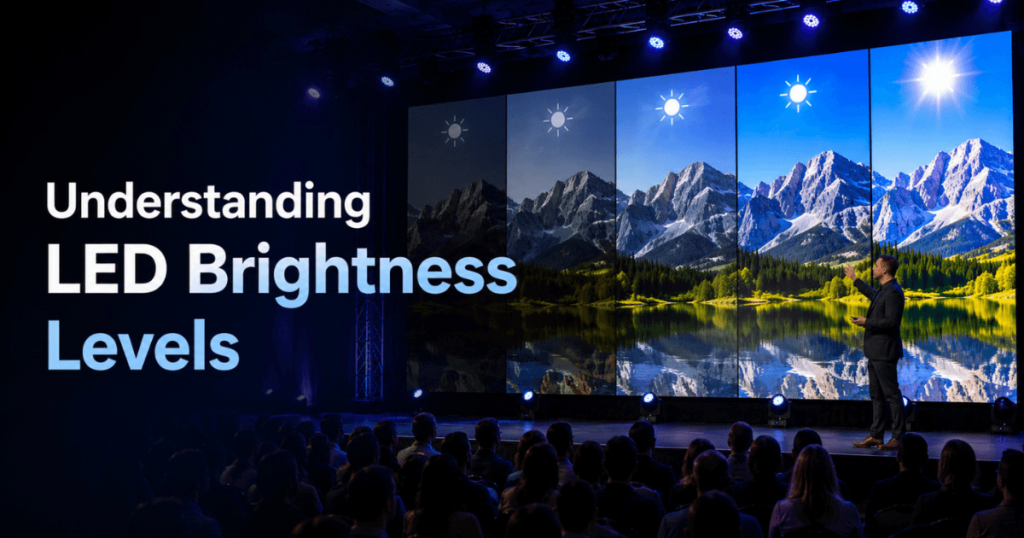
LED brightness determines how visible, comfortable, and camera-friendly an LED screen will be in a particular event environment. Brightness is commonly measured in nits, and the correct level depends on much more than simply choosing the screen with the highest number.
For indoor events, excessive brightness can make an LED wall uncomfortable for nearby attendees and create exposure challenges for cameras. For outdoor events, insufficient brightness can make content appear weak or washed out in daylight. The right brightness therefore depends on ambient light, screen position, indoor or outdoor use, audience distance, content, cameras, and time of day.
Our Toronto LED screen rental team provides LED display systems for conferences, trade shows, corporate events, exhibitions, product launches, concerts, festivals, sporting events, weddings, galas, and other productions across Toronto and the GTA. With 23+ years of event production experience, we configure LED brightness as part of the complete visual system rather than treating maximum brightness as the goal.
This guide explains LED brightness levels, nits, indoor vs outdoor requirements, daylight visibility, camera considerations, and how to determine the appropriate brightness for an event.
What Does LED Screen Brightness Mean?
LED screen brightness describes the amount of visible light produced by the display.
A brighter LED wall can produce a more intense image, which becomes especially important when the screen needs to compete with strong ambient light.
However, brightness should not be confused with overall image quality.
A screen can be extremely bright and still deliver poor results if it has:
- Poor contrast
- Incorrect calibration
- Weak colour reproduction
- Low-quality processing
- Inappropriate pixel pitch
- Poor content
- Incorrect camera settings
Brightness is therefore one part of LED display performance—not the complete measurement of quality.
What Are Nits?
LED screen brightness is commonly specified in nits.
A nit is a unit used to describe luminance.
In simple terms:
More nits = greater potential screen brightness.
For example, an LED product capable of several thousand nits can produce significantly more light than a lower-brightness indoor display.
However, this does not mean the screen should always operate at its maximum rated brightness.
Professional event technicians can adjust display output according to the environment.
The goal is to create enough brightness for excellent visibility without overwhelming the audience, cameras, or surrounding stage design.
Why Are Nits Important for Event LED Screens?
Event environments can vary dramatically.
Consider these three situations:
Hotel Ballroom
The room has controlled lighting, attendees sit relatively close to the screen, and cameras are recording the presenters.
Very high brightness is usually unnecessary.
Trade Show Floor
The exhibition hall may contain substantial overhead lighting, illuminated booths, signage, and competing displays.
The LED wall needs enough brightness and contrast to remain visually prominent.
Outdoor Festival
The screen may operate during daylight with an open sky and potentially strong sunlight.
Much higher brightness becomes necessary.
The same brightness setting would not be appropriate for all three environments.
What Is a Good Brightness Level for an Indoor LED Screen?
Indoor LED screens generally require significantly less brightness than outdoor displays.
The exact requirement depends on:
- Venue lighting
- Distance from the audience
- Stage lighting
- Screen dimensions
- Cameras
- Content
- Display location
Indoor LED walls used for conferences, corporate meetings, trade shows, and product launches should provide enough output to remain clear under the venue’s lighting conditions without becoming visually overpowering.
Fine-pitch indoor LED systems can deliver excellent perceived image quality without extreme brightness because they operate in more controlled environments.
Can an Indoor LED Screen Be Too Bright?
Yes.
More brightness is not always better.
If an indoor LED wall is operating unnecessarily bright, it can create several problems.
Audience Discomfort
People sitting close to the screen may find the display harsh or tiring to view.
Camera Exposure Problems
A very bright screen behind a presenter can make it more difficult to balance the camera exposure between the person and the display.
Stage-Lighting Conflicts
The LED wall can overpower scenic and stage lighting.
Reduced Visual Balance
Bright whites and graphics may dominate the room instead of supporting the event.
For indoor production, brightness should be balanced with the environment.
Why Do Outdoor LED Screens Need More Brightness?
Outdoor screens must compete with substantially stronger ambient light.
During the day, the display may be surrounded by:
- Bright sky
- Direct sunlight
- Reflected sunlight
- Open outdoor spaces
If an LED screen cannot generate enough visible output, the image can appear washed out.
Colours may lose impact, dark areas may become difficult to distinguish, and content readability can decrease.
Outdoor LED products are therefore typically designed to provide significantly higher brightness than indoor fine-pitch displays.
LED Brightness Levels: General Event Comparison
The following categories are useful for understanding the relationship between brightness and event environment.
| Environment | Brightness Requirement | Main Challenge |
|---|---|---|
| Dark indoor venue | Low to moderate | Avoid excessive brightness |
| Hotel ballroom | Moderate | Balance audience and cameras |
| Conference room | Moderate | Presentation readability |
| Trade show floor | Moderate to high | Strong ambient venue lighting |
| Indoor arena | Application-dependent | Large scale and venue lighting |
| Covered outdoor area | Higher | Daylight and environmental light |
| Outdoor shaded area | High | Open-sky ambient light |
| Outdoor daylight | Very high | Daylight visibility |
| Direct-sun environment | Very demanding | Strong sunlight |
These categories are more useful for planning than choosing a screen from a single universal nit number.
Actual requirements depend on the equipment and event conditions.
Is 1,000 Nits Enough for an LED Screen?
It depends entirely on where the display will be used.
A brightness level around this range can be substantial for many indoor environments.
Inside a ballroom or conference venue, operating a screen at full brightness may not even be necessary.
For an outdoor daytime event, however, the same output may not provide enough visibility under strong daylight.
This illustrates why asking, “Is 1,000 nits good?” without describing the environment provides an incomplete picture.
A better question is:
Is the available brightness appropriate for the ambient light where the screen will operate?
Is 5,000 Nits Good for an Outdoor LED Screen?
Several-thousand-nit capability is commonly associated with high-brightness outdoor LED applications, but the appropriate requirement still depends on the environment and specific product.
An outdoor screen needs to be evaluated according to:
- Daylight conditions
- Screen orientation
- Sun direction
- Audience location
- Content
- Time of day
- Camera requirements
A high brightness specification can provide useful headroom, but screen placement and environmental planning remain critical.
Brightness cannot compensate for every poor screen-positioning decision.
How Does Direct Sunlight Affect LED Brightness?
Direct sunlight is one of the most challenging conditions for any event display.
When sunlight reaches the display surface or strongly illuminates the surrounding environment, perceived contrast can decrease.
The production team should therefore consider the sun’s position relative to:
- LED screen
- Audience
- Stage
- Cameras
For an event running several hours, the sun’s position may change considerably between installation, doors opening, and the main program.
Outdoor LED planning should therefore consider time of day as well as screen brightness.
Why Does Screen Orientation Matter Outdoors?
Two identical outdoor LED screens can provide different viewing experiences depending on where they face.
Screen orientation can affect:
- Direct sunlight exposure
- Reflections
- Perceived contrast
- Audience visibility
- Camera angles
When site conditions allow, thoughtful positioning can improve display performance without relying entirely on additional brightness.
For festivals, sporting events, fan zones, and community events, screen placement should therefore be part of early site planning.
Does Pixel Pitch Affect LED Brightness?
Pixel pitch and brightness are separate specifications.
Pixel pitch describes the spacing between LED pixels.
Brightness describes the amount of visible light produced by the display.
A P2 screen is not automatically brighter than a P3.9 screen, and a P3.9 display is not automatically suitable for outdoor use.
This is a common misunderstanding.
When comparing LED products, planners should evaluate:
Pixel Pitch + Brightness + Environmental Rating + Screen Size + Viewing Distance
Each specification answers a different question.
Does Higher Brightness Mean Better Image Quality?
No.
Brightness can improve visibility in high ambient light, but overall image quality depends on multiple characteristics.
These include:
- Contrast
- Colour reproduction
- Pixel density
- Processing
- Calibration
- Refresh performance
- Source-content quality
- Panel consistency
For a dark corporate ballroom, an extremely bright outdoor LED display would not automatically look better than a properly configured fine-pitch indoor wall.
In fact, excessive brightness could reduce the quality of the viewing experience.
Why Is Contrast Important?
Contrast helps viewers distinguish bright and dark parts of an image.
Imagine two displays with strong brightness output.
One maintains deep dark areas and good colour separation. The other produces washed-out blacks and poor image depth.
The first display may appear visually stronger even if both have similar headline brightness specifications.
This is why LED quality should not be judged by nits alone.
Brightness and contrast need to work together.
How Does Ambient Light Affect LED Screen Brightness?
Ambient light is all the light in the environment surrounding the display.
Indoor sources can include:
- House lighting
- Stage lighting
- Exhibition lighting
- Windows
- Scenic lighting
- Other displays
Outdoor sources can include:
- Sunlight
- Open sky
- Building reflections
- Street lighting
- Event lighting
As ambient light increases, the display generally needs greater output to maintain perceived contrast and readability.
This makes an on-site or venue-specific assessment valuable when specifying LED equipment.
What Brightness Is Best for Conferences?
Conference LED walls usually operate in controlled indoor environments.
The priorities are often:
- Comfortable audience viewing
- PowerPoint readability
- Accurate video
- Speaker IMAG
- Camera compatibility
- Balanced stage lighting
The screen should be bright enough to remain clear when stage lighting is active but not so bright that it dominates presenters.
For camera-heavy conferences, the video and lighting teams should coordinate the LED brightness with camera exposure.
What Brightness Is Best for Trade Shows?
Trade show halls can be considerably brighter than hotel ballrooms.
Exhibition environments may include:
- Strong overhead lighting
- Illuminated signage
- Nearby LED screens
- Backlit graphics
- Booth lighting
An LED display needs enough visual output to stand out without becoming uncomfortable for visitors standing close to the booth.
Because trade show audiences frequently approach screens at short distances, brightness and fine pixel pitch need to be balanced together.
What Brightness Is Best for Product Launches?
Product launches often place strong emphasis on visual quality.
The LED wall may display:
- Product close-ups
- Promotional films
- Motion graphics
- Technical information
- Speaker presentations
- Live camera feeds
Brightness should support both the audience and cameras.
For indoor product launches, maximum output is rarely the objective. Controlled brightness, strong contrast, accurate content, and appropriate stage lighting are usually more important.
Outdoor product launches may require much higher brightness depending on daylight conditions.
What Brightness Is Best for Outdoor Events?
Outdoor event requirements depend heavily on when and where the screen is operating.
An event held entirely after sunset may need very different settings from an afternoon festival.
Outdoor production should consider:
- Morning light
- Midday sun
- Afternoon sun
- Sunset
- Evening conditions
If an event runs from afternoon into the night, technicians may adjust LED brightness as environmental light changes.
This provides a more consistent viewing experience throughout the event.
How Does LED Brightness Affect Cameras?
Cameras have limited exposure ranges.
If the LED wall is significantly brighter than the presenter standing in front of it, the camera may struggle to expose both correctly.
The result could be:
- Properly exposed screen but dark presenter
- Properly exposed presenter but overexposed LED content
- Lost highlight detail
- Poor visual balance
Professional production teams coordinate:
- LED brightness
- Camera exposure
- Stage lighting
- Content levels
- Screen position
This is especially important for livestreams, recorded conferences, broadcasts, product launches, and IMAG.
Should LED Brightness Be Reduced for Livestreaming?
Sometimes.
There is no universal brightness percentage for livestreaming because every stage and camera environment is different.
Instead, technicians should evaluate the display through the actual camera system.
The goal is to achieve a balanced image where:
- Presenters are properly exposed
- LED content remains readable
- Colours remain natural
- Bright graphics retain detail
- Stage lighting looks balanced
This should ideally be tested during rehearsal.
How Does Content Affect Perceived Brightness?
Content itself can dramatically change how bright an LED wall appears.
A full-screen white presentation slide can appear much brighter than a dark video playing on the same screen at the same system setting.
Content containing:
- White backgrounds
- Bright graphics
- Large light-coloured areas
can produce a much stronger perceived output.
Dark cinematic content may appear significantly less intense.
For this reason, brightness testing should include real event content, not only a generic test image.
Why White PowerPoint Slides Can Be a Problem
Traditional presentations often use white backgrounds because they are designed for laptops, office monitors, or projection.
On a large direct-view LED wall, a full-screen white slide can become visually intense.
For large conference LED walls, presentation designers may benefit from considering:
- Reduced large white areas
- Strong contrast
- Appropriate font sizes
- Cleaner layouts
- Event-specific design
The LED brightness can also be adjusted to suit the presentation environment.
The objective is readability without unnecessary visual intensity.
How We Set LED Brightness for Toronto Events
Our approach begins with the environment rather than a fixed nit target.
1. Determine Indoor or Outdoor Use
This establishes the general brightness category.
2. Review Ambient Light
We consider venue lighting, windows, daylight, stage lighting, or outdoor conditions.
3. Evaluate Screen Position
Orientation can significantly affect outdoor performance.
4. Review Audience Distance
Nearby audiences require particular attention to visual comfort.
5. Check Content
Presentations, video, IMAG, and branding can create very different perceived brightness.
6. Coordinate Cameras
LED output needs to work with camera exposure and stage lighting.
7. Test the System
Whenever possible, real content and cameras are checked during setup or rehearsal.
8. Adjust During the Event
Outdoor conditions and event lighting can change, making brightness adjustment useful throughout the production.
Common LED Brightness Mistakes
Choosing the Highest Nit Rating Automatically
Higher brightness is useful only when the environment requires it.
Using an Indoor Screen for Bright Outdoor Daylight
Fine pixel pitch cannot compensate for insufficient daylight visibility.
Running Indoor LED at Maximum Brightness
This can create uncomfortable viewing and camera problems.
Ignoring the Sun’s Direction
Screen orientation can dramatically affect outdoor visibility.
Ignoring Cameras
A display that looks good to the eye may still be too bright relative to the presenter on camera.
Confusing Pixel Pitch With Brightness
They measure completely different LED characteristics.
Testing With Only One Image
Real presentations, videos, graphics, and camera feeds should be evaluated.
Forgetting That Outdoor Light Changes
A screen configured for midday may need adjustment after sunset.
Understanding LED Brightness Levels
LED brightness is normally measured in nits, but the highest nit rating is not automatically the best specification.
The correct brightness depends on:
Indoor or Outdoor Environment + Ambient Light + Screen Position + Audience Distance + Content + Cameras + Time of Day
Indoor LED screens generally prioritize controlled brightness, close-view comfort, fine detail, and camera balance.
Outdoor LED screens require substantially greater brightness to remain visible under daylight, but screen orientation, weather, content, and audience position are also important.
Most importantly, brightness should be treated as an adjustable production parameter, not a competition to achieve the highest possible number.
How Does Brightness Affect LED Screen Contrast?
Brightness and contrast work together, but they describe different characteristics of an LED display.
Brightness refers to how much visible light the screen can produce.
Contrast describes the visual difference between the brightest and darkest parts of the image.
A screen with very high brightness but weak dark levels can still appear washed out. A properly configured LED wall with strong contrast can produce deeper blacks, clearer colours, and greater image depth without operating at maximum brightness.
For indoor events, strong perceived contrast can often be more important than extreme brightness.
For outdoor events, sufficient brightness becomes essential because ambient daylight reduces perceived contrast.
The objective is therefore not simply:
More nits = better image
A better approach is:
Appropriate brightness + strong contrast + suitable ambient conditions = better visibility.
Why Are Black Levels Important on LED Screens?
Dark areas help create visual depth.
Good black levels can improve:
- Video playback
- Product imagery
- Photography
- Event branding
- Motion graphics
- Camera backgrounds
- Scenic content
This becomes particularly noticeable during premium corporate events, product launches, award ceremonies, and entertainment productions.
If dark portions of the image appear grey instead of black, colours may appear less vibrant even if the display is technically very bright.
For indoor applications, panel quality, processing, calibration, ambient light, and brightness settings all influence perceived black levels.
Is a Brighter LED Screen Always Easier to Read?
No.
Readability depends on several factors working together:
- Brightness
- Contrast
- Font size
- Content design
- Pixel pitch
- Screen dimensions
- Viewing distance
- Ambient light
For example, increasing brightness will not make very small text readable for an attendee sitting at the back of a large ballroom.
Likewise, a 7,000-nit outdoor display would not solve a poorly designed presentation containing tiny text.
Brightness helps the screen compete with environmental light. It does not replace proper content and screen-size planning.
How Does LED Brightness Affect Power Consumption?
Brightness can influence LED power requirements because producing more light generally requires greater electrical output.
However, actual power consumption depends on much more than the brightness specification printed on a product sheet.
Important factors include:
- LED panel model
- Total screen area
- Content
- Operating brightness
- Power-supply design
- Display configuration
A large white image can also create different power demand from predominantly dark content.
For event production, power should therefore be planned from the actual LED system specifications and manufacturer requirements, rather than estimated only from screen brightness.
Qualified event-production and electrical professionals should handle the final electrical design.
Does Running an LED Wall at Lower Brightness Reduce Power Use?
Generally, reducing output can reduce power demand, but the exact relationship varies by LED product, system design, and displayed content.
This is another reason not to operate an indoor LED wall at maximum brightness unnecessarily.
The primary reason for reducing brightness should still be visual performance.
For an indoor conference, the goal is to create:
- Comfortable viewing
- Good presentation readability
- Balanced stage lighting
- Proper camera exposure
- Strong contrast
Lower power demand can be an additional benefit when the display does not require maximum output.
Should LED Brightness Change During an Event?
It can.
This is especially useful for outdoor events that run from daytime into the evening.
Consider an outdoor event beginning at 2:00 PM and ending at 10:00 PM.
The LED screen may experience:
Afternoon: strong ambient daylight.
Sunset: rapidly changing environmental light.
Evening: relatively dark surroundings.
A setting suitable for the afternoon may become unnecessarily intense after sunset.
Technicians can adjust the display as environmental conditions change so that the screen remains visible without becoming overpowering.
Daytime vs Nighttime LED Brightness
The required output can change dramatically between day and night.
| Condition | General Brightness Approach | Main Goal |
|---|---|---|
| Dark indoor room | Lower | Comfortable viewing |
| Ballroom | Moderate | Balance screen and stage |
| Bright exhibition hall | Moderate to higher | Compete with ambient lighting |
| Covered outdoor event | Higher | Maintain daylight visibility |
| Outdoor daytime | High | Maintain strong visibility |
| Strong daylight | Very high capability may be needed | Compete with environmental light |
| Sunset | Gradually reduce as appropriate | Maintain balance |
| Outdoor night event | Reduced from daytime level | Avoid excessive intensity |
The actual settings should be based on the display, site, content, and production environment.
How Bright Should a Mobile LED Trailer Be?
Mobile LED Trailers are primarily designed for outdoor viewing environments, so daylight visibility is an important consideration.
Depending on the specific system, high-brightness outdoor LED technology may be used to support daytime applications.
Mobile LED trailers can be effective for:
- Sporting events
- Fan zones
- Festivals
- Community events
- Outdoor corporate events
- University events
- Public screenings
Brightness is only one part of trailer placement.
The production team should also consider:
- Screen orientation
- Audience location
- Sun direction
- Screen elevation
- Viewing distance
- Site access
- Weather conditions
A high-brightness trailer positioned poorly relative to the audience or sun may not deliver the best possible viewing experience.
What Brightness Is Best for a Corporate Conference?
Corporate conferences normally require controlled rather than extreme brightness.
The LED wall may need to display:
- PowerPoint
- Keynote presentations
- Charts
- Videos
- Speaker IMAG
- Sponsor content
- Event branding
The screen needs enough output to remain clear under stage and house lighting while still allowing cameras to expose speakers correctly.
During rehearsal, the video and lighting teams can evaluate the display from both:
Audience perspective and camera perspective.
This produces a better result than selecting a fixed brightness percentage in advance.
What Brightness Is Best for a Trade Show?
Trade show environments can contain substantial ambient lighting.
An exhibition booth may compete visually with:
- Overhead hall lighting
- Illuminated signs
- Backlit graphics
- Nearby LED displays
- Booth lighting
- Large digital signage
The LED wall therefore needs enough output to maintain contrast.
At the same time, visitors may stand very close to the display.
Running it unnecessarily bright can create an uncomfortable viewing experience.
For trade shows, the best configuration usually balances:
Brightness + Fine Pixel Pitch + Close Viewing + Content Design
What Brightness Is Best for a Gala or Award Ceremony?
Galas and award ceremonies usually take place in controlled indoor environments.
The LED wall often functions as part of the stage design rather than simply as a presentation display.
Content can include:
- Award graphics
- Nominee information
- IMAG
- Videos
- Sponsor branding
- Scenic motion graphics
Brightness should complement the stage lighting.
If the LED wall is significantly brighter than presenters, scenic elements, and surrounding lighting, it can dominate the entire visual design.
A balanced LED output generally creates a more polished event environment.
What Brightness Is Best for Concerts?
The answer depends on whether the concert is indoor or outdoor.
Indoor Concert
Brightness should work with:
- Stage lighting
- Scenic design
- Cameras
- Audience viewing
- Video content
Outdoor Daytime Concert
Much greater brightness may be necessary to maintain visibility under daylight.
Outdoor Night Concert
The display can often operate at substantially lower output than during daytime.
Concerts are a good example of why one brightness specification cannot describe the ideal operating level throughout an entire event.
What Brightness Is Best for Sporting Events and Fan Zones?
Sporting events and fan zones frequently use LED displays for:
- Live game feeds
- Scores
- Replays
- Sponsor content
- Advertising
- Event information
- Entertainment
Outdoor fan zones may operate throughout the afternoon and evening.
High-brightness capability can therefore be valuable during daylight, while adjustable output allows the screen to remain comfortable after dark.
Physical screen size and audience sightlines are equally important.
A very bright screen that is too small for the viewing area will not solve the overall visibility problem.
What Brightness Is Best for Weddings?
Indoor weddings typically do not require extreme LED brightness.
The display may show:
- Photos
- Videos
- Live cameras
- Introductions
- Custom graphics
- Entertainment visuals
The LED wall should complement décor, lighting, and photography rather than overpower them.
Outdoor weddings can require more brightness during daylight.
As the event moves into the evening, screen output can be reduced to maintain a more comfortable visual environment.
LED Brightness vs Pixel Pitch: Which Matters More?
They solve different problems.
Pixel Pitch Answers:
How densely are the pixels arranged?
It affects close-view detail and the resolution available within a particular physical area.
Brightness Answers:
How much light can the screen produce?
It affects visibility under different ambient-light conditions.
For example:
A P1.9 indoor display may provide excellent fine detail but may not be designed for bright outdoor daylight.
A high-brightness P3.9 outdoor screen may remain highly visible during an outdoor event but provide less pixel density at very close viewing distances.
Neither specification replaces the other.
LED Brightness vs Pixel Pitch Comparison
| Requirement | Pixel Pitch | Brightness |
|---|---|---|
| Close-view image detail | Critical | Secondary |
| Small presentation text | Critical | Needs appropriate balance |
| Bright exhibition hall | Important | Important |
| Outdoor daylight | Application-dependent | Critical |
| Long-distance viewing | Larger pitch may work | High output may be needed |
| Camera production | Important | Must be controlled |
| PowerPoint | Fine pitch often useful | Moderate indoor output |
| Outdoor IMAG | Viewing-distance dependent | High daylight visibility |
| Night event | Depends on viewing distance | Lower setting may be appropriate |
A professional LED specification considers both simultaneously.
How Does LED Brightness Affect Colour?
Brightness settings can influence how the audience perceives colour.
If a screen is excessively bright for its environment, highlights can appear visually dominant and subtle image details may become harder to appreciate.
If output is too low for the ambient light, colours can appear weak or washed out.
Professional configuration aims to maintain:
- Clear whites
- Strong colours
- Good dark detail
- Natural-looking images
- Comfortable overall intensity
Colour performance also depends on the LED product, processing, calibration, and source content.
Brightness alone cannot guarantee accurate colour reproduction.
How Should LED Content Be Designed for Bright Environments?
Outdoor and high-ambient-light environments benefit from content designed for visibility.
Useful principles include:
- Strong contrast
- Large text
- Simple layouts
- Bold graphics
- Clear logos
- Large visual elements
- Limited unnecessary detail
Increasing LED brightness is not the only way to improve readability.
For example, large white text against a dark background may be easier to understand from a distance than a complex slide containing several small content blocks.
Screen technology and content design should support each other.
Does a White Background Need More Attention on LED?
Yes, particularly on very large LED walls.
A full-screen white PowerPoint slide can create a substantial amount of perceived light.
This can become visually intense in a dark ballroom.
Presentation designers may consider layouts that use:
- Controlled background areas
- Strong contrast
- Clear hierarchy
- Appropriate typography
- Event branding
Technicians can also adjust LED output to match the content and environment.
Content testing during rehearsal helps determine whether slides are comfortable and readable from the audience area.
How Do We Balance LED Screens With Stage Lighting?
LED and lighting departments should not operate as completely separate systems.
The LED wall may form a large luminous surface behind presenters.
Stage lights need to illuminate those presenters sufficiently for both the audience and cameras.
If the LED screen is too bright relative to the stage lighting, presenters can appear visually dark.
If the screen is too dim, the display may lack impact.
During technical rehearsal, the production team can coordinate:
- LED brightness
- Stage-light levels
- Camera exposure
- Presentation content
- Scenic lighting
This creates a more balanced stage.
How Do We Choose the Right Brightness for Toronto Events?
Our Toronto LED screen rental team evaluates brightness as part of the complete event-production system.
Indoor Events
We consider:
- Venue lighting
- Audience distance
- Screen size
- Pixel pitch
- Stage lighting
- Cameras
- Presentation content
Outdoor Events
We also consider:
- Daylight
- Sun direction
- Screen orientation
- Time of day
- Audience position
- Weather
- Screen dimensions
Events With Cameras
We coordinate the LED output with:
- Camera exposure
- Frame rate and shutter settings
- Stage lighting
- Content brightness
- IMAG requirements
The result should look appropriate both in the room and on camera.
Common Mistakes When Comparing LED Brightness Specifications
Choosing the Screen With the Highest Nit Number
Maximum brightness does not equal maximum image quality.
Comparing Indoor and Outdoor Screens Directly
They are designed for different environments.
Ignoring Adjustable Brightness
Maximum capability and actual operating brightness are not the same thing.
Ignoring Contrast
A bright display with weak contrast may still provide disappointing image quality.
Ignoring Screen Orientation
Outdoor sunlight can dramatically affect perceived performance.
Ignoring Content
Full-screen white graphics can appear far brighter than dark video content.
Ignoring Cameras
The ideal setting for the eye may need adjustment for camera production.
Forgetting About Nighttime Conditions
Outdoor screens configured for daylight can become excessively bright after sunset.
Selecting Brightness Without Considering Pixel Pitch
Brightness and pixel density address different requirements.
Looking Only at the LED Panels
Processing, content, calibration, screen size, stage lighting, and installation all influence the final result.
LED Brightness Selection Guide
| Event Environment | Brightness Priority | Other Important Factors |
|---|---|---|
| Executive Meeting | Controlled | Fine pitch, presentations |
| Corporate Conference | Controlled/moderate | Cameras, PowerPoint |
| Trade Show | Moderate to higher | Close viewing, ambient light |
| Product Launch | Controlled | Cameras, colour, content |
| Gala Dinner | Controlled | Stage lighting, IMAG |
| Award Ceremony | Controlled | Cameras, scenic integration |
| Indoor Concert | Application-specific | Stage lighting, IMAG |
| Outdoor Concert | High during daylight | Sun, cameras, screen size |
| Festival | High | Daylight, distance, weather |
| Sporting Event | High when outdoors | IMAG, audience depth |
| Fan Zone | High during daylight | Screen size, orientation |
| Outdoor Wedding | Time-dependent | Décor, cameras, sunset |
There is no single nit specification that is ideal for every event in these categories.
Frequently Asked Questions About LED Brightness Levels
What is a nit on an LED screen?
A nit is a unit used to measure luminance. Higher nit values indicate greater potential display brightness.
How many nits does an indoor LED screen need?
There is no universal number. Indoor requirements depend on venue lighting, screen dimensions, content, audience distance, stage lighting, and cameras.
How many nits does an outdoor LED screen need?
Outdoor displays generally require significantly greater brightness than indoor displays, particularly in daylight. The correct capability depends on sunlight, screen orientation, site conditions, content, and the specific LED product.
Is a higher nit LED screen always better?
No. Higher brightness is beneficial only when the environment requires it. Excessive indoor brightness can create uncomfortable viewing and camera-exposure problems.
Can LED screen brightness be adjusted?
Professional LED systems generally allow output to be adjusted within the capabilities of the equipment, allowing technicians to match the display to changing event conditions.
Does pixel pitch determine LED brightness?
No. Pixel pitch measures the distance between pixels, while brightness measures luminance. They are separate specifications.
Why does my LED screen look washed out in daylight?
Strong ambient light reduces perceived contrast. The display may require greater brightness, better positioning, suitable outdoor equipment, or a combination of these factors.
Why does an LED wall look too bright on camera?
The screen may be producing much more light than the presenter or surrounding stage. LED output, stage lighting, camera exposure, and content should be balanced together.
Should an outdoor LED screen be dimmed at night?
Often, yes. A screen configured for daylight may be unnecessarily intense after sunset. The appropriate setting depends on the event environment and audience.
What brightness level is best for my event?
The appropriate level depends on whether the event is indoors or outdoors, ambient light, screen position, audience distance, content, cameras, time of day, and the specifications of the selected LED system.
Why Choose Our Toronto LED Screen Rental Team?
LED brightness is not simply a specification to maximize. It needs to work with the venue, audience, content, pixel pitch, cameras, stage lighting, screen dimensions, and environmental conditions.
Our Toronto LED screen rental team provides complete display and event-video solutions, including:
- Fine-pitch indoor LED video walls
- High-brightness outdoor LED displays
- Mobile LED Trailers
- Large-format LED screens
- Video processors
- Presentation switching
- Media playback
- Cameras and IMAG
- Signal distribution
- Content testing
- Ground-support planning
- Rigging coordination
- Rehearsal support
- Live technical operation
- Professional installation and removal
With 23+ years of event production experience, we support conferences, corporate events, trade shows, product launches, galas, award ceremonies, concerts, festivals, sporting events, fan zones, weddings, and other productions throughout Toronto and the GTA.
The best LED brightness level is not the highest number available. It is the level that gives the audience clear visibility, strong contrast, comfortable viewing, and balanced camera performance in the actual event environment.