
LED Pixel Pitch Guide
We provide professional LED Screen Rental Services in Toronto and across the GTA for conferences, corporate events, trade shows, exhibitions, product launches, galas, sporting events, festivals, weddings, and live productions. With 23+ years of event production experience, we select LED pixel pitch according to the actual audience, content, screen dimensions, and production environment rather than simply specifying the finest available LED.
Our capabilities include fine-pitch indoor LED walls, outdoor LED displays, Mobile LED Trailers, Kinetic Video Walls, Sphere LED Walls, LED posters, interactive kiosks, video processing, cameras, IMAG, presentation switching, media servers, audio, lighting, and live streaming. The correct pixel pitch depends on viewing distance, content detail, physical screen size, required native resolution, indoor or outdoor use, and camera requirements.
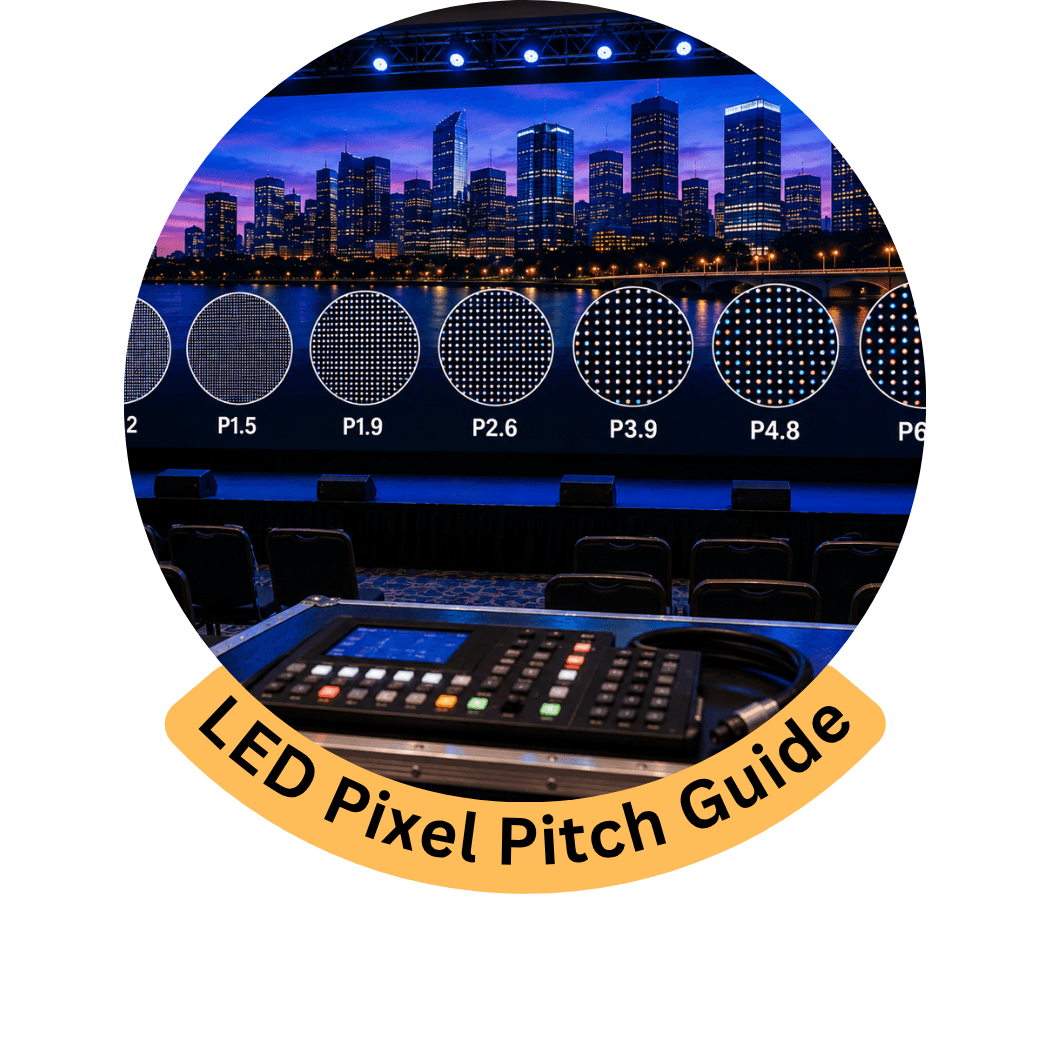
1. What Is LED Pixel Pitch?
LED pixel pitch is the distance from the centre of one LED pixel to the centre of the next, normally measured in millimetres (mm).
A display described as P2.6, for example, has approximately 2.6 mm between neighbouring pixels.
The basic relationship is:
Smaller Pixel Pitch → Pixels Closer Together → Higher Pixel Density
Larger Pixel Pitch → Pixels Farther Apart → Lower Pixel Density
Pixel pitch affects:
- Native screen resolution
- Close-view image quality
- Content detail
- Suitable viewing distance
- LED cabinet selection
- Processing requirements
- Overall system specification
Pixel pitch is therefore an important part of LED wall planning, but it should never be selected without considering the physical screen and audience.
2. How Do We Select the Right LED Pixel Pitch?
We start with the event requirements rather than choosing a pitch from a product list.
| Factor | What We Evaluate | Why It Matters |
|---|---|---|
| Closest Viewing Distance | Nearest audience position | Helps determine required pixel density |
| Farthest Viewing Distance | Rear audience position | Helps determine screen dimensions |
| Screen Size | Physical width and height | Determines native pixel canvas |
| Content Type | Text, video, data, graphics, IMAG | Determines required detail |
| Indoor / Outdoor | Production environment | Influences suitable LED technology |
| Audience Layout | Width and depth | Determines overall visibility |
| Cameras | Whether the LED appears on camera | Can influence visual requirements |
| Stage Design | Screen position and dimensions | Determines practical display configuration |
| Aspect Ratio | Standard or custom canvas | Influences final resolution |
| Budget & Scope | Appropriate production specification | Helps avoid unnecessary over-specification |
We combine these factors to determine the pitch that provides appropriate visual performance without specifying more pixel density than the production actually requires.
3. How Does Pixel Pitch Affect Viewing Distance?
Pixel pitch has its greatest visual impact on attendees positioned relatively close to the LED surface.
At shorter viewing distances, individual pixels become easier to distinguish. A finer pitch reduces the spacing between pixels and creates a denser image.
Close Viewing
Fine-pitch LED is commonly appropriate for:
- Corporate presentations
- Conference stages
- Exhibition booths
- Product demonstrations
- Software demonstrations
- Detailed graphics
- Financial information
- Technical content
Longer Viewing
As audience distance increases, individual pixels become less noticeable.
For large stages and outdoor productions, a wider pixel pitch may provide appropriate visual quality without requiring the pixel density used for close-view corporate applications.
Do Not Use Viewing Distance Alone
Viewing distance is important, but we also consider:
Viewing Distance + Screen Dimensions + Content + Native Resolution + Environment
This provides a more useful specification than selecting pixel pitch from distance alone.
4. What Pixel Pitch Should We Use for Different Events?
There is no single pitch required for each event type, but these ranges provide a useful starting point.
| Pixel Pitch | General Application | Common Event Use |
|---|---|---|
| P1.5–P1.9 | Very fine-pitch indoor LED | Premium presentations, close-view corporate environments |
| P2–P2.6 | Fine-pitch indoor LED | Conferences, corporate events, exhibitions, product demos |
| P2.9–P3.9 | General event LED | Conferences, stages, galas, trade shows, live events |
| P3.9–P4.8 | Medium-distance event LED | Large stages, concerts, indoor/outdoor productions |
| P5–P6 | Longer-distance LED | Festivals, sporting events, outdoor productions |
| P8–P10 | Long-distance outdoor LED | Large outdoor audiences and selected public events |
These are planning ranges rather than fixed rules. Final selection depends on the actual screen size, audience, content, and production environment.
5. How Does Pixel Pitch Affect LED Wall Resolution?
Physical LED wall dimensions do not determine resolution by themselves.
Pixel pitch determines how many pixels fit within those dimensions.
A simplified calculation is:
Screen Width in mm ÷ Pixel Pitch = Horizontal Resolution
Screen Height in mm ÷ Pixel Pitch = Vertical Resolution
For example, consider an LED canvas approximately 6,000 mm wide:
| Pixel Pitch | Approx. Horizontal Pixels |
|---|---|
| P1.9 | 3,158 |
| P2.5 | 2,400 |
| P2.9 | 2,069 |
| P3.9 | 1,538 |
| P4.8 | 1,250 |
The physical width remains approximately the same, but the native horizontal resolution changes significantly.
This matters when the screen needs to display detailed presentations, graphics, dashboards, software interfaces, or multiple content windows.
6. Is a Smaller Pixel Pitch Always Better?
No. A smaller pixel pitch provides greater pixel density, but that does not automatically make it the best choice for every event.
Specifying an unnecessarily fine pitch can increase the production specification without providing a meaningful visual improvement for the actual audience.
When Fine Pitch Is Valuable
A smaller pitch may be justified when:
- Audience members are close to the screen
- Small text must remain clear
- Content contains detailed graphics
- Software interfaces are displayed
- Premium close-range visual quality is required
- The LED wall needs high native resolution within limited physical dimensions
When a Wider Pitch Can Be Appropriate
A wider pitch may be practical when:
- Audiences are farther away
- The LED screen is physically large
- Content contains large graphics or IMAG
- The production is outdoors
- Fine presentation detail is not required
The objective is not to rent the smallest pixel pitch available. It is to choose the appropriate pixel density for the event.
7. How Does Content Affect Pixel Pitch Selection?
Content is one of the most important factors when selecting LED pitch.
PowerPoint & Keynote
Presentation content may contain:
- Small text
- Charts
- Tables
- Numbers
- Diagrams
- Images
Fine-pitch LED can provide greater native resolution when this detail needs to remain clear for nearby attendees.
Software Demonstrations
Software interfaces can contain small icons, menus, controls, and text. We evaluate both pixel pitch and screen dimensions before determining the LED canvas.
Video
Full-motion video often does not require the same close-range detail as spreadsheets or technical presentation slides.
The appropriate pitch can therefore differ even when the physical screen size is identical.
Speaker IMAG
Speaker IMAG generally uses large facial and body images. Physical screen size and audience visibility can be more important than extremely fine pixel density.
Multiple Content Zones
A wide LED canvas might display:
IMAG | Presentation | IMAG
Each zone needs enough pixels to display its assigned content properly, making total native resolution an important part of pitch selection.
8. How Does Indoor or Outdoor Use Affect Pixel Pitch?
Indoor and outdoor LED systems operate under different production conditions.
| Requirement | Indoor LED | Outdoor LED |
|---|---|---|
| Typical Viewing | Often closer | Often farther |
| Pixel Density | Fine pitch frequently useful | Wider pitch may be practical |
| Brightness | Controlled indoor environment | Higher ambient-light requirements |
| Environmental Exposure | Limited | Outdoor conditions must be considered |
| Screen Scale | Small to very large | Often larger-format |
| Common Content | Presentations, data, IMAG, video | IMAG, video, graphics, event information |
Indoor Events
Conferences, corporate events, exhibitions, and product launches frequently place attendees relatively close to the LED wall.
Fine-pitch LED can therefore be valuable where detailed content needs to remain clear.
Outdoor Events
Outdoor festivals, concerts, sporting events, and fan zones often have significantly longer viewing distances.
In these applications, we balance pixel pitch with screen size, brightness, elevation, audience depth, and content rather than automatically using indoor fine-pitch specifications.
9. How Do We Select Pixel Pitch for Conferences and Corporate Events?
Conferences and corporate events often require LED walls to display detailed presentation content at relatively close viewing distances. Pixel pitch therefore needs to support both audience viewing and the required native resolution.
We evaluate:
- Closest audience position
- Farthest audience position
- LED wall dimensions
- PowerPoint or Keynote content
- Charts and data
- Software demonstrations
- Cameras and IMAG
- Stage dimensions
- Audience layout
Presentation-Heavy Events
For presentations containing small text, financial information, technical diagrams, or detailed graphics, a finer pixel pitch can provide more pixels within the available screen dimensions.
General Sessions
Large general sessions may have both close and distant attendees. We balance pixel density with sufficient physical screen size rather than optimizing only for the front row.
Conferences With IMAG
When a wide LED canvas displays multiple sources:
Speaker IMAG | Presentation | Speaker IMAG
we calculate whether each content zone has enough native pixels for its intended source.
10. How Do We Select Pixel Pitch for Trade Shows and Exhibitions?
Trade show attendees frequently view LED displays from short distances, making pixel pitch particularly important.
We evaluate:
- Booth dimensions
- Closest aisle distance
- LED wall dimensions
- Product content
- Text size
- Software interfaces
- Branding
- Native resolution
- Display position
Fine-Pitch Exhibition LED
Fine-pitch LED can be useful for:
- Product demonstrations
- Technical specifications
- Detailed graphics
- Software demonstrations
- Interactive content
- Premium brand visuals
Larger Exhibition Displays
A large booth LED wall viewed primarily from farther down an aisle may not require the same pixel density as a smaller screen designed for close interaction.
The correct selection depends on how attendees actually experience the display.
11. How Do We Select Pixel Pitch for Outdoor Events?
Outdoor LED applications often involve larger displays and longer viewing distances than indoor corporate events.
Common applications include:
- Festivals
- Concerts
- Sporting events
- Fan zones
- Community events
- Outdoor ceremonies
- Public viewing
- Brand activations
For these productions, we evaluate:
Audience Distance + Screen Size + Brightness + Pixel Pitch + Screen Elevation + Content
Longer Viewing Distances
When audiences are positioned farther from the display, a wider pixel pitch may provide appropriate visual performance.
Using an extremely fine outdoor pitch may add pixel density that the audience cannot meaningfully distinguish from its viewing position.
Outdoor Content
Outdoor displays frequently show:
- Camera IMAG
- Video
- Sponsor graphics
- Scores
- Event information
- Branding
- Announcements
Because these elements are often designed at a large visual scale, they may not require the same pixel density as detailed indoor presentation content.
12. How Do Cameras and IMAG Affect Pixel Pitch Selection?
Cameras and IMAG can influence LED specifications, but they should be considered as part of the complete video system.
Speaker IMAG
Speaker IMAG usually contains large visual elements, so it can remain effective without extremely fine pixel density when viewed from an appropriate distance.
LED Screens on Camera
When an LED wall appears in camera shots, we also consider:
- Camera position
- Shooting distance
- Camera settings
- LED refresh performance
- Processing
- Content
- Screen brightness
- Production workflow
Pixel pitch alone does not determine how an LED wall will appear on camera.
Multiple Content Zones
If one LED canvas displays multiple sources simultaneously, the available pixels must be divided between those sources.
For example:
| Left | Centre | Right |
|---|---|---|
| IMAG | Presentation | IMAG |
A higher-resolution LED canvas can provide more usable pixels for each zone, but the final specification should still be based on viewing distance and content requirements.
13. How Do We Match Content Resolution to LED Pixel Pitch?
LED content should be configured around the native resolution of the completed LED canvas.
The production workflow may include:
Presenter Laptops → Presentation Switching → Media Playback → Cameras → Video Processing → LED Canvas
The processor then maps and scales sources appropriately for the display.
Standard HD Content
A source may be 1920 × 1080, but that does not mean the LED wall itself must have exactly 1920 × 1080 physical pixels.
Professional processing can map the source to the native LED canvas.
Custom LED Canvases
Ultra-wide and custom-shaped LED walls may have non-standard resolutions.
Content can be prepared specifically for that canvas to use the available pixels efficiently.
Why This Matters
Selecting pixel pitch without calculating native resolution can result in either:
- Insufficient resolution for detailed content, or
- More pixel density than the production actually needs.
We therefore calculate the physical canvas and pixel pitch together.
14. What LED Pixel Pitch Mistakes Do We Help Prevent?
Pixel pitch is often treated as a simple specification, but several common selection mistakes can affect performance or unnecessarily increase production scope.
Assuming the Smallest Pixel Pitch Is Always Best
The finest available LED is not automatically the best system.
We select enough pixel density for the audience and content without unnecessarily over-specifying the display.
Selecting Pixel Pitch Without Viewing Distance
Pixel pitch should reflect where the audience will actually be positioned.
A pitch appropriate for a trade show booth may be unnecessary for a large outdoor screen viewed from much farther away.
Ignoring Physical Screen Size
Pixel pitch and physical dimensions together determine native resolution.
Selecting pitch without knowing the final LED wall size provides an incomplete specification.
Ignoring Content
Detailed PowerPoint presentations and large-format speaker IMAG have different pixel-density requirements.
We review the content before finalizing the LED system.
Using a Generic Pixel Pitch Chart as a Final Specification
Viewing-distance charts can provide a useful starting point, but they cannot account for:
- Screen dimensions
- Audience layout
- Content detail
- Native resolution
- Cameras
- Indoor or outdoor conditions
- Production objectives
We use these charts as planning references rather than absolute rules.
Confusing Resolution With Physical Size
A high-resolution screen can still be physically too small for distant attendees.
Pixel density and audience visibility need to be planned separately and then combined.
15. What Information Do We Need to Recommend the Right Pixel Pitch?
You do not need to select P1.9, P2.6, P2.9, P3.9, or another pitch before requesting an LED screen rental.
We can determine the appropriate configuration from the event requirements.
| Information | Why We Need It |
|---|---|
| Venue / Location | Establishes the production environment |
| Indoor or Outdoor | Determines suitable LED technology |
| Audience Size | Helps establish display scale |
| Closest Viewing Distance | Important for pixel-pitch selection |
| Farthest Viewing Distance | Helps determine physical screen size |
| Screen Dimensions | Allows native resolution calculations |
| Stage Dimensions | Establishes available display area |
| Content Type | Determines required pixel detail |
| Presentation Format | Helps plan the LED canvas |
| Cameras / IMAG | Influences video and display workflow |
| Audience Layout | Helps evaluate overall visibility |
| Screen Position | Helps evaluate practical viewing conditions |
If the exact LED dimensions are not yet known, the venue, audience size, stage dimensions, viewing distance, and intended content provide a useful starting point.
16. What Do We Verify Before Finalizing LED Pixel Pitch?
Before finalizing the LED system, we verify that the selected pixel pitch works with the physical display, content, audience, and complete production workflow.
| We Verify | What We Confirm |
|---|---|
| Pixel Pitch | Appropriate density for the application |
| Closest Viewing Distance | Suitable close-range image quality |
| Farthest Viewing Distance | Screen is physically large enough |
| Screen Dimensions | Appropriate width and height |
| Native Resolution | Enough pixels for required content |
| Content Detail | Text, graphics and data are practical |
| Aspect Ratio | Appropriate canvas proportions |
| Presentation Sources | Correct mapping and scaling |
| Cameras & IMAG | Suitable content zones and workflow |
| Indoor / Outdoor Use | Appropriate LED technology |
| Video Processing | Correct source management and canvas mapping |
| Audience Layout | Effective visibility across intended positions |
The final pixel pitch should provide the appropriate balance of viewing distance, pixel density, native resolution, physical screen size, content detail, and production requirements rather than simply using the smallest available pitch.