
LED Power Requirements Guide
We provide professional LED Screen Rental Services in Toronto and across the GTA for conferences, corporate events, trade shows, exhibitions, product launches, galas, concerts, sporting events, festivals, and outdoor productions. With 23+ years of event production experience, we plan the electrical requirements of each LED system around the actual screen configuration, venue power, supporting AV equipment, and event production workflow.
Our capabilities include fine-pitch indoor LED walls, outdoor LED displays, Mobile LED Trailers, Kinetic Video Walls, Sphere LED Walls, video processing, cameras, IMAG, presentation switching, media servers, professional audio, lighting, and live streaming. LED power planning requires more than estimating consumption from screen size. We calculate LED cabinet load, processing equipment, power distribution, circuit capacity, cable routing, supporting production equipment, and available electrical service before installation.
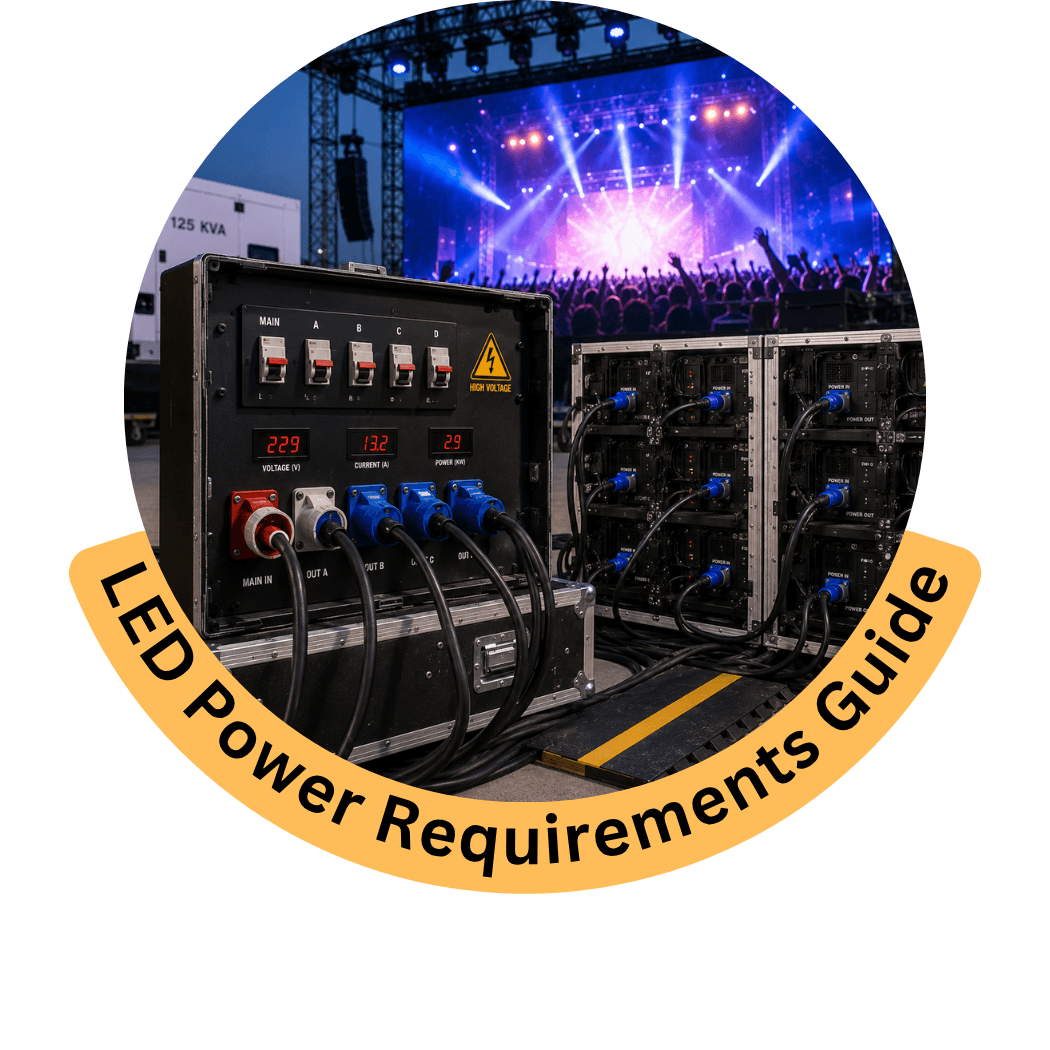
1. How Much Power Does an LED Wall Require?
The electrical requirement of an LED wall depends on the exact display system rather than one standard wattage.
We calculate power from factors including:
| Power Factor | What We Evaluate | Why It Matters |
|---|---|---|
| LED Wall Size | Number of LED cabinets/modules | Larger walls generally require more power |
| LED Product | Manufacturer and cabinet specifications | Different LED systems have different loads |
| Pixel Pitch | Selected LED technology | Can influence cabinet design and power characteristics |
| Brightness | Intended operating level | Higher output can increase consumption |
| Indoor / Outdoor | Display environment | Outdoor systems can have different requirements |
| Video Processing | Processors and controllers | Adds supporting electrical load |
| Cameras & IMAG | Cameras, switchers and monitoring | Adds production equipment |
| Media Servers | Playback and graphics systems | Requires additional circuits |
| Audio & Lighting | Supporting event systems | Must be considered in the overall event power plan |
| Venue Power | Available circuits and service | Determines distribution strategy |
The correct electrical plan should be based on the complete equipment specification, not a generic watts-per-square-metre estimate alone.
2. How Do We Calculate LED Screen Power Requirements?
We begin with the electrical specifications of the selected LED cabinets and calculate the load for the complete display.
A simplified planning method is:
Power per LED Cabinet × Number of Cabinets = LED Display Load
We then add the electrical requirements of the supporting equipment.
We Calculate the LED Cabinet Load
Once screen dimensions are established, we determine how many cabinets are required.
We review manufacturer specifications for the selected LED product, including relevant operating and maximum power figures.
We Add Processing Equipment
The LED wall can also require:
LED controllers
Video processors
Distribution equipment
Conversion equipment
Monitoring
Networking equipment
These loads are included in the system plan.
We Add Production Equipment
If the event includes cameras, IMAG, presentation switching, media servers, playback, streaming, or other production systems, their electrical requirements also need to be considered.
We Plan Distribution
Finally, we determine how the load will be distributed across suitable circuits and electrical infrastructure.
3. What Is the Difference Between Maximum and Typical LED Power Consumption?
LED equipment may have different maximum and typical operating power figures.
Maximum Power
Maximum power represents a higher-demand operating condition for the LED system.
Electrical planning should account for the equipment specifications and the required design margin rather than assuming the screen will always operate at a lower average load.
Typical Operating Power
During normal event operation, actual consumption may be lower depending on:
Brightness level
Content
LED product
Screen configuration
Operating conditions
However, typical consumption should not be used as an excuse to undersize the electrical system.
Why We Consider Both
Understanding typical consumption is useful for production planning, but the electrical distribution must be designed around appropriate equipment ratings and operating requirements.
4. How Does LED Wall Size Affect Power Requirements?
Larger LED walls generally require more cabinets, which increases the total electrical load.
The basic relationship is:
Larger LED Wall → More LED Cabinets → Greater Electrical Load
However, screen area alone is not enough to calculate the final requirement.
Two LED walls of similar dimensions may use different:
LED cabinet models
Pixel pitches
Brightness levels
Power supplies
Processing systems
We therefore calculate from the actual LED product and cabinet quantity.
Multiple LED Walls
If an event uses a main LED wall plus supplemental displays, each display needs to be included in the power plan.
For example:
Side LED + Main LED Wall + Side LED
The electrical calculation must cover the complete display system rather than only the primary wall.
5. Does Pixel Pitch Affect LED Wall Power Consumption?
Pixel pitch can influence the electrical characteristics of an LED system, but it should not be used by itself to estimate power requirements.
Fine-pitch and wider-pitch products can differ in:
LED density
Cabinet design
Power-supply configuration
Brightness
Maximum consumption
Typical operating consumption
The correct calculation comes from the specifications of the actual LED product being deployed.
Fine-Pitch Indoor LED
Fine-pitch systems are frequently used for conferences, corporate presentations, exhibitions, and close-view applications.
Power planning should account for the complete wall configuration and its supporting processing equipment.
Outdoor LED
Outdoor displays may operate at substantially higher brightness levels and can have different electrical requirements.
For outdoor events, we also need to consider how electrical power will be safely supplied and distributed across the site.
6. How Does Brightness Affect LED Power Consumption?
LED brightness can affect actual power consumption.
A screen operating at a higher output level may consume more power than the same system running at a reduced brightness level.
Indoor Events
Indoor venues usually provide controlled ambient lighting, allowing LED walls to operate at appropriate indoor brightness levels.
The display does not normally need to operate at maximum output simply because that level is available.
Outdoor Events
Outdoor screens may require significantly higher brightness to remain visible during daylight.
The power plan should therefore be based on the outdoor LED system and intended operating environment.
Day-to-Night Events
For festivals, concerts, sporting events, and other long-duration productions, LED brightness can be adjusted as ambient conditions change.
Electrical planning should still support the required operating configuration rather than relying on reduced evening brightness.
7. What Electrical Circuits Are Needed for an LED Wall?
The number and type of circuits depend on the calculated electrical load, selected equipment, venue infrastructure, and applicable electrical requirements.
We do not assume that an available wall outlet can support an LED display simply because the connector physically fits.
We evaluate:
Circuit voltage
Circuit capacity
Existing circuit loads
LED system demand
Distribution equipment
Cable distances
Connector requirements
Production equipment
Venue electrical infrastructure
Dedicated Circuits
LED systems may require dedicated electrical circuits so the display is not sharing capacity with unrelated venue equipment.
Multiple Circuits
Larger LED systems can require the load to be distributed across multiple circuits or a larger event power distribution system.
Venue Electrical Service
Convention centres, hotels, exhibition facilities, arenas, and outdoor sites can have different electrical infrastructure and operating procedures.
The electrical plan therefore needs to be coordinated with the actual event location.
8. How Do We Distribute Power Across an LED Wall?
Power distribution divides the total electrical load into appropriate feeds for the LED cabinets and supporting equipment.
A simplified workflow can be:
Venue / Event Power → Distribution → LED Power Feeds → LED Cabinets
Separate feeds may also support:
Processing | Switching | Cameras | Media Servers | Control Equipment
Load Distribution
We calculate how many cabinets can be supported by each appropriate power feed based on the selected LED system and electrical configuration.
Cable Routing
Power cables must be routed around:
Stage layouts
Audience areas
Production control
Structural systems
Venue access
Pedestrian routes
Other AV equipment
System Separation
Depending on the production, separating LED display power from sensitive control and production equipment can make the electrical system easier to manage and troubleshoot.
The final distribution plan should support the entire LED and video production system, not just provide power to individual LED cabinets.
9. How Do Video Processing, Cameras, and IMAG Affect Power Requirements?
The LED panels are only one part of the electrical load. Professional events can include a complete video production system that also requires reliable power.
Supporting equipment may include:
LED video processors
Presentation switchers
Video switchers
Media servers
Playback computers
Camera systems
Camera control equipment
Preview monitors
Confidence monitors
Recording systems
Streaming encoders
Signal distribution equipment
A typical production workflow can be:
Presentation Sources + Cameras + Playback → Video Switching → Video Processing → LED Wall
Cameras & IMAG
Multi-camera IMAG productions add cameras, monitoring, switching, communications, and control equipment. These requirements are included when we plan the overall production power.
Production Control
Video control equipment should have stable, appropriately planned power. We do not calculate the LED wall and then treat the control system as an afterthought.
10. How Do We Plan Power for Outdoor LED Screens?
Outdoor LED productions can require a different electrical approach because suitable event power may not be available near the display location.
We evaluate:
Outdoor LED screen size
LED product specifications
Operating brightness
Screen location
Cable distance
Available site power
Temporary power requirements
Cameras and IMAG
Audio and supporting AV
Production control location
Environmental conditions
Available Site Power
Where appropriate electrical service is available, we verify whether its capacity and location can support the planned system.
Temporary Event Power
Festivals, sporting events, fan zones, community events, and remote outdoor productions may require temporary electrical infrastructure.
The system needs to account for the LED wall and all associated production equipment.
Mobile LED Trailers
Mobile LED Trailers have their own specific electrical and operational requirements depending on the system being deployed.
We verify those requirements as part of the overall event power plan rather than assuming every mobile display operates the same way.
11. When Is a Generator Required for an LED Screen?
A generator may be considered when the event site does not provide suitable electrical capacity or when the production requires temporary event power.
Common situations can include:
Outdoor festivals
Sporting events
Fan zones
Remote event sites
Community events
Temporary stages
Outdoor brand activations
Generator Sizing
Generator capacity should not be determined from the LED screen alone.
We calculate the expected requirements for the relevant production equipment and include appropriate operating considerations.
The overall load can include:
LED Display + Processing + Video Control + Cameras + Playback + Supporting Production Equipment
Power Quality
Sensitive video and control equipment requires appropriate electrical supply. Generator selection and distribution should therefore consider more than total wattage alone.
Separate Production Loads
Depending on the production design, LED, audio, lighting, and control systems may be distributed separately rather than placing every system on one electrical feed.
The final approach depends on the equipment specification and site infrastructure.
12. How Do Audio, Lighting, and Live Streaming Affect Event Power?
When we provide more than the LED wall, the power plan needs to account for the complete production.
| Production System | Electrical Considerations |
|---|---|
| LED Wall | Cabinets, controllers and processing |
| Professional Audio | Amplification, consoles and supporting equipment |
| Event Lighting | Fixtures, control and distribution |
| Cameras | Cameras, monitoring and control |
| IMAG | Switching, processing and monitors |
| Media Servers | Playback and graphics computers |
| Live Streaming | Encoding, computers and networking equipment |
| Presentation Systems | Laptops, switching and confidence monitors |
Avoiding Unplanned Shared Loads
Adding equipment after the electrical system has already been planned can create unnecessary problems.
We therefore identify the expected AV scope before determining the final distribution requirements.
Production Coordination
For larger events, LED, audio, lighting, staging, venue electrical services, and other technical departments may need to coordinate their requirements before load-in.
13. How Do Venue Power and Event Logistics Affect the LED Setup?
Available electrical capacity is only one part of venue power planning.
We also need to understand where that power is located and how it can reach the LED system.
Power Location
A suitable electrical service located far from the stage can require a different distribution plan from power available directly beside the LED wall.
Cable Routing
We evaluate practical routes between electrical sources and equipment while considering:
Stage access
Audience circulation
Doors
Service corridors
Production areas
Booths
Structural equipment
Cable protection
Convention Centres and Exhibition Facilities
Trade shows and exhibitions can involve venue-specific electrical ordering and distribution procedures.
We coordinate the LED system specification with the event’s approved electrical plan.
Hotels and Ballrooms
Ballrooms can have multiple existing circuits, but we verify how those circuits are distributed and what other equipment may already be using them.
Outdoor Sites
Outdoor sites can require substantially more temporary infrastructure, particularly when power is located far from the display or suitable electrical service is unavailable.
14. What LED Power Planning Mistakes Do We Help Prevent?
Electrical requirements should be determined during system design rather than after the LED wall arrives on site.
Estimating Power From Screen Size Alone
Screen dimensions provide only an initial indication.
We calculate from the actual LED product, cabinet quantity, supporting equipment, and production configuration.
Using Typical Consumption as the Only Design Number
Actual consumption may be below maximum equipment demand during normal operation, but electrical infrastructure still needs to support the required system appropriately.
Assuming Any Wall Outlet Can Power the LED Wall
A receptacle does not tell us whether the circuit has sufficient available capacity.
We verify the electrical infrastructure before relying on it.
Forgetting Video Production Equipment
Processors, switching, cameras, IMAG, media servers, monitors, and streaming systems also require power.
Adding Audio or Lighting Too Late
Supporting production systems can substantially change the overall event electrical plan.
We identify them before final distribution is determined.
Ignoring Cable Distance
Power may be available at the venue but located far from the LED system.
Distribution distance and cable routing need to be considered during planning.
Underestimating Outdoor Power Requirements
Outdoor locations may have limited or no suitable event power near the screen.
Temporary electrical infrastructure should be identified before load-in.
15. What Information Do We Need to Calculate LED Power Requirements?
Clients do not need to calculate amperage or electrical loads themselves. We can determine the requirements once the event and equipment scope are known.
| Information | Why We Need It |
|---|---|
| Venue / Location | Helps identify available electrical infrastructure |
| Indoor or Outdoor | Influences equipment and distribution |
| LED Wall Dimensions | Helps determine cabinet quantity |
| LED Product | Provides equipment power specifications |
| Number of Screens | Determines total LED system load |
| Operating Environment | Helps establish expected screen operation |
| Cameras / IMAG | Adds video production equipment |
| Presentation System | Adds computers, switching and monitoring |
| Audio Requirements | Adds supporting electrical load |
| Lighting Requirements | Influences total event power planning |
| Live Streaming | Adds encoding and production equipment |
| Available Venue Power | Determines distribution strategy |
| Power Location | Determines cable routing and distribution |
| Event Schedule | Helps plan installation, testing and operation |
If the final equipment list is not yet available, the venue, LED wall size, indoor/outdoor environment, event type, and supporting AV requirements provide a useful starting point.
16. What Do We Verify Before Powering an LED Screen?
Before the LED system is placed into event operation, the power configuration should match the equipment and production requirements.
| We Verify | What We Confirm |
|---|---|
| LED Cabinet Load | Electrical requirement of the complete display |
| Total Screen Quantity | All LED destinations are included |
| Equipment Specifications | Appropriate manufacturer power data is used |
| Available Power | Suitable electrical capacity is available |
| Circuit Distribution | Loads are appropriately distributed |
| Power Distribution Equipment | Suitable distribution for the planned system |
| Cable Routing | Practical routing to LED and production equipment |
| Video Processing | Processor and controller power requirements |
| Cameras & IMAG | Production equipment is included |
| Media Servers / Playback | Show computers and playback are included |
| Audio & Lighting | Supporting systems are coordinated where required |
| Outdoor Power | Temporary infrastructure is planned where necessary |
| Backup / Redundancy | Included where required by the production design |
| System Testing | Complete LED and production system is tested before the event |
The final electrical plan should support the LED display, video processing, cameras, IMAG, playback, control equipment, and supporting event technology as one coordinated production system, with the actual electrical design and connections handled according to applicable requirements and qualified venue or electrical personnel where required.