
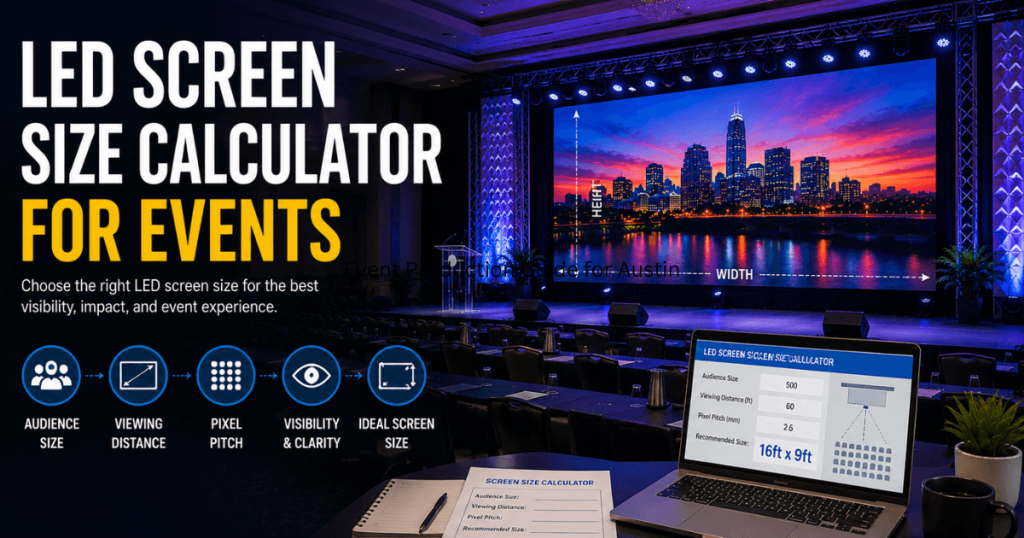
Choosing the right LED screen size for an event is not simply a matter of selecting the largest display that fits the stage. The correct size depends on audience distance, room dimensions, seating layout, content type, pixel pitch, stage design, and the farthest viewing position.
For many events, screen width is especially important because attendees at the back of the room must still be able to read presentations and clearly see live camera feeds. A screen that looks large during an empty-room site visit can appear surprisingly small once the venue is filled with attendees.
Our Toronto LED screen rental team uses screen-size planning alongside pixel pitch, viewing distance, content resolution, IMAG, venue layout, and installation requirements. With 23+ years of event production experience, we configure LED walls for conferences, corporate meetings, trade shows, product launches, galas, concerts, festivals, sporting events, and other productions throughout Toronto and the GTA.
This guide provides a practical LED screen size calculator for events and explains how to estimate the right dimensions before final production planning.
Quick LED Screen Size Calculator
A useful starting point for presentation-heavy events is to consider the distance from the LED wall to the farthest important viewer.
A simple planning method is:
Recommended Screen Height ≈ Farthest Viewing Distance ÷ 6 to 8
This is a preliminary event-planning guideline rather than a fixed engineering rule.
For example:
Farthest Viewer = 60 ft
60 ÷ 8 = 7.5 ft
60 ÷ 6 = 10 ft
A practical screen height could therefore begin around 8–10 feet, depending on the content, room, stage, and audience.
For detailed PowerPoint presentations, smaller text, or important data, the larger end of the range may be more appropriate.
LED Screen Size Calculator Table
| Farthest Viewer | Starting Screen Height | Approx. 16:9-Style Width |
|---|---|---|
| 30 ft | 4–5 ft | 7–9 ft |
| 40 ft | 5–7 ft | 9–12 ft |
| 50 ft | 6–8 ft | 11–14 ft |
| 60 ft | 8–10 ft | 14–18 ft |
| 75 ft | 9–12 ft | 16–21 ft |
| 100 ft | 13–17 ft | 23–30 ft |
| 120 ft | 15–20 ft | 27–36 ft |
| 150 ft | 19–25 ft | 34–44 ft |
These dimensions are starting points. The actual LED cabinet dimensions may require the final screen to be slightly wider or taller.
How Do You Calculate LED Screen Width?
Once the approximate screen height is known, width can be estimated from the desired aspect ratio.
For a 16:9 screen:
Screen Width = Screen Height × 1.78
For example:
If the target height is 9 ft:
9 × 1.78 = 16.02 ft
The target display would therefore be approximately:
16 ft wide × 9 ft high
However, modular LED cabinets come in fixed physical dimensions. The production team may adjust the final wall slightly to match the available panel configuration.
Why Does Audience Distance Determine Screen Size?
The farther the audience is from the screen, the larger important visual elements need to appear.
Imagine displaying the same PowerPoint slide on:
- A 75-inch television
- A 10-foot-wide LED wall
- A 20-foot-wide LED wall
The source presentation might be identical, but readability from 80 feet away will be completely different.
This is why event LED planning should begin with the audience environment, not simply the available screen inventory.
Important distances include:
- Closest viewer
- Average viewer
- Farthest viewer
Each influences a different part of the LED specification.
Closest Viewer vs Farthest Viewer
These two measurements solve different problems.
Closest Viewing Distance
The closest viewer helps determine the appropriate pixel pitch.
Someone sitting close to the LED wall can perceive the pixel structure more easily.
Farthest Viewing Distance
The farthest viewer helps determine the required physical screen size.
Someone sitting far away needs a sufficiently large image to read text and understand visual content.
A strong LED design therefore considers:
Closest Viewer → Pixel Pitch
Farthest Viewer → Screen Size
This distinction prevents a common planning mistake: selecting a fine-pitch LED wall that has excellent resolution but is physically too small for the room.
Does Audience Size Determine LED Screen Size?
Audience size matters, but it should not be used alone.
A 500-person audience can be arranged in many different ways.
For example:
Wide Ballroom
The audience may not be particularly deep, but attendees at the far sides may have difficult viewing angles.
Long Ballroom
The audience may extend a significant distance from the stage.
Theatre Seating
The room may be relatively narrow but very deep.
Exhibition Hall
Viewers may move throughout a large open space rather than remain seated.
Two events with 500 attendees can therefore require completely different LED configurations.
Audience geometry is often more important than audience count alone.
LED Screen Size by Audience Size
For early budgeting, the following can be used as a general planning reference.
| Audience Size | Possible LED Configuration | Typical Environment |
|---|---|---|
| Under 50 | 8–10 ft wide | Meeting / small event |
| 50–100 | 10–12 ft wide | Corporate meeting |
| 100–250 | 12–16 ft wide | Conference |
| 250–500 | 16–20 ft wide | Ballroom event |
| 500–1,000 | 20–30 ft+ | Large general session |
| 1,000+ | Large main wall and/or side screens | Convention / large event |
These are not fixed rules.
Room depth, content, stage design, and sightlines should determine the final dimensions.
What Size LED Screen Is Best for a Conference?
Conference LED screens need to support content such as:
- PowerPoint
- Charts
- Speaker names
- Videos
- IMAG
- Sponsor logos
- Remote speakers
For a smaller conference, a 12–16 ft wide LED wall may provide an effective starting point.
Medium and large ballrooms may require:
- 16–20 ft main LED wall
- 20–30 ft+ LED backdrop
- Main wall plus side screens
- Ultra-wide LED canvas
The appropriate solution depends heavily on audience depth.
Presentation readability should take priority over simply creating a visually impressive stage.
What Size LED Screen Is Best for a Corporate Event?
Corporate events frequently involve detailed information.
Attendees may need to read:
- Financial figures
- Charts
- Product information
- Timelines
- Speaker presentations
- Business data
For this reason, screen sizing and content design need to work together.
A physically larger display does not automatically make tiny PowerPoint text readable.
Corporate event planning should consider:
Screen Size + Font Size + Viewing Distance + Pixel Pitch
What Size LED Wall Is Best for a Trade Show Booth?
Trade show booths operate differently from conferences because attendees usually view the screen from much closer distances.
Typical configurations might include:
- 8–10 ft wide LED display
- 10–12 ft LED wall
- 16 ft wide booth backdrop
- Larger custom booth LED wall
Fine pixel pitch becomes more important because visitors may stand only a few feet away.
A large P3.9 wall may be appropriate for a distant audience but less suitable for a premium booth where visitors inspect detailed content at close range.
What Size LED Screen Is Best for a Product Launch?
Product launches often benefit from larger or more creative LED canvases.
The screen may display:
- Product close-ups
- Technical animations
- Videos
- IMAG
- Demonstrations
- Brand graphics
- Launch sequences
Instead of using a standard 16:9 display, a product launch may use an ultra-wide LED wall integrated into the scenic design.
For example:
Camera | Product Content | Camera
or:
Branding | Product Presentation | Branding
In these situations, the LED dimensions should be designed alongside the content.
What Size LED Screen Is Best for a Gala or Award Ceremony?
Galas and awards events commonly combine scenic content with live cameras.
The screen may show:
- Award categories
- Nominees
- Winners
- Sponsor graphics
- Videos
- IMAG
- Event branding
A medium ballroom may use a 16–20 ft main display, while larger productions may use a much wider LED backdrop.
The correct size should maintain good visibility without overwhelming the stage design.
What Size LED Screen Is Best for a Concert?
Concert screen sizing depends heavily on audience depth.
Large audiences usually need substantial screen area because attendees farther from the stage rely on IMAG to see performers.
Concert productions may use:
- One large centre LED wall
- Two side LED walls
- Centre wall plus side IMAG screens
- Large scenic LED backdrop
For large entertainment events, several strategically positioned displays can sometimes provide better visibility than one extremely large central screen.
What Size LED Screen Is Best for an Outdoor Event?
Outdoor screen sizing depends on:
- Audience area
- Viewing distance
- Screen elevation
- Daylight
- Content
- Site layout
Outdoor events often involve greater viewing distances than indoor corporate events.
Typical applications include:
- Festivals
- Sporting events
- Fan zones
- Community events
- Public screenings
- Outdoor concerts
Large physical screen dimensions may therefore be more important than very fine pixel pitch.
How Does Pixel Pitch Affect Screen Size?
Pixel pitch and screen size are related, but they solve different problems.
Consider:
P1.9
High pixel density. Useful for detailed close-view content.
P2.6
Strong balance for conferences, corporate events, and trade shows.
P3.9
Commonly practical for larger screens and longer viewing distances.
If the audience is far from the display, investing the budget in a larger P3.9 wall can sometimes provide more audience benefit than choosing a much smaller fine-pitch wall.
The correct decision depends on actual viewing conditions.
LED Screen Size and Pixel Pitch Comparison
| Event Situation | Screen Size Priority | Pixel Pitch Priority |
|---|---|---|
| Executive Meeting | Moderate | Very High |
| Conference | High | High |
| Trade Show Booth | Moderate | Very High |
| Product Launch | High | High |
| Gala | High | Medium–High |
| Concert | Very High | Medium |
| Festival | Very High | Medium |
| Sporting Event | Very High | Viewing-distance dependent |
| Fan Zone | Very High | Viewing-distance dependent |
Screen dimensions and pixel pitch should always be selected together.
How Do You Calculate LED Wall Resolution?
Once the physical LED configuration is established, native resolution can be calculated from the panel specifications.
Suppose an LED cabinet has:
192 pixels wide × 192 pixels high
If the wall uses:
8 cabinets across × 5 cabinets high
the native resolution becomes:
Width: 192 × 8 = 1,536 pixels
Height: 192 × 5 = 960 pixels
Final canvas:
1536 × 960 pixels
This native resolution can then be used for content mapping and video processing.
The exact calculation varies according to the LED panel model.
Does an LED Wall Need to Be 1920 × 1080?
No.
This is a common misunderstanding.
A modular LED wall can have many different native resolutions.
For example, the canvas might be:
- 1536 × 864
- 1920 × 1080
- 2560 × 960
- 3840 × 1080
- Another custom resolution
Professional LED processors can scale and map standard content onto custom LED canvases.
What matters is whether the final system delivers appropriate detail for the intended audience.
Should You Build a 16:9 LED Screen?
A 16:9-style configuration is useful when most content consists of:
- PowerPoint
- Standard videos
- Camera feeds
- Livestream content
It simplifies content preparation because many common video formats already use 16:9.
However, LED does not need to follow traditional television dimensions.
For conferences, product launches, and awards events, an ultra-wide LED wall can create a much more integrated stage environment.
LED Screen Size vs Content Size
Screen dimensions alone do not determine readability.
Content design is equally important.
Imagine a 20-foot-wide LED wall displaying a slide with:
- 12-point text
- Eight charts
- Small labels
- Several paragraphs
The screen may still be difficult to read from the back of the room.
Event presentations should use:
- Large fonts
- Simple layouts
- High contrast
- Large graphics
- Limited text
- Clear hierarchy
The LED wall and presentation design need to be planned as one visual system.
Should Large Events Use Side Screens?
Sometimes.
A very wide or deep audience may benefit from additional screens.
For example:
Side LED | Main Stage | Side LED
Side displays can primarily show IMAG while the main LED wall handles presentations and scenic content.
This can improve viewing for:
- Large conferences
- Conventions
- Concerts
- Award ceremonies
- General sessions
Adding side screens increases equipment and production cost, but it can provide better visibility than simply enlarging the central screen.
How Does Screen Height Affect Sightlines?
Screen height matters almost as much as screen size.
If the bottom of the display is positioned too low, attendees near the front can block the view for people behind them.
Elevating the LED wall can improve sightlines.
Planning should consider:
- Stage height
- Screen elevation
- Audience seating
- Room depth
- Ceiling height
- Camera positions
The objective is to make the important content visible across the audience—not simply fit the largest screen onto the stage.
Common LED Screen Size Mistakes
Choosing by Audience Count Alone
Five hundred attendees in a wide ballroom have different needs from 500 attendees in a deep room.
Ignoring the Farthest Viewer
Screen size should account for people near the back.
Ignoring the Closest Viewer
Pixel pitch must still work for attendees near the stage.
Choosing Resolution Instead of Physical Size
A high-resolution wall can still be too small.
Automatically Choosing 16:9
Custom LED canvases may better suit the stage and content.
Forgetting IMAG
Large audiences may need cameras and live speaker images.
Making the Screen Too Low
Poor elevation can create obstructed sightlines.
Using Tiny Presentation Text
A large LED wall cannot completely compensate for poor content design.
Our LED Screen Size Planning Process
For Toronto events, we evaluate the complete viewing environment before finalizing screen dimensions.
1. Measure the Audience Area
We review audience width and depth.
2. Identify the Closest Viewer
This helps determine pixel pitch.
3. Identify the Farthest Viewer
This helps determine physical screen size.
4. Review the Content
PowerPoint, IMAG, video, branding, and scenic graphics have different requirements.
5. Review Stage Dimensions
The LED wall needs to integrate with the stage rather than dominate it unnecessarily.
6. Determine Aspect Ratio
We decide whether standard 16:9 or a custom canvas better supports the production.
7. Select Pixel Pitch
Pixel density is matched to viewing conditions.
8. Plan Screen Elevation
Sightlines are checked across the room.
9. Calculate Native Resolution
The final cabinet configuration establishes the LED canvas.
10. Test Content
Presentations, videos, and camera feeds are checked before the live event.
How Do Room Dimensions Affect LED Screen Size?
Room dimensions can change the ideal LED screen configuration even when two events have the same number of attendees.
The three most important measurements are:
- Room width
- Audience depth
- Available stage width
A deep ballroom generally requires more screen height because attendees are farther from the stage. A wide ballroom may require a wider main LED wall or additional side screens so attendees seated at the edges have comfortable sightlines.
For this reason, screen size should not be calculated from audience count alone.
A better planning approach is:
Room Depth + Audience Width + Stage Width + Content = Practical Screen Size
LED Screen Size by Room Depth
Using the earlier planning guideline:
Screen Height ≈ Farthest Viewing Distance ÷ 6 to 8
we can create a preliminary sizing table.
| Farthest Viewer | Starting Screen Height | Approx. 16:9 Width |
|---|---|---|
| 30 ft | 4–5 ft | 7–9 ft |
| 40 ft | 5–7 ft | 9–12 ft |
| 50 ft | 6–8 ft | 11–14 ft |
| 60 ft | 8–10 ft | 14–18 ft |
| 75 ft | 9–12 ft | 16–21 ft |
| 90 ft | 11–15 ft | 20–27 ft |
| 100 ft | 13–17 ft | 23–30 ft |
| 120 ft | 15–20 ft | 27–36 ft |
| 150 ft | 19–25 ft | 34–44 ft |
These figures are useful for early planning, not final engineering or production specifications.
Content can push the requirement toward a larger or smaller display.
How Wide Should an LED Screen Be Compared With the Stage?
There is no fixed percentage that works for every event.
The LED wall needs to leave enough space for:
- Speakers
- Lecterns
- Scenic elements
- Lighting
- Cameras
- Performers
- Stage entrances
- Branding
For a simple corporate conference, a central 16:9 LED wall may occupy only part of the stage.
For a product launch or award ceremony, an ultra-wide LED wall may become the primary scenic backdrop.
The screen should therefore be designed as part of the complete stage, not added after the stage layout has already been finalized.
Should Screen Width Be Based on Audience Width?
Audience width matters primarily because of viewing angles.
Imagine a 50-foot-wide ballroom with a relatively narrow screen in the centre.
People sitting directly in front may have an excellent view. Attendees at the far left and right may need to look across the room at an uncomfortable angle.
Possible solutions include:
- Wider main LED wall
- Additional side LED screens
- Side projection screens
- Strategically positioned displays
- Revised seating layout
For wide audiences, screen placement can sometimes be more important than simply increasing screen size.
How Large Should PowerPoint Text Appear?
This is one of the most important questions for conferences.
A large LED wall cannot fix a presentation containing excessive small text.
PowerPoint slides should generally use:
- Large headings
- Large body text
- Short sentences
- Simple charts
- High contrast
- Large graphics
Avoid trying to place an entire report onto one slide.
For example, this is difficult for distant viewers:
Eight charts + four paragraphs + several footnotes
A better event slide might contain:
One headline + one key chart + one takeaway
The screen and presentation should be designed together.
Does a Bigger LED Screen Make Small Text Readable?
Only to a point.
Making the physical screen larger increases the physical size of displayed elements.
However, readability still depends on:
- Font size
- Viewing distance
- Contrast
- Pixel pitch
- Native resolution
- Content layout
If important text is extremely small within the presentation, increasing screen dimensions alone may not produce an ideal result.
Content simplification can often improve readability more efficiently than adding several feet to the LED wall.
How Does IMAG Change LED Screen Size Requirements?
IMAG — Image Magnification — uses live cameras to show speakers or performers on large displays.
For large audiences, IMAG can become one of the main reasons for installing LED screens.
Without IMAG, someone sitting 100 feet from the stage may struggle to see a presenter’s facial expressions.
A large LED wall allows the camera image to make the speaker visually accessible throughout the room.
Events that commonly benefit from IMAG include:
- Conferences
- Conventions
- Award ceremonies
- Galas
- Concerts
- Graduations
- Sporting events
- Large corporate meetings
The larger and deeper the audience, the more important physical image size becomes.
How Much of the LED Wall Should IMAG Use?
It depends on the screen design.
Full-Screen IMAG
The speaker fills most of the LED wall.
Useful when visibility is the primary requirement.
Split-Screen IMAG
The wall may show:
Speaker | Presentation
This allows attendees to see both the presenter and presentation simultaneously.
Ultra-Wide Canvas
A larger LED backdrop could display:
Branding | IMAG | Presentation | IMAG | Branding
This is particularly effective for conferences and corporate productions.
The content layout should be planned before the LED wall dimensions are finalized.
One Large Screen or Two Smaller Screens?
Both configurations can work.
One Large Centre LED Wall
Advantages include:
- Strong visual focal point
- Simple audience attention
- Large presentation canvas
- Clean stage design
Best for rooms where most attendees have good sightlines toward the centre.
Two Side Screens
Advantages include:
- Better coverage for wide audiences
- Improved IMAG visibility
- Flexible stage design
This can work well when a scenic stage or performance area occupies the centre.
Main Wall Plus Side Screens
Large productions may use:
Side Screen | Main LED Wall | Side Screen
This provides a central presentation canvas while side screens support IMAG.
When Should You Add Side LED Screens?
Side screens become worth considering when:
- The audience is very wide
- The room is very deep
- The central screen has poor viewing angles
- IMAG is important
- Scenic design limits the main screen size
- Large numbers of attendees need consistent visibility
Adding screens increases cost because the production may require:
- Additional LED panels
- More processing
- More support structure
- More power
- More cabling
- More installation labour
The benefit should therefore be based on actual sightline requirements.
How Do You Size an Ultra-Wide LED Wall?
Ultra-wide LED walls are common for:
- Corporate conferences
- Product launches
- Award ceremonies
- Brand events
- Entertainment productions
Unlike a conventional 16:9 screen, the width may be two, three, or even more times the height.
For example, a stage might use a display approximately:
30 ft wide × 8 ft high
Instead of forcing standard 16:9 content across the entire canvas, the screen can be divided into content zones.
For example:
| Left Zone | Centre Zone | Right Zone |
|---|---|---|
| IMAG | PowerPoint | IMAG |
| Branding | Video | Branding |
| Speaker Info | Presentation | Event Graphics |
This makes better use of the available pixels.
How Does Native Resolution Affect an Ultra-Wide LED Wall?
Custom screen dimensions create custom native resolutions.
For example, an ultra-wide LED wall might have a canvas such as:
3840 × 1080
or another configuration determined by the cabinets and pixel pitch.
This does not mean every event should use that exact resolution.
The important point is that custom LED walls require content mapping.
A media server, video processor, or presentation system can place content into the correct areas of the canvas.
What Size LED Screen Is Best for a 100-Person Event?
For many 100-person corporate events, a display around 10–14 feet wide can be a reasonable starting point.
However, the room layout matters.
A 100-person audience sitting close to a stage in a compact ballroom has different requirements from 100 attendees spread across a long room.
For detailed PowerPoint content, also consider:
- Fine pixel pitch
- Font size
- Screen elevation
- Closest viewer
- Farthest viewer
What Size LED Screen Is Best for a 250-Person Event?
A 12–18 ft wide LED wall can provide a useful starting range for many 250-person conference environments.
The final configuration could be:
- 16:9 main LED wall
- Ultra-wide presentation wall
- Main screen with IMAG
- Centre wall plus supporting displays
Room depth remains more important than the exact attendee number.
What Size LED Screen Is Best for a 500-Person Event?
For a 500-person ballroom event, planners might begin evaluating screens around 16–24 ft wide, depending on room depth and content.
If the audience is especially wide or deep, a better solution may be:
Main LED Wall + Side IMAG Screens
This can distribute visual information more effectively than simply making the centre screen wider.
What Size LED Screen Is Best for 1,000+ Attendees?
At this scale, screen planning should be based on a detailed room and audience layout.
Possible configurations include:
- 20–30 ft+ main LED wall
- Large ultra-wide LED backdrop
- Centre screen plus side LED screens
- Multiple strategically positioned displays
IMAG becomes increasingly valuable because physical distance makes it difficult for attendees to see speakers directly.
For very large audiences, display placement can matter as much as display dimensions.
Indoor vs Outdoor LED Screen Size
Outdoor audiences often spread across larger areas.
This can require:
- Larger screens
- Greater screen elevation
- Longer viewing distances
- Higher brightness
Indoor events usually have more controlled seating and shorter viewing distances.
| Requirement | Indoor Event | Outdoor Event |
|---|---|---|
| Typical Viewing Distance | Shorter | Often longer |
| Screen Size | Small to very large | Often medium to very large |
| Pixel Pitch | Often finer | Often larger |
| Brightness | Controlled | High |
| Audience Position | Structured | Can be widely distributed |
| Screen Elevation | Venue-dependent | Often important |
| Weather Planning | Limited | Critical |
An outdoor screen should never be sized solely from its indoor equivalent.
How Large Should a Mobile LED Trailer Be?
Mobile LED trailers are often used where fast outdoor deployment and elevated screens are useful.
Common applications include:
- Fan zones
- Sporting events
- Festivals
- Community events
- Outdoor screenings
- Corporate events
Trailer screen size should be matched to:
- Audience depth
- Audience width
- Viewing distance
- Content
- Site layout
For a large crowd, a small trailer screen may provide insufficient visual scale even if its brightness is excellent.
Again:
Brightness solves ambient light.
Physical size solves long-distance visibility.
How Does Screen Elevation Affect the Calculation?
A properly sized LED wall can still perform poorly if it is installed too low.
Imagine a seated audience of several hundred people.
If the bottom of the LED wall begins just above stage level, people in the front rows may block the lower portion for those behind them.
Raising the display can improve visibility.
However, excessive elevation can create uncomfortable viewing angles for people close to the stage.
Screen elevation should therefore consider:
- Audience depth
- Stage height
- Ceiling height
- Closest viewer
- Screen height
- Seating arrangement
LED Screen Size Example: Small Corporate Conference
Assume:
- 120 attendees
- Farthest viewer: 45 ft
- PowerPoint-heavy program
- Indoor ballroom
- Close viewing
Using the preliminary formula:
45 ÷ 8 = 5.6 ft
45 ÷ 6 = 7.5 ft
A practical target might therefore be approximately 6–8 ft high.
A 16:9-style screen could be approximately:
11–14 ft wide
The final configuration might use fine-pitch LED such as P2–P2.6 depending on the closest viewing distance.
LED Screen Size Example: Medium Conference
Assume:
- 400 attendees
- Farthest viewer: 75 ft
- PowerPoint + IMAG
- Ballroom
Calculation:
75 ÷ 8 = 9.4 ft
75 ÷ 6 = 12.5 ft
A screen approximately 9–12 ft high could provide a starting point.
A 16:9-style display would be roughly:
16–22 ft wide
Depending on audience width, side IMAG screens could also be considered.
LED Screen Size Example: Large General Session
Assume:
- 1,000 attendees
- Farthest viewer: 120 ft
- Presentations + IMAG
- Large event hall
Calculation:
120 ÷ 8 = 15 ft
120 ÷ 6 = 20 ft
A single 16:9 display at that height would become extremely large.
Instead, the production team might consider:
- Large central LED canvas
- Side IMAG screens
- Multiple LED displays
This demonstrates why the calculator provides a planning signal, not an automatic equipment order.
LED Screen Size Example: Trade Show Booth
Assume:
- 20′ × 20′ booth
- Visitors stand relatively close
- Product videos and demonstrations
- High-detail graphics
The screen might only need to be:
8–12 ft wide
But pixel pitch becomes important because viewing distances are short.
A smaller fine-pitch wall can provide more value than a very large coarse-pitch display.
LED Screen Size Example: Outdoor Fan Zone
Assume:
- Large standing audience
- Long viewing distances
- Live sporting content
- Daylight operation
The priorities become:
- Large physical screen
- High brightness
- Screen elevation
- Outdoor-rated equipment
- Appropriate viewing distance
- Reliable live video system
Fine-pitch LED may be less important because most viewers are farther away.
Final LED Screen Size Calculator Table
| Event Situation | Starting Screen Width | Main Priority |
|---|---|---|
| Small Meeting | 8–10 ft | Presentation readability |
| 50–100 Person Corporate Event | 10–14 ft | Fine detail |
| 100–250 Person Conference | 12–18 ft | PowerPoint + sightlines |
| 250–500 Person Conference | 16–24 ft | Audience depth |
| 500–1,000 Person Event | 20–30 ft+ | Size + IMAG |
| 1,000+ General Session | Custom / multiple screens | Sightline coverage |
| Trade Show Booth | 8–16 ft | Fine pitch |
| Product Launch | 16–30 ft+ | Creative canvas |
| Gala / Awards | 16–24 ft+ | IMAG + stage design |
| Concert | Large/custom | Audience visibility |
| Festival | Large outdoor | Distance + brightness |
| Fan Zone | Large outdoor/mobile | Size + elevation |
These ranges are planning references rather than fixed requirements.
LED Screen Size Calculator Checklist
Before selecting a screen, collect these details:
- Audience size
- Audience width
- Audience depth
- Closest viewing distance
- Farthest viewing distance
- Stage width and height
- Available ceiling height
- Indoor or outdoor environment
- Content type
- PowerPoint requirements
- Camera/IMAG requirements
- Desired aspect ratio
- Installation method
- Venue limitations
With these details, screen sizing becomes much more accurate than simply asking for a screen based on attendee count.
Frequently Asked Questions About LED Screen Size for Events
How do I calculate LED screen size for an event?
Start with audience depth. A preliminary planning method for presentation-heavy events is to estimate screen height at roughly one-sixth to one-eighth of the farthest important viewing distance, then adjust for content, audience width, stage dimensions, and sightlines.
What size LED screen do I need for 100 people?
A screen around 10–14 ft wide can be a useful starting point for many 100-person events, but room depth and presentation content should determine the final size.
What size LED wall do I need for 500 people?
Many 500-person events may begin evaluating approximately 16–24 ft wide displays. Wide or deep rooms may benefit from side screens or multiple displays.
What size screen do I need for 1,000 people?
There is no universal size. Large general sessions often require a large main LED canvas, side IMAG screens, or multiple displays because audience geometry becomes more important than attendee count alone.
How does viewing distance affect LED screen size?
The farthest viewing distance helps determine physical screen size, while the closest viewing distance is important when selecting pixel pitch.
What pixel pitch should I use for my LED screen?
Close-view corporate events and trade shows may benefit from fine pitches such as P1.9–P2.6. Larger screens viewed from farther away may use P2.9 or P3.9 depending on the application.
Should an LED wall be 16:9?
Not necessarily. 16:9 works well for standard presentations and videos, but modular LED can also create ultra-wide, vertical, or custom canvases.
Is one large LED screen better than two smaller screens?
It depends on the audience layout. One central wall can provide a strong focal point, while multiple screens can improve sightlines across wide or deep rooms.
How high should an LED screen be installed?
The screen should be elevated enough to remain visible above attendees while avoiding uncomfortable viewing angles. Stage height, audience depth, ceiling height, and screen dimensions should all be considered.
Can an LED screen be too large for an event?
Yes. An unnecessarily large screen can increase rental, labour, structural, and processing costs while overwhelming a small room. Screen dimensions should match the actual audience and stage environment.
Why Choose Our Toronto LED Screen Rental Team?
Correct LED screen sizing involves much more than choosing dimensions from a rental inventory.
Our Toronto LED screen rental team considers the complete viewing environment:
- Audience width and depth
- Closest viewing distance
- Farthest viewing distance
- Screen dimensions
- Pixel pitch
- Native resolution
- Content requirements
- PowerPoint readability
- Cameras and IMAG
- Screen elevation
- Stage dimensions
- Ground support
- Rigging coordination
- Video processing
- Signal distribution
- Content testing
Our capabilities include fine-pitch indoor LED walls, large-format LED displays, outdoor LED screens, Mobile LED Trailers, custom LED canvases, video processing, presentation switching, cameras, IMAG, media playback, and live technical operation.
With 23+ years of event production experience, we support conferences, corporate events, trade shows, exhibitions, product launches, galas, award ceremonies, concerts, festivals, sporting events, fan zones, weddings, and other productions throughout Toronto and the GTA.
The most useful LED screen size calculator is therefore not based on attendee count alone. Start with:
Closest Viewer → Pixel Pitch
Farthest Viewer → Screen Height
Audience Width → Screen Placement
Content → Resolution and Aspect Ratio
Stage & Venue → Final Configuration
When these factors are planned together, the LED wall becomes large enough to communicate clearly without adding unnecessary screen size, pixel density, or production cost.