
Outdoor LED Screen Guide
We provide professional outdoor LED screen rental services in Toronto and across the GTA for festivals, concerts, sporting events, fan zones, corporate events, community programs, product launches, public events, and outdoor brand activations. With 23+ years of event production experience, we configure outdoor LED systems around the actual site, audience, daylight conditions, viewing distance, screen position, content, power, and production requirements.
Our outdoor capabilities include modular outdoor LED walls, Mobile LED Trailers, video processing, cameras, IMAG, media playback, presentation switching, professional audio, event lighting, live streaming, signal distribution, and on-site technical operation. Outdoor LED planning requires more than choosing a screen size—the complete system must be designed for the specific outdoor production environment.
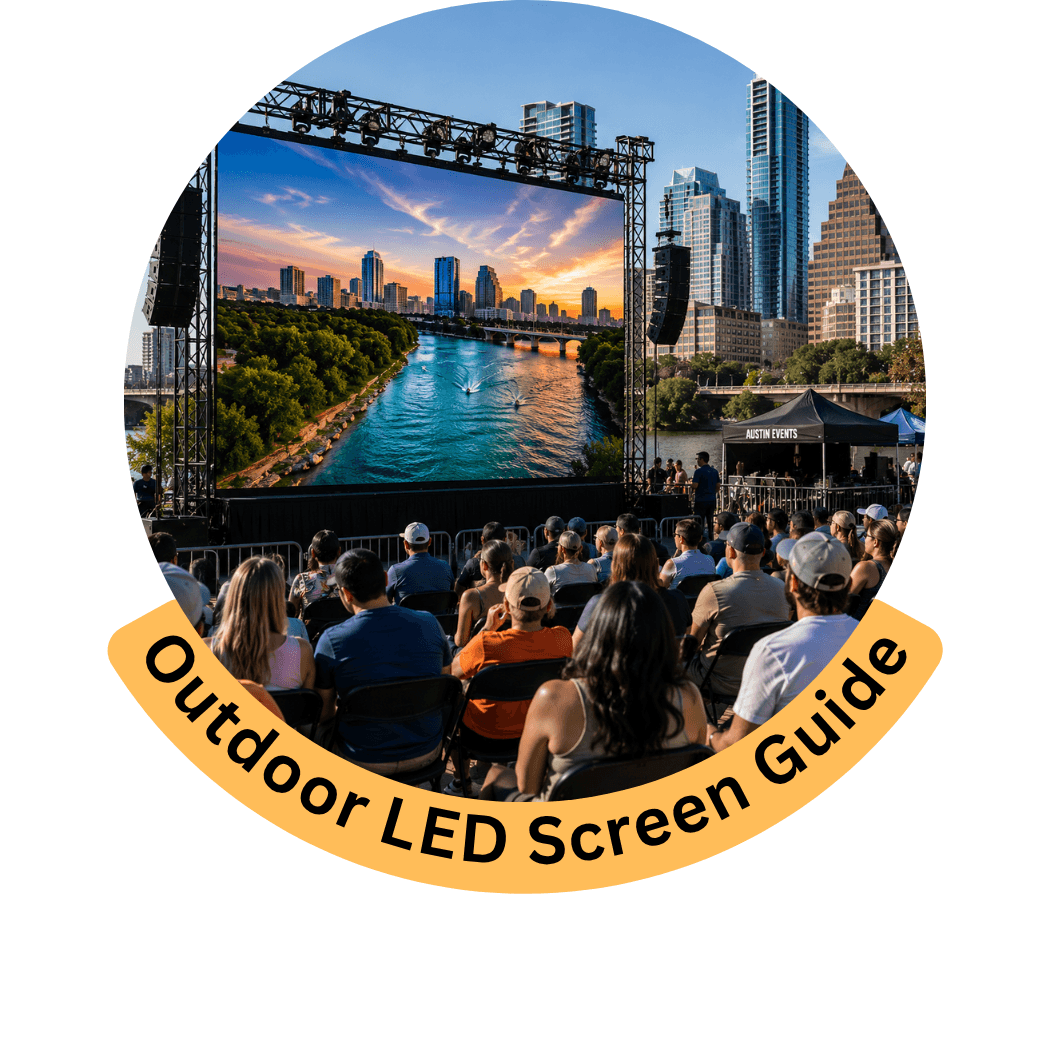
1. What Is an Outdoor LED Screen?
An outdoor LED screen is a high-brightness modular display designed for events where daylight, environmental exposure, longer viewing distances, audience scale, and outdoor installation conditions must be considered.
Outdoor LED systems can be configured in different dimensions and positions depending on the event.
Typical applications include:
- Festivals
- Concerts
- Sporting events
- Fan zones
- Community events
- Outdoor corporate events
- Product launches
- Public viewing
- University events
- Brand activations
- Ceremonies
- Outdoor presentations
Unlike an indoor LED wall, an outdoor system must be planned around the actual site conditions in addition to content and audience requirements.
2. How Do We Configure an Outdoor LED Screen?
We start by reviewing how the screen will be used and the conditions under which it must operate.
| Requirement | What We Evaluate | Why It Matters |
|---|---|---|
| Audience Size | Number and distribution of viewers | Helps establish display scale |
| Viewing Distance | Closest and farthest viewers | Influences size and pixel pitch |
| Daylight | Screen orientation and ambient conditions | Influences required brightness |
| Screen Position | Height, angle and audience direction | Affects visibility and sightlines |
| Site Conditions | Ground, access and installation area | Affects deployment method |
| Environment | Outdoor exposure and operating conditions | Determines suitable equipment |
| Content | Video, IMAG, graphics, scores or presentations | Influences resolution and processing |
| Power | Available electrical infrastructure | Determines distribution requirements |
| Cameras | Live production and IMAG requirements | Affects switching and signal workflow |
| Installation | Modular structure or Mobile LED Trailer | Changes equipment and deployment |
The final configuration is based on the complete production rather than selecting an outdoor screen from dimensions alone.
3. How Bright Should an Outdoor LED Screen Be?
Outdoor LED screens generally require substantially greater brightness than indoor displays because they may operate under daylight and high ambient-light conditions.
However, brightness should not be selected from a single number alone.
We evaluate:
- Time of day
- Screen orientation
- Direct and indirect sunlight
- Audience direction
- Event duration
- Viewing distance
- Content type
- Site environment
- Evening operation
Daytime Events
For daytime events, the LED system needs sufficient output for the content to remain visible under the actual ambient-light conditions.
Screen orientation can be particularly important. A poorly positioned display can be difficult to view even when the LED equipment itself provides high brightness.
Evening Events
As ambient light decreases, maximum daytime brightness may no longer be necessary.
Professional LED control allows output to be adjusted for comfortable viewing while maintaining appropriate image quality.
Day-to-Night Productions
For festivals, sporting events, concerts, and other long-duration productions, screen brightness can be managed as exterior lighting conditions change throughout the event.
4. What Pixel Pitch Should We Use for an Outdoor LED Screen?
Outdoor pixel pitch should be selected according to the viewing distance, screen dimensions, content detail, and required native resolution.
A finer pixel pitch provides greater pixel density, but the finest available outdoor LED is not automatically the correct choice.
We evaluate:
- Closest audience position
- Farthest audience position
- Screen dimensions
- Content detail
- Camera feeds
- Graphics
- Text
- Viewing environment
Shorter Viewing Distances
When attendees can approach relatively close to the outdoor LED wall, a finer-pitch configuration may be appropriate, particularly for detailed graphics or branded content.
Longer Viewing Distances
Large outdoor screens viewed from greater distances may not require extremely fine pixel density.
In these applications, physical screen size, elevation, brightness, and audience coverage can be more important than specifying the smallest pixel pitch.
We therefore determine:
Viewing Distance + Screen Size + Pixel Pitch + Content = Appropriate Outdoor LED Configuration
5. What Size Outdoor LED Screen Do We Need?
Outdoor LED screen size depends primarily on how far the audience is from the display and how widely viewers are distributed across the event site.
We evaluate:
- Audience size
- Audience depth
- Audience width
- Closest viewing position
- Farthest viewing position
- Screen elevation
- Stage dimensions
- Site dimensions
- Content type
- Camera and IMAG requirements
Large Audiences
Large festivals, sporting events, and fan zones may require a large primary display or multiple screens positioned around the event site.
Deep Audiences
For audiences extending far from the stage, increasing screen height and elevation can be important for visibility.
Wide Audiences
For wide audience layouts, multiple LED screens can sometimes provide better coverage than one oversized central display.
The correct outdoor screen is therefore not simply the largest display available. It is the configuration that provides appropriate visibility, viewing angles, content scale, and audience coverage.
6. How Do Weather and Environmental Conditions Affect Outdoor LED?
Outdoor LED equipment must be appropriate for the environment in which it will operate.
We evaluate site and environmental conditions during production planning, including:
- Expected weather
- Temperature
- Wind conditions
- Rain exposure
- Ground conditions
- Drainage
- Screen position
- Structural configuration
- Cable routing
- Electrical distribution
- Equipment protection
- Site access
Rain and Moisture
Outdoor-rated LED equipment is designed for exterior applications, but the complete production includes more than LED cabinets.
Processing, power, connections, control equipment, cabling, and supporting systems also need to be appropriately planned and protected.
Wind
Wind can create significant structural loads on a large LED display.
Screen dimensions, support configuration, elevation, site conditions, and applicable structural requirements must therefore be considered together.
Severe Weather
Outdoor event operation should follow the approved production plan and applicable safety requirements. Conditions may require operational changes when continuing the installation or event would not be appropriate.
7. How Do We Install an Outdoor LED Screen?
The installation method depends on the screen dimensions, event site, audience layout, ground conditions, stage design, required elevation, structural requirements, and access.
Ground-Supported Outdoor LED
A modular outdoor LED wall can be installed using an appropriate ground-support system where the site and production design allow it.
Planning can include:
- Structural support
- Screen elevation
- Approved ballast provisions where applicable
- Power distribution
- Video processing
- Signal cabling
- Equipment protection
- Installation crew
Stage-Integrated LED
For concerts, festivals, ceremonies, and live productions, the LED display may form part of a larger stage production.
We coordinate the LED configuration with the stage, cameras, lighting, audio, video control, and other production systems.
Mobile LED Trailer
A Mobile LED Trailer provides another approach for outdoor events.
The display is integrated into a mobile platform, allowing efficient positioning and deployment without constructing a conventional modular LED wall.
8. When Should We Use a Mobile LED Trailer Instead of a Modular LED Wall?
A Mobile LED Trailer can be particularly useful when rapid deployment, screen elevation, mobility, and reduced on-site construction are important.
| Requirement | Modular Outdoor LED Wall | Mobile LED Trailer |
|---|---|---|
| Screen Configuration | Highly customizable | Based on trailer display dimensions |
| Deployment | Built on site | Mobile self-contained platform |
| Elevation | Designed through support structure | Integrated elevation system |
| Positioning | Determined during structural setup | Trailer positioned at suitable site location |
| Custom Dimensions | Strong flexibility | More standardized |
| Site Access | Equipment and structure need access | Trailer access and positioning required |
| Production Integration | Highly customizable | Can integrate video, cameras and playback |
| Best Application | Custom stages and complex productions | Festivals, sports, fan zones and public events |
Choose a Modular Outdoor LED Wall When:
- Custom screen dimensions are important
- The display is integrated into a stage
- Scenic design requires a specific LED configuration
- Multiple LED surfaces are required
- A highly customized production is planned
Choose a Mobile LED Trailer When:
- Fast deployment is important
- An elevated outdoor screen is required
- The event site provides suitable trailer access
- A self-contained display platform is practical
- The production is a fan zone, festival, sporting event, community event, or public viewing program
Both solutions can integrate with cameras, IMAG, video playback, graphics, presentations, and professional video processing.
9. How Do Cameras and IMAG Work With Outdoor LED Screens?
Outdoor LED screens are frequently used as large-format destinations for live camera feeds and IMAG — Image Magnification. This allows audiences farther from the stage, field, performance area, or presentation platform to see the action clearly.
We plan the complete camera workflow around:
- Number of cameras
- Camera positions
- Audience layout
- Stage or field activity
- LED screen locations
- Video switching
- Graphics
- Playback
- Signal distribution
- Technical control position
A typical workflow can be:
Cameras → Video Switching → Graphics / Playback → Video Processing → Outdoor LED Screen
Live Events & Concerts
For concerts and performances, cameras can capture performers and stage activity while the LED screen provides enlarged live images to the audience.
Sporting Events & Fan Zones
Outdoor LED screens can combine live video with:
- Event graphics
- Scores
- Sponsor content
- Replays where supported by the production workflow
- Announcements
- Branded content
Corporate & Public Events
Cameras and IMAG can also support outdoor presentations, ceremonies, speeches, product launches, university programs, and community events.
10. How Do We Plan Power for an Outdoor LED Screen?
Outdoor LED systems can require significant electrical infrastructure. Power should be calculated from the actual LED configuration and supporting production equipment, not estimated from screen dimensions alone.
We evaluate:
- LED cabinet quantity
- LED system load
- Video processors
- Switching equipment
- Media servers
- Playback systems
- Cameras
- Production control
- Audio equipment
- Supporting technical systems
Venue or Site Power
Where suitable electrical service is available, we verify the capacity and distribution requirements against the planned LED system.
Temporary Power
Some outdoor sites may require temporary power infrastructure when suitable event power is unavailable.
The complete power plan must account for both the LED display and the equipment required to operate the production.
Power Distribution
Electrical distribution is planned around the equipment configuration, cable routes, control position, display location, and site conditions.
We verify power requirements before installation rather than treating electrical planning as a last-minute production detail.
11. How Do We Position Outdoor LED Screens for Better Visibility?
Outdoor screen positioning can be just as important as screen size or brightness.
We evaluate:
- Audience direction
- Audience depth
- Viewing angles
- Screen elevation
- Stage position
- Sun orientation
- Site obstacles
- Camera positions
- Pedestrian circulation
- Equipment access
- Production control location
Screen Elevation
An elevated LED display can improve visibility where standing audiences, barriers, stages, or other site features could obstruct lower sightlines.
Audience Viewing Angle
The screen should be positioned so the primary audience has a practical viewing angle rather than forcing attendees to view the display from an extreme side position.
Multiple Screens
For large or distributed audiences, multiple LED screens may provide better coverage than one extremely large display.
For example:
Outdoor LED ← Main Stage / Event Area → Outdoor LED
The final positioning should be determined from the actual site plan.
12. What Content Works Best on an Outdoor LED Screen?
Outdoor LED content should be designed around the screen dimensions, native resolution, viewing distance, daylight conditions, and audience environment.
Live Camera IMAG
Large images of speakers, performers, athletes, or stage activity work well for audiences viewing from greater distances.
Video Content
Promotional films, event videos, product content, entertainment visuals, and branded media can be mapped to the native LED canvas.
Sponsor Graphics
Sponsor logos and branding should be designed with sufficient scale and contrast for the expected audience distance.
Event Information
Outdoor LED screens can display:
- Schedules
- Announcements
- Event information
- Speaker names
- Scores
- Sponsor messaging
- Public information
Presentations
PowerPoint and other presentation content can be used outdoors, but small text and detailed charts may not be appropriate for audiences viewing from long distances.
We evaluate the content before finalizing the display configuration.
13. How Do Outdoor LED Screens Integrate With Event Production?
The LED screen is often only one part of a larger outdoor production system.
Depending on the event, we can integrate:
Video Processing
Professional processors manage scaling, canvas mapping, source positioning, and final LED output.
Presentation & Video Switching
Switchers can manage cameras, presentations, graphics, videos, playback systems, and other sources.
Media Servers & Playback
Media servers can support motion graphics, branded content, mapped visuals, show sequences, and scheduled playback.
Cameras & IMAG
Professional cameras can provide live audience views of speakers, performers, athletes, and stage activity.
Professional Audio
Audio systems can support microphones, music, presentations, announcements, performances, and program sound.
Event Lighting
Stage and event lighting can be coordinated with LED content and the overall production environment.
Live Streaming
Outdoor events can incorporate cameras, graphics, presentations, program audio, switching, recording, and streaming into one production workflow.
Signal Distribution
We route video signals between cameras, production control, processors, stages, and individual LED destinations.
14. What Outdoor LED Screen Planning Mistakes Do We Help Prevent?
Outdoor LED planning requires the screen, site, audience, structure, power, and production workflow to be considered together.
Choosing Screen Size Only by Audience Count
Audience size alone does not determine the correct display.
We also evaluate audience depth, width, viewing distance, screen elevation, site dimensions, and content.
Selecting Brightness Without Considering Screen Position
High brightness is important outdoors, but screen orientation and ambient conditions also affect visibility.
We evaluate both equipment output and physical positioning.
Ignoring Outdoor Site Access
A modular LED structure, Mobile LED Trailer, production vehicle, and supporting equipment all require suitable access.
Site access should be evaluated before finalizing the system.
Underestimating Power Requirements
Outdoor sites may not provide the same electrical infrastructure available in convention centres or hotels.
We calculate power requirements early and determine how the complete production will be supplied.
Treating the LED Cabinets as the Complete System
An outdoor LED production can also require:
- Structural support
- Video processing
- Power distribution
- Cabling
- Switching
- Playback
- Cameras
- IMAG
- Signal distribution
- Technical crew
These requirements should be included when planning the complete rental scope.
Adding Cameras Too Late
Live cameras affect switching, signal distribution, operators, control positions, monitoring, and LED screen content.
If IMAG is required, it should be incorporated into the initial production design.
15. What Information Do We Need to Plan an Outdoor LED Screen?
You do not need to determine the exact screen size, pixel pitch, brightness, or technical configuration yourself.
Provide the basic event information and we can determine the appropriate system.
| Information | Why We Need It |
|---|---|
| Event Date | Establishes equipment and production schedule |
| Event Location | Helps us evaluate the outdoor environment |
| Audience Size | Helps determine overall display scale |
| Audience Layout | Establishes width, depth and viewing distribution |
| Site Dimensions | Helps determine screen positioning |
| Viewing Distance | Helps determine screen size and pixel pitch |
| Event Hours | Identifies daytime, evening or day-to-night requirements |
| Content Type | Determines resolution and processing requirements |
| Cameras / IMAG | Determines live-video workflow |
| Stage Information | Helps coordinate display position and dimensions |
| Available Power | Helps determine electrical requirements |
| Site Access | Determines equipment and installation logistics |
| Mobile Trailer Access | Determines whether a Mobile LED Trailer is practical |
If complete technical information is not yet available, the event location, audience size, approximate site layout, event hours, and intended screen use are enough to begin planning.
16. What Do We Verify Before Finalizing an Outdoor LED Screen?
Before the outdoor LED system is finalized, we verify the technical and production requirements for the actual event site.
| We Verify | What We Confirm |
|---|---|
| Screen Dimensions | Appropriate physical size for audience and site |
| Pixel Pitch | Suitable pixel density for viewing distance |
| Brightness | Appropriate output for expected viewing conditions |
| Screen Position | Audience visibility, orientation and sightlines |
| Screen Elevation | Required height for effective audience coverage |
| Outdoor Equipment | Suitability for the intended environment |
| Structural Configuration | Appropriate support for the planned installation |
| Power | Required load, available supply and distribution |
| Content Workflow | Video, graphics, presentations and playback |
| Cameras & IMAG | Camera positions, switching and screen destinations |
| Signal Distribution | Routing between control and display locations |
| Site Access | Delivery, installation and equipment movement |
| Production Schedule | Load-in, testing, event operation and strike |
| Technical Crew | Installation, operation and removal requirements |
The final outdoor LED configuration should balance screen size, brightness, pixel pitch, audience visibility, structural requirements, power, content, cameras, and site conditions as one complete event production system.