
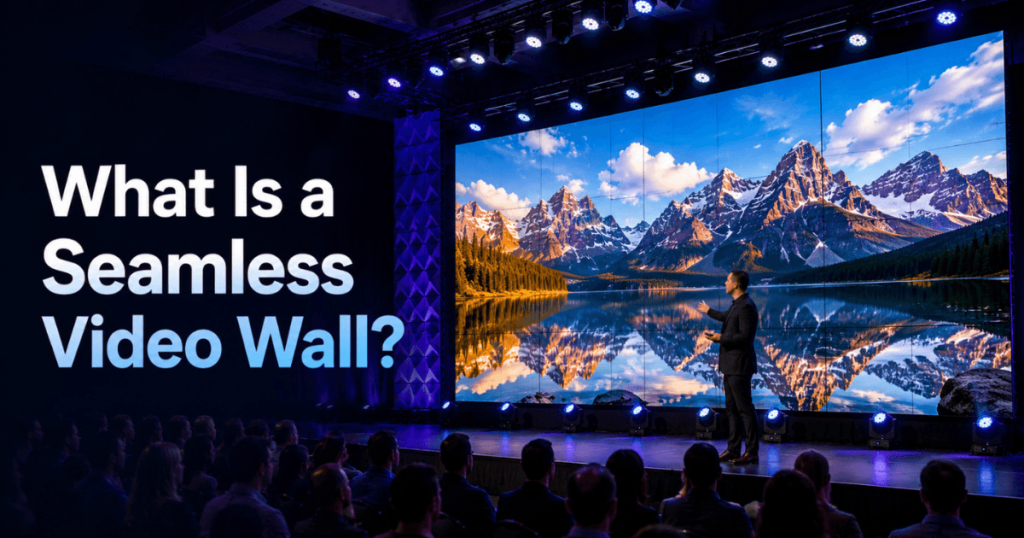
A seamless LED wall is a large-format digital display built by connecting multiple LED panels or cabinets so precisely that they appear to the audience as one continuous video surface. Unlike traditional multi-monitor video walls, there are no thick bezels separating individual screens. When the LED cabinets are correctly aligned, configured, and calibrated, presentations, videos, graphics, and live camera feeds can flow across the entire display without obvious dividing lines.
For events, seamless LED walls are commonly used for conferences, corporate meetings, trade shows, exhibitions, product launches, award ceremonies, galas, concerts, and other large visual productions.
Our Toronto LED screen rental team provides modular LED video wall solutions for events across Toronto and the GTA. With 23+ years of event production experience, we configure the complete system around screen size, viewing distance, pixel pitch, content resolution, cameras, processing, structural support, and venue requirements.
This guide explains what a seamless LED wall is, how it works, what makes LED panels appear seamless, how it compares with LCD video walls, and how to choose the right configuration for an event.
What Does “Seamless” Mean in an LED Wall?
“Seamless” does not mean that an LED wall is manufactured as one enormous display.
Most professional event LED walls are modular.
A large screen may be assembled from many individual:
- LED modules
- LED cabinets
- LED tiles or panels
These components physically connect to create a much larger display.
The key difference is that LED cabinets are designed so the pixel structure continues very close to the edges. When panels are properly installed, the boundaries between them become difficult for the audience to notice under normal viewing conditions.
The result appears to be one large digital canvas rather than several individual monitors.
How Does a Seamless LED Wall Work?
A seamless LED wall combines modular display hardware with video processing, power, data distribution, and professional installation.
A simplified signal workflow looks like this:
Content Source → Video/Presentation System → LED Processor → LED Panels → Complete Image
The content source could be:
- Laptop
- Presentation computer
- Media server
- Video playback system
- Camera switcher
- Livestream system
The LED processor receives the video signal and maps the appropriate portion of the image to each LED cabinet.
Although many physical panels are being used, the audience sees one coordinated image.
What Makes an LED Wall Look Seamless?
Several factors contribute to a seamless appearance.
Precision LED Cabinets
LED cabinets are manufactured so that panels can connect closely together.
Accurate Physical Alignment
Cabinets must be installed correctly. Poor alignment can create visible lines or irregularities.
Consistent Pixel Pitch
The pixel grid needs to continue consistently across the display.
Panel Calibration
Brightness and colour should appear consistent between neighbouring panels.
Proper Video Processing
The LED processor needs to map the image correctly across the complete canvas.
Appropriate Viewing Distance
The audience’s distance from the screen also affects how easily individual pixels or panel boundaries can be perceived.
A seamless result therefore depends on more than simply connecting LED panels together.
Is a Seamless LED Wall Really Completely Seamless?
Physically, the LED wall still contains individual cabinets and modules.
The term seamless describes the visual experience.
At an appropriate viewing distance, a professionally installed LED wall can appear to be one continuous display with no distracting monitor bezels running through the content.
Extremely close inspection may still reveal:
- Individual pixels
- Module boundaries
- Cabinet construction
This is normal for modular LED technology.
The objective is for those physical divisions to become visually insignificant from the intended audience positions.
What Is the Difference Between an LED Panel and a Seamless LED Wall?
An LED panel is one modular component of the larger display.
A seamless LED wall is the complete system created when multiple panels are assembled and configured together.
For example:
Individual LED Cabinet + Multiple Matching Cabinets + Processing + Power + Data + Structure = Complete LED Video Wall
This modular design is one of the major advantages of LED technology.
Instead of being limited to a few standard television sizes, event-production teams can create displays around the required stage and audience environment.
Why Don’t LED Walls Have TV-Style Bezels?
Traditional televisions and LCD monitors have physical frames around their display surfaces.
When several monitors are placed together, these frames create lines through the image.
Direct-view LED technology works differently.
The LED pixels extend across modular display surfaces designed specifically to connect with neighbouring panels.
This allows the visible image to continue across cabinet boundaries without the prominent black frames associated with conventional multi-monitor walls.
That is one of the primary reasons LED has become popular for large event stages.
Seamless LED Wall vs LCD Video Wall
The difference becomes particularly clear when comparing modular LED with tiled LCD displays.
| Feature | Seamless LED Wall | LCD Video Wall |
|---|---|---|
| Display Construction | Modular LED cabinets | Multiple LCD monitors |
| Visible Bezels | Minimal visual interruption | Bezel lines between displays |
| Screen Size | Highly scalable | Limited by monitor arrangement |
| Custom Aspect Ratios | Flexible | More restricted |
| Large Stage Use | Excellent | Application-dependent |
| Close Viewing | Depends on pixel pitch | High pixel density |
| Creative Shapes | Possible with suitable LED | Limited |
| Brightness | Product-dependent, often strong | Product-dependent |
| Event Scalability | High | More limited |
| Content Canvas | Continuous visual surface | Divided by monitor bezels |
LCD video walls still have useful applications, particularly where viewers are close and the installation suits standard monitor dimensions.
For large event stages, LED provides much greater flexibility.
Why Are Seamless LED Walls Popular for Events?
Large events frequently need one visual surface that can handle several types of content throughout the program.
A seamless LED wall can display:
- PowerPoint presentations
- Keynote slides
- Videos
- Live cameras
- IMAG
- Sponsor graphics
- Event branding
- Product demonstrations
- Motion graphics
- Remote presenters
Because the display behaves as one large canvas, the production team can also create different content layouts without physical monitor bezels cutting through the image.
How Does Pixel Pitch Affect a Seamless LED Wall?
Pixel pitch is the distance between neighbouring LED pixels, usually expressed in millimetres.
Examples include:
- P1.5
- P1.9
- P2
- P2.5
- P2.6
- P2.9
- P3.9
Smaller pixel pitches place pixels closer together.
This can improve perceived image smoothness when the audience is close to the display.
For example, an executive conference with attendees sitting relatively close to the stage may benefit from finer-pitch LED than a large concert where viewers are much farther away.
Pixel pitch should therefore be selected according to:
Viewing Distance + Content Detail + Screen Size + Audience Layout + Budget
Does a Smaller Pixel Pitch Make the Wall More Seamless?
It can improve the visual smoothness of the image from close distances, but pixel pitch is not the only factor.
A fine-pitch LED wall can still look poor if:
- Cabinets are misaligned
- Modules have inconsistent brightness
- Colour calibration is poor
- Processing is incorrect
- Content resolution is unsuitable
Likewise, a larger-pitch display can appear very smooth when viewed from an appropriate distance.
Seamlessness is the result of the complete display system, not a single specification.
How Does Viewing Distance Affect the Seamless Appearance?
Viewing distance is extremely important.
When an attendee stands very close to an LED wall, the individual LED pixels become easier to identify.
As the viewer moves farther away, those pixels visually blend together and create a smoother image.
This is why the same LED product can appear different in:
- A small meeting room
- A conference ballroom
- A trade show booth
- A large arena
- An outdoor festival
The closest audience position should be considered when selecting pixel pitch.
What Resolution Does a Seamless LED Wall Have?
A seamless LED wall does not automatically have a standard resolution such as 1920×1080 or 3840×2160.
Its native resolution depends on:
- Pixel pitch
- Individual panel resolution
- Number of panels horizontally
- Number of panels vertically
Adding LED cabinets increases the physical dimensions and usually increases the total pixel canvas.
Using a finer pixel pitch can place more pixels within the same physical screen area.
This is why event LED resolution should be calculated from the actual wall configuration.
Can a Seamless LED Wall Be 16:9?
Yes.
A modular LED wall can be designed around a 16:9 or near-16:9 format when appropriate for the equipment and stage.
This can be useful for:
- Standard video
- PowerPoint
- Livestream content
- Camera IMAG
- Corporate presentations
However, one major advantage of modular LED is that the screen does not always need to follow a standard television shape.
It can also be configured as:
- Ultra-wide stage backdrop
- Tall vertical display
- Multiple coordinated screens
- Creative scenic display
- Custom content canvas
The final dimensions should be planned around the content and event design.
Can PowerPoint Be Displayed on a Seamless LED Wall?
Yes.
PowerPoint is one of the most common content sources for corporate and conference LED walls.
A typical production workflow may be:
Presentation Laptop → Presentation Switcher → LED Processor → Seamless LED Wall
For good presentation results, planners should consider:
- LED wall resolution
- Aspect ratio
- Pixel pitch
- Font size
- Viewing distance
- Presentation layout
A seamless screen eliminates bezel lines that might otherwise pass through text, charts, or images.
Can Live Cameras Be Displayed on a Seamless LED Wall?
Yes.
Live cameras can be integrated through an event video system.
A simplified workflow is:
Cameras → Video Switcher → LED Processor → LED Wall
This allows the wall to display IMAG, or Image Magnification, so attendees farther from the stage can see speakers, performers, demonstrations, or other live activity.
This is useful for:
- Conferences
- Award ceremonies
- Concerts
- Product launches
- Galas
- Sporting events
- Large corporate meetings
Camera compatibility should be considered when configuring the LED wall, processor, brightness, refresh performance, and stage lighting.
Can a Seamless LED Wall Show Multiple Sources?
Yes.
A large LED canvas can be divided into several content zones when supported by the production and processing system.
For example:
| Screen Area | Content |
|---|---|
| Left | Speaker IMAG |
| Centre | Presentation |
| Right | Event branding |
| Lower Section | Sponsor graphics |
Another event might display two camera feeds alongside presentation content.
Because there are no prominent monitor bezels crossing the display, these layouts can be visually clean and flexible.
Are Seamless LED Walls Good for Conferences?
Yes.
Conferences are one of the strongest applications for seamless LED walls because the same screen may need to support multiple content formats throughout the day.
Typical conference content includes:
- PowerPoint
- Keynote slides
- Speaker IMAG
- Videos
- Sponsor content
- Session titles
- Remote speakers
- Event branding
Fine-pitch indoor LED can also provide the detail needed for presentation-heavy environments.
Are Seamless LED Walls Good for Trade Shows?
Yes.
Trade show displays often need to create visual impact while also looking good from close distances.
Seamless LED walls can be used for:
- Product videos
- Brand presentations
- Demonstrations
- Motion graphics
- Product launches
- Booth backdrops
- Digital branding
Fine-pitch displays can be particularly useful because visitors may approach the LED wall closely.
Are Seamless LED Walls Good for Product Launches?
Product launches can benefit significantly from seamless LED because the display can become part of the entire stage design.
The wall can show:
- Product close-ups
- Launch films
- Technical animations
- Product specifications
- Live demonstrations
- Camera IMAG
- Brand graphics
Ultra-wide or custom LED canvases can also create more immersive launch environments than a conventional fixed-format screen.
Are Seamless LED Walls Suitable for Concerts?
Yes.
Large LED video walls are widely suited to concert and entertainment environments where screens may be used for:
- IMAG
- Music visuals
- Motion graphics
- Artist content
- Sponsor graphics
- Scenic backgrounds
For larger audiences, physical screen size and viewing distance may become more important than extremely fine pixel pitch.
Indoor and outdoor concerts also require different LED specifications.
How Are Seamless LED Walls Installed?
Event LED walls can be installed using different professional support methods depending on the venue and production design.
Ground-Supported LED Wall
The LED display is supported using an appropriate structure from the stage, floor, or another engineered support system.
This can be useful where rigging is unavailable or unnecessary.
Rigged LED Wall
In suitable venues, LED displays may be suspended using venue-approved professional rigging systems.
Rigging can help with:
- Stage space
- Screen elevation
- Audience sightlines
- Large production designs
The appropriate method depends on the screen weight, dimensions, venue, structural requirements, and production design.
Installation and rigging should be handled by qualified professionals.
What Can Make an LED Wall Look Less Seamless?
Several issues can reduce the quality of the final image.
Poor Cabinet Alignment
Even small physical differences can make panel boundaries more noticeable.
Damaged or Uneven Modules
A module with different brightness or colour characteristics can stand out.
Inconsistent Calibration
Neighbouring panels should produce visually consistent colour and brightness.
Incorrect Screen Mapping
Processing errors can place content incorrectly across cabinets.
Wrong Pixel Pitch
A coarse pixel pitch viewed too closely can make the display structure more noticeable.
Poor Content Resolution
Low-quality graphics and video can make a premium LED wall look less impressive.
Incorrect Brightness
Brightness that does not suit the venue can reduce perceived image quality.
How We Plan a Seamless LED Wall for Toronto Events
Our configuration process begins with the event rather than simply selecting panels.
1. Review the Venue
We consider stage dimensions, audience layout, installation location, access, and available production conditions.
2. Determine Screen Size
The LED wall needs enough physical scale for the audience.
3. Select Pixel Pitch
We match pixel density to viewing distance and content requirements.
4. Calculate the LED Canvas
The final panel configuration determines the native display resolution.
5. Plan Content
PowerPoint, videos, IMAG, branding, and custom layouts are considered.
6. Design Video Processing
The system is configured to map content correctly across the LED canvas.
7. Plan Structural Support
Ground support or venue-approved rigging is coordinated as appropriate.
8. Install and Align the Panels
Cabinets are assembled into the required screen configuration.
9. Configure and Test the Display
Processing, mapping, brightness, content, and signal paths are checked.
10. Rehearse the Production
Presentations, videos, cameras, and show cues can be tested before the audience arrives.
Seamless LED Wall Selection Guide
| Event Requirement | Recommended Consideration |
|---|---|
| Close audience | Fine pixel pitch |
| Detailed PowerPoint | Fine pitch + sufficient resolution |
| Large ballroom | Screen dimensions + sightlines |
| Live cameras | IMAG + processing + camera coordination |
| Trade show booth | Fine pitch + close-view quality |
| Product launch | Fine detail + custom content canvas |
| Gala | Stage integration + IMAG |
| Concert | Large screen + cameras |
| Creative stage | Custom dimensions + media playback |
| Outdoor event | Outdoor-rated LED + brightness + structural planning |
The right configuration depends on the combination of these requirements rather than one specification.
Common Seamless LED Wall Planning Mistakes
Assuming Every LED Wall Is Equally Seamless
Panel quality, installation, alignment, calibration, and processing all matter.
Choosing Pixel Pitch Without Considering Viewing Distance
Fine pitch should solve an actual viewing requirement.
Making the Wall Too Small
High resolution cannot compensate for insufficient physical screen size for a large audience.
Ignoring Content Resolution
The content needs to be prepared for the actual LED canvas.
Treating the Wall Like a Large Television
Event LED walls require processing, power, data, structural support, and production integration.
Forgetting About Cameras
Camera performance should be considered for IMAG, recording, and livestreaming.
Ignoring Panel Calibration
Visible differences between cabinets can reduce the seamless appearance.
Skipping Content Testing
PowerPoint, videos, graphics, and live sources should be checked before the event.
Seamless LED Wall Sizes and Configurations
One of the biggest advantages of a seamless LED wall is modular sizing.
Unlike televisions or standard projection screens, LED walls are assembled from individual cabinets. This allows the overall display dimensions to be configured around the stage, room, audience, and content.
A seamless LED wall can be designed as:
- Standard widescreen display
- Large 16:9-style screen
- Ultra-wide stage backdrop
- Tall vertical display
- Multiple coordinated LED walls
- Custom scenic display
- Large exhibition booth wall
The available dimensions ultimately depend on the specific LED cabinet size and system being used.
For event planning, the goal should not simply be to build the largest possible screen. The display should be large enough for the audience while remaining appropriate for the venue and content.
How Large Should a Seamless LED Wall Be?
Screen size should primarily be determined by audience viewing requirements.
Important factors include:
- Closest viewer
- Farthest viewer
- Audience width
- Audience depth
- Stage dimensions
- Ceiling height
- Content type
- Camera use
- Venue layout
For example, a smaller fine-pitch wall may work well for an executive meeting where everyone is relatively close.
A large conference ballroom with hundreds of attendees may require a much larger display so people near the back can comfortably see presentations and IMAG.
A common mistake is concentrating entirely on resolution while ignoring physical screen size.
A high-resolution screen can still be too small for the audience.
Does a Seamless LED Wall Need to Be 16:9?
No.
This is one of the major creative advantages of modular LED technology.
A 16:9-style configuration works well when the event primarily displays standard:
- PowerPoint presentations
- Videos
- Camera feeds
- Livestream content
But LED panels can also create wider or taller canvases.
An ultra-wide conference stage might use the centre for presentation content while the surrounding canvas carries branding, motion graphics, speaker information, or IMAG.
For example:
IMAG | Presentation | IMAG
or:
Branding | Camera | Presentation | Camera | Branding
This can transform the LED wall from a simple screen into part of the overall stage design.
What Pixel Pitch Is Best for a Seamless LED Wall?
There is no universal best pixel pitch.
The appropriate option depends mainly on viewing distance, screen dimensions, content detail, and event type.
| Pixel Pitch | General Viewing Environment | Typical Use |
|---|---|---|
| P1.5–P1.9 | Very close | Premium corporate displays |
| P2–P2.6 | Close to medium | Conferences, trade shows |
| P2.9 | Medium | Larger meetings and stages |
| P3.9 | Medium to longer | Large stages and entertainment |
These are planning categories rather than fixed distance rules.
For detailed PowerPoint presentations, product demonstrations, and close-view trade shows, finer pitch can be valuable.
For a large concert screen viewed from farther away, physical size may provide more practical value than extremely fine pixel density.
Does Fine-Pitch LED Look More Seamless?
From close viewing distances, fine-pitch LED generally creates a smoother perceived image because the pixels are positioned more closely together.
This can be particularly useful for:
- Corporate presentations
- Medical conferences
- Financial events
- Technology conferences
- Product launches
- Trade show booths
- Executive meetings
However, fine pixel pitch cannot correct poor installation.
The final seamless appearance still depends on:
- Cabinet alignment
- Module consistency
- Calibration
- Processing
- Content quality
- Appropriate brightness
A properly installed P2.6 display can provide a better event experience than a poorly configured P1.9 wall.
How Is Resolution Planned for a Seamless LED Wall?
Resolution is calculated from the actual LED configuration.
The production team needs to know:
- Resolution of each LED cabinet
- Number of cabinets across
- Number of cabinets vertically
These values determine the final native pixel canvas.
For example, if the completed LED wall has a custom ultra-wide resolution, content can be created specifically for that canvas rather than simply stretching a standard 16:9 graphic across it.
This is particularly important for:
- Product launches
- Large conference stages
- Creative corporate events
- Award ceremonies
- Entertainment productions
Content and LED design should ideally be coordinated before the event.
Can You Display 1080p Content on a Seamless LED Wall?
Yes.
Standard HD content can be processed and scaled for an LED wall.
However, the physical LED wall does not need to have exactly 1920×1080 native pixels.
The LED processor can map and scale source content for the available canvas.
For presentation-heavy events, the important question is whether the final result provides sufficient detail for the audience.
The complete workflow may look like:
1080p Presentation Source → Video Switcher → LED Processor → Custom LED Canvas
Professional processing ensures that the source is correctly displayed across the modular screen.
Can a Seamless LED Wall Be 4K?
Yes, an LED wall can be configured with enough pixels to create a 4K-class native canvas, but this can require a substantial physical display depending on pixel pitch.
A 4K source and a 4K LED canvas are also two different things.
A laptop can send 4K content even when the LED wall itself has a different native resolution. The processing system then handles the required scaling and mapping.
For event applications, pursuing 4K should not automatically take priority over:
- Appropriate physical screen size
- Viewing distance
- Pixel pitch
- Content
- Budget
The audience experience matters more than achieving a particular specification on paper.
How Should PowerPoint Be Designed for a Seamless LED Wall?
PowerPoint should be created with the actual viewing environment in mind.
Useful considerations include:
- Large, readable fonts
- Strong contrast
- Clean layouts
- High-resolution graphics
- Limited small text
- Appropriate aspect ratio
- Safe positioning of important information
If the LED wall uses an ultra-wide custom canvas, standard PowerPoint may occupy only one section of the display.
The remaining canvas can carry event graphics or IMAG.
This allows presentations to remain in a familiar format without wasting the creative potential of the larger LED wall.
Can Seamless LED Walls Be Curved?
Some modular LED systems can support curved configurations when the specific equipment is designed for that purpose.
Curved LED can be used to create:
- Immersive stage backgrounds
- Exhibition displays
- Product-launch environments
- Scenic installations
- Brand experiences
The curve cannot simply be added to any LED panel system.
Cabinet design, structural support, viewing angles, content mapping, and installation requirements all need to support the intended configuration.
What Is a Creative Seamless LED Wall?
A creative LED wall moves beyond the conventional rectangular screen.
Depending on the available equipment, event design can incorporate:
- Ultra-wide LED walls
- Vertical LED columns
- Multiple synchronized screens
- Curved displays
- Corner configurations
- Scenic LED elements
- Kinetic LED displays
- Other custom visual arrangements
Creative displays can be particularly effective for:
- Product launches
- Fashion shows
- Brand activations
- Concerts
- Award ceremonies
- Exhibitions
- Experiential events
Content design becomes especially important because standard 16:9 videos may not naturally fit these canvases.
Can Multiple LED Walls Work as One System?
Yes.
A production may use several LED displays that receive content from the same video-control environment.
For example, a conference could have:
- Main centre LED wall
- Left IMAG screen
- Right IMAG screen
- Supporting lobby displays
A larger production might distribute synchronized or independent content across several LED canvases.
Video processors, switchers, media servers, and signal-distribution systems can be configured according to the required workflow.
This creates flexibility beyond one physical screen.
Are Seamless LED Walls Suitable for Outdoor Events?
Yes, when the LED product and complete system are designed and rated for the outdoor environment.
Outdoor seamless LED walls may be used for:
- Concerts
- Festivals
- Sporting events
- Fan zones
- Community events
- Outdoor ceremonies
- Public events
Outdoor installations introduce additional considerations, including:
- Daylight brightness
- Environmental protection
- Weather
- Wind
- Power
- Structural requirements
- Screen orientation
An indoor LED product should not be assumed suitable for outdoor exposure simply because it uses the same modular display concept.
Indoor vs Outdoor Seamless LED Walls
| Feature | Indoor Seamless LED | Outdoor Seamless LED |
|---|---|---|
| Viewing Distance | Often closer | Often farther |
| Pixel Pitch | Usually finer | Often larger |
| Brightness | Controlled | Much higher |
| Weather Protection | Limited/product-specific | Outdoor-rated |
| Detailed PowerPoint | Excellent | Application-dependent |
| Daylight Visibility | Not primary requirement | Critical |
| Typical Events | Conferences, trade shows | Festivals, sports |
| Structural Planning | Venue-based | Site and weather dependent |
Both technologies can create large continuous images, but they are engineered around different operating environments.
Seamless LED Wall vs Projector
Projection and direct-view LED create images in fundamentally different ways.
A projector sends light onto a separate projection surface.
A seamless LED wall generates the image directly from its own pixels.
| Feature | Seamless LED Wall | Projection |
|---|---|---|
| Image Source | Direct-view LEDs | Projected light |
| Modular Sizing | Highly flexible | Screen-dependent |
| Visible Panel Bezels | Minimal | Not applicable |
| Bright Ambient Light | Strong with suitable LED | More challenging |
| Custom Aspect Ratio | Highly flexible | Possible but setup-dependent |
| Projector Beam | None | Required |
| Stage Integration | Excellent | Application-dependent |
| Setup Complexity | Modular installation | Projector + surface + positioning |
Projection remains useful for many breakout rooms, meetings, and other event environments.
LED becomes particularly attractive when large visual scale, modular sizing, brightness, or creative stage integration is important.
Seamless LED Wall vs Large TV
Large televisions can be effective for:
- Small meetings
- Breakout rooms
- Confidence monitors
- Digital signage
- Small exhibition applications
However, television dimensions are fixed.
A modular LED wall can scale much further.
For example, instead of choosing between fixed 75-inch or 98-inch displays, an LED system can be configured around the actual stage dimensions.
LED also eliminates the need to place multiple televisions together with visible frames separating them.
What Events Benefit Most From Seamless LED Walls?
Conferences
Ideal for presentations, IMAG, videos, remote speakers, and branding.
Corporate Events
Useful for executive presentations, internal meetings, announcements, and branded stage environments.
Trade Shows
Fine-pitch LED can create high-impact booth displays with close-view image quality.
Product Launches
Custom LED canvases can combine product visuals, cameras, animations, and branding.
Award Ceremonies
LED can support nominee graphics, IMAG, videos, sponsor content, and scenic backgrounds.
Galas
Large seamless displays can integrate video content with elegant stage design.
Concerts
Large LED walls provide IMAG and entertainment visuals for audiences farther from the stage.
Fashion Shows
Wide or creative LED canvases can provide branded and scenic visual environments.
How Much Does a Seamless LED Wall Rental Cost?
There is no single fixed rental price because the final system depends on several technical and production requirements.
Major cost factors include:
- Physical screen dimensions
- Pixel pitch
- LED product
- Number of panels
- Rental duration
- Ground support or rigging
- Video processing
- Presentation switching
- Cameras and IMAG
- Media servers
- Signal distribution
- Delivery
- Installation
- Technical labour
- On-site operation
- Venue logistics
Fine-pitch LED can cost more because a given screen area contains substantially more pixels and may use more specialized equipment.
A large P3.9 screen and a smaller P1.9 screen therefore should not be compared only by square footage.
Is Fine-Pitch Seamless LED Worth the Extra Cost?
It can be when the audience will actually benefit from the additional pixel density.
Fine-pitch LED is particularly valuable when:
- Attendees are close
- PowerPoint contains detailed information
- Products need to be shown clearly
- Screen dimensions are relatively compact
- Premium image quality is important
It may provide less practical value when:
- The audience is very far away
- The screen is extremely large
- Content is primarily IMAG
- Large-format visibility matters more than close detail
The objective should be to choose enough resolution—not simply the smallest available pixel pitch.
Seamless LED Wall Selection Table
| Requirement | Recommended Priority |
|---|---|
| Close-view conference | Fine pixel pitch |
| PowerPoint-heavy event | Resolution + readable screen size |
| Trade show booth | Fine pitch + close-view quality |
| Large ballroom | Physical size + sightlines |
| Product launch | Fine detail + creative canvas |
| IMAG | Screen size + camera integration |
| Award ceremony | Scenic integration + video |
| Concert | Large-format visibility |
| Outdoor festival | Brightness + outdoor-rated LED |
| Creative event | Custom configuration + content mapping |
| Livestreamed event | Camera performance + processing |
| Multi-screen production | Signal distribution + control |
Frequently Asked Questions About Seamless LED Walls
What is a seamless LED wall?
A seamless LED wall is a modular display built from multiple LED panels that visually form one continuous digital canvas without prominent monitor bezels dividing the image.
Are there really no seams between LED panels?
Physical cabinet boundaries still exist, but properly designed and installed LED panels can make those boundaries visually insignificant from the intended viewing distance.
What pixel pitch is best for a seamless LED wall?
It depends on viewing distance, screen dimensions, content, and event type. Fine-pitch options such as P1.9, P2, P2.5, or P2.6 may be useful for close-view indoor events.
Can a seamless LED wall display PowerPoint?
Yes. PowerPoint, Keynote, video, graphics, websites, and other presentation sources can be routed through the production and processing system to the LED wall.
Can seamless LED walls show live cameras?
Yes. Camera feeds can be switched and displayed as IMAG across the complete LED canvas or within selected content zones.
Can an LED wall be larger than 16:9?
Yes. Modular LED can create ultra-wide, vertical, and other custom configurations when supported by the equipment and production design.
Can seamless LED walls be curved?
Some LED systems support curved configurations. The cabinets, structure, processing, and content must all be suitable for the required curve.
Can seamless LED walls be used outdoors?
Yes, provided the specific LED equipment and complete installation are appropriately designed and rated for outdoor conditions.
Is a seamless LED wall better than a projector?
It depends on the event. LED can offer modular sizing, direct-view brightness, custom dimensions, and strong stage integration. Projection can remain practical for breakout rooms and other applications where its characteristics suit the venue and budget.
How early should I plan a seamless LED wall rental?
Planning early is recommended, especially for large conferences, trade shows, product launches, custom stage designs, outdoor events, or productions requiring rigging, cameras, custom content, or multiple LED screens.
Why Choose Our Toronto LED Screen Rental Team?
A seamless LED wall is not created simply by placing LED panels next to each other. The final result depends on how the panels, alignment, pixel pitch, processing, content, structure, cameras, power, and signal distribution work together.
Our Toronto LED screen rental capabilities include:
- Fine-pitch seamless LED video walls
- Large-format LED displays
- Custom and ultra-wide LED configurations
- Outdoor LED screens
- Creative LED displays
- Video processors
- Presentation switching
- Media servers and playback
- Cameras and IMAG
- Signal distribution
- Ground-support planning
- Rigging coordination
- Content testing
- Rehearsal support
- Live technical operation
- Professional installation and removal
With 23+ years of event production experience, we support conferences, corporate events, trade shows, exhibitions, product launches, galas, award ceremonies, fashion shows, concerts, and other productions throughout Toronto and the GTA.
A properly configured seamless LED wall gives event planners something conventional multi-monitor displays cannot easily provide: one scalable, continuous visual canvas that can be designed around the stage, audience, and content rather than forcing the event to fit a fixed screen size.