
Truss-Hung LED Screen Guide
We provide professional LED Screen Rental Services in Toronto and across the GTA for conferences, corporate events, trade shows, exhibitions, product launches, galas, award ceremonies, concerts, and large live productions. With 23+ years of event production experience, we configure truss-hung LED screens around the venue, screen dimensions, audience sightlines, stage design, approved rigging infrastructure, power, video workflow, and production schedule.
Our capabilities include fine-pitch indoor LED walls, outdoor LED displays, truss-hung and ground-supported configurations, video processing, cameras, IMAG, presentation switching, media servers, signal distribution, professional audio, lighting, and live streaming. A suspended LED wall requires more than assembling LED cabinets. Structural planning, rigging coordination, screen weight, elevation, power, signal routing, installation sequence, and qualified personnel must be considered as one complete production system.
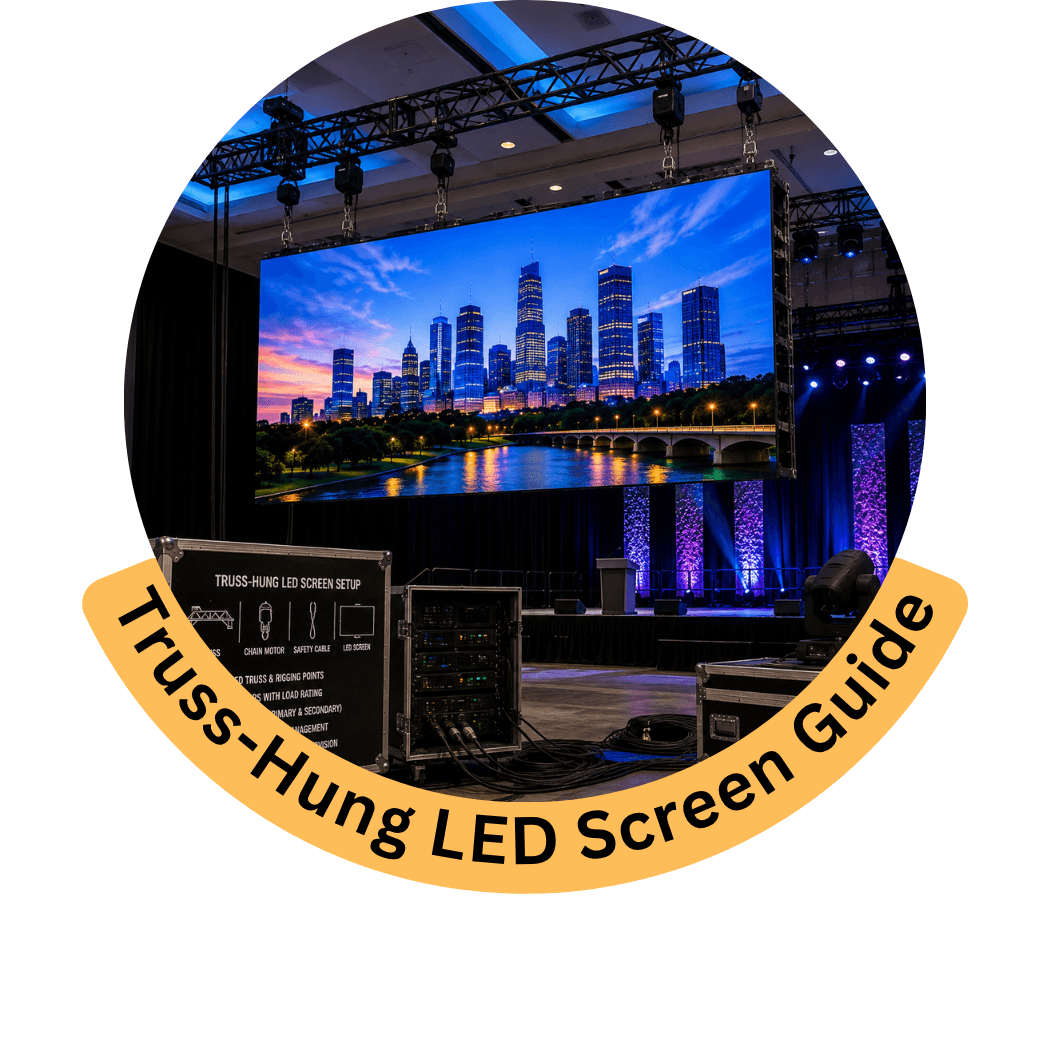
1. What Is a Truss-Hung LED Screen?
A truss-hung LED screen is an LED display suspended from an approved overhead rigging system rather than supported directly from the floor.
Depending on the production, the system can include:
- LED cabinets
- LED hanging hardware
- Truss
- Approved rigging hardware
- Hoists or lifting systems
- Power distribution
- LED controllers
- Video processors
- Signal distribution
- Safety and structural provisions appropriate to the installation
Truss-hung LED can be useful when a production requires greater elevation, clear stage space, improved audience sightlines, or integration with a larger event rigging system.
2. When Should We Use a Truss-Hung LED Wall?
We determine whether a suspended display is appropriate after reviewing the venue and production requirements.
| Requirement | Why Truss-Hung LED May Be Considered |
|---|---|
| Clear Floor Space | Removes conventional ground-support structure from the stage area |
| Screen Elevation | Allows the display to be positioned higher for audience visibility |
| Large Audience | Can improve sightlines across deeper rooms |
| Scenic Design | Allows LED to integrate with overhead production elements |
| Wide Stage | Can position screens independently of stage-floor structures |
| Side IMAG Screens | Allows elevated displays beside a main stage |
| Trade Show Booth | Can preserve usable booth floor space where approved |
| Complex Production | Can integrate with lighting, audio and scenic rigging plans |
Truss-hung LED is not automatically preferable to ground-supported LED. The appropriate method depends on the venue, structural conditions, display design, schedule, and production scope.
3. What Do We Evaluate Before Suspending an LED Screen?
Before a truss-hung configuration is finalized, we review the complete installation environment.
We evaluate:
- LED wall dimensions
- Complete system weight
- Proposed screen position
- Required elevation
- Venue ceiling height
- Approved rigging locations
- Audience sightlines
- Stage dimensions
- Lighting positions
- Audio positions
- Scenic elements
- Power requirements
- Signal routing
- Load-in schedule
- Installation and removal requirements
Screen Dimensions
The physical width and height affect the LED cabinet quantity, total load, support configuration, and screen position.
Complete System Weight
Rigging planning must consider the relevant suspended equipment rather than only the visible LED panels.
Venue Infrastructure
Not every event space can support the same suspended configuration. Venue rigging information and applicable structural requirements need to be reviewed before the installation method is confirmed.
4. How Is a Truss-Hung LED Screen Supported?
The exact support configuration depends on the LED product, screen dimensions, venue infrastructure, and approved rigging design.
A simplified system relationship can be:
Approved Building / Venue Rigging Infrastructure
↓
Rigging System / Hoists
↓
Truss or Approved Support
↓
LED Hanging Hardware
↓
LED Cabinets
The actual rigging arrangement must be determined for the specific production by the appropriate qualified professionals.
LED Hanging Hardware
Professional rental LED cabinets typically use compatible hanging or structural hardware designed for the selected display system.
Truss
Truss may provide a support interface for the LED display and help distribute the system according to the approved rigging design.
Hoists
Suitable lifting equipment can be used as part of the approved installation process to position the display at its required elevation.
5. How Do We Determine the Weight of a Truss-Hung LED Wall?
The suspended load is not determined from LED wall area alone.
Planning can include the weight of:
- LED cabinets
- Hanging hardware
- Truss
- Rigging hardware
- Cabling
- Power distribution components
- Other suspended equipment associated with the configuration
A simplified planning relationship is:
LED Cabinet Weight × Cabinet Quantity + Supporting Suspended Equipment = System Load
The actual load calculation should use the specifications of the equipment selected for the production.
Why Weight Matters
Increasing LED wall dimensions generally increases:
- Cabinet quantity
- Display weight
- Support requirements
- Installation labor
- Power requirements
- Cable requirements
This is why screen dimensions and rigging should be planned together rather than treating rigging as a decision made after the LED wall has already been specified.
6. How High Should a Truss-Hung LED Screen Be?
There is no single correct LED screen height for every event.
We determine screen elevation from:
- Audience layout
- Stage height
- Closest audience position
- Farthest audience position
- Screen dimensions
- Presenter positions
- Camera sightlines
- Scenic elements
- Ceiling height
- Venue infrastructure
Audience Sightlines
The screen should be positioned high enough to reduce obstruction while remaining comfortable for attendees to view.
Stage Integration
For conferences and corporate events, the LED wall may need to work visually with the stage, lectern, scenic elements, lighting, and presenters.
Side IMAG Screens
Suspended side screens can be positioned to improve visibility for attendees who cannot clearly see the main stage or central display.
The final elevation should therefore be based on the actual room and audience geometry, not a generic height recommendation.
7. How Do We Coordinate Truss-Hung LED With Lighting and Audio?
Large productions can have LED, lighting, audio, scenic, and other equipment sharing the overhead production environment.
Coordination is therefore essential.
We review:
- LED positions
- Lighting trusses
- Lighting fixtures
- Speaker arrays
- Scenic elements
- Projection equipment
- Cameras
- Cable routes
- Rigging locations
- Required elevations
Production Layout
The LED wall should not be planned independently from lighting and audio.
For example:
Lighting System
LED Display / Video
Audio System
Scenic Elements
may all require overhead positions within the same production area.
Installation Sequence
The order in which equipment is installed can affect the entire load-in schedule. Rigging, LED, lighting, audio, and scenic teams should therefore work from a coordinated production plan.
8. How Do We Connect Power and Video Signal to a Truss-Hung LED Screen?
A suspended LED wall still requires power, LED data, and video signals from the production system.
A simplified video workflow can be:
PowerPoint + Playback + Cameras → Video Switching → Video Processing → LED Controller → Truss-Hung LED Wall
The electrical workflow can be planned as:
Event Power → Distribution → LED Power Feeds → Suspended LED System
Power Cabling
Power requirements are calculated from the selected LED product, cabinet quantity, and supporting equipment.
Cable routing must account for the elevated display and approved production layout.
LED Data
LED data is distributed across the cabinet configuration according to the mapped screen layout.
Video Signal
The processor maps presentations, videos, graphics, cameras, and IMAG to the native LED canvas.
Cable Management
Power and signal cabling should be incorporated into the installation plan rather than added after the screen has been suspended.
This allows the physical display, power system, video processing, and production control to operate as one coordinated system.
9. How Do Cameras and IMAG Work With Truss-Hung LED Screens?
Truss-hung LED screens are often used as main presentation displays or elevated IMAG screens for conferences, corporate events, galas, concerts, and other large productions.
A typical video workflow can be:
Cameras → Video Switching → Video Processing → Truss-Hung LED Screens
When presentations and other sources are included:
PowerPoint + Playback + Graphics + Cameras → Video Switching → Processing → Main LED + Side LED Screens
Side IMAG Screens
Suspended side screens can provide enlarged camera images for attendees positioned farther from the stage.
A common configuration is:
Truss-Hung IMAG Screen ← Main Stage / Main LED → Truss-Hung IMAG Screen
Multiple Content Destinations
Different LED screens can display different content. For example:
- Main LED — presentation and event graphics
- Left LED — speaker IMAG
- Right LED — speaker IMAG
- Supplemental LED — sponsor or event content
Professional processing and signal distribution allow the production team to manage these destinations from a central control position.
10. How Do We Install a Truss-Hung LED Screen?
The exact installation procedure depends on the approved rigging design, LED product, venue, and production configuration.
A typical production sequence can include:
Rigging Preparation → Truss / Support Installation → LED Assembly → Power & Data → Positioning → Video Configuration → Testing
Rigging Preparation
The approved rigging locations, equipment, loads, and installation sequence are confirmed before the LED system is suspended.
LED Assembly
LED cabinets are assembled according to the required screen dimensions using the compatible structural and hanging system.
Power & Data
Power and LED data connections are incorporated into the display as required by the system design.
Screen Positioning
The display is positioned at the planned elevation and alignment according to the approved installation configuration.
Video Configuration
The LED processor is mapped to the physical cabinet layout and native screen resolution.
System Testing
Before event operation, we test the LED wall, sources, processing, cameras, IMAG, signal distribution, and content workflow.
Rigging and structural work should be performed according to the approved plan and applicable venue requirements by qualified personnel.
11. How Does Venue Rigging Affect a Truss-Hung LED Installation?
Venue infrastructure can determine whether a proposed suspended LED configuration is practical.
We may need to coordinate:
- Approved rigging locations
- Venue rigging procedures
- Structural information
- Proposed loads
- Screen dimensions
- Screen position
- Required elevation
- Other suspended production equipment
- Installation schedule
- Venue-approved personnel or contractors
Convention Centres
Large convention and exhibition facilities may have established procedures for overhead rigging and event production.
The LED system should be incorporated into the overall rigging plan early in the production process.
Hotels and Ballrooms
Ballrooms can have different ceiling heights, structural conditions, and approved rigging options.
A suspended LED configuration should therefore be confirmed for the specific event space.
Trade Shows
Trade show installations may require coordination with show management, booth contractors, venue rigging services, and neighboring exhibit structures.
Venue approval should be addressed before the final LED configuration is committed.
12. How Long Does a Truss-Hung LED Screen Installation Take?
Installation time depends on the complete production rather than screen dimensions alone.
Factors include:
- LED wall size
- Number of screens
- Rigging complexity
- Venue access
- Rigging schedule
- Cabinet quantity
- Screen elevation
- Power distribution
- Signal routing
- Cameras and IMAG
- Other suspended equipment
- Testing and rehearsal requirements
Multiple Suspended Screens
A conference using one main LED wall and two suspended IMAG screens requires more installation and testing than a single display.
Coordination With Other Departments
LED installation may need to be sequenced with:
Rigging → Audio → Lighting → LED → Scenic → Video Control → Testing
The exact sequence depends on the production design.
Testing Time
The installation schedule should include time after physical assembly for processing, screen mapping, source testing, cameras, IMAG, content checks, and rehearsal where required.
13. When Should We Use Ground-Supported Instead of Truss-Hung LED?
Truss-hung LED is not automatically the best installation method.
We compare the production requirements before selecting the support approach.
| Requirement | Ground-Supported LED | Truss-Hung LED |
|---|---|---|
| Floor Structure | Uses floor/stage support | Reduces conventional floor support |
| Overhead Rigging | Generally not required | Required |
| Screen Elevation | Limited by support design | Greater positioning flexibility |
| Venue Coordination | Often simpler | More rigging coordination |
| Floor Space | Requires support footprint | Can preserve stage/floor space |
| Installation Complexity | Often lower | Generally higher |
| Large Side IMAG Screens | Possible | Often useful where approved |
| Overhead Integration | Limited | Integrates with production rigging |
Ground-Supported LED May Be Better When:
- Suitable floor space is available
- Overhead rigging is unavailable
- A simpler installation is preferred
- Screen elevation can be achieved from the floor
- Venue conditions make suspension impractical
Truss-Hung LED May Be Better When:
- Clear floor space is important
- Greater screen elevation is required
- Large side IMAG screens are needed
- The production already uses an overhead rigging system
- The approved venue infrastructure supports the configuration
The decision should be made from the actual event design rather than visual preference alone.
14. What Truss-Hung LED Screen Mistakes Do We Help Prevent?
Suspended LED systems require early coordination between video, rigging, staging, venue operations, and other production departments.
Finalizing the LED Wall Before Reviewing Rigging
Screen dimensions affect weight, support requirements, position, and installation logistics.
We consider the installation method while designing the LED wall.
Considering Only LED Cabinet Weight
The relevant suspended system can include LED cabinets, hanging hardware, truss, cabling, and other components.
The complete approved configuration needs to be considered.
Assuming Every Venue Can Support the Same Screen
Rigging infrastructure varies between venues and event spaces.
A configuration suitable for one venue should not automatically be assumed suitable for another.
Ignoring Lighting and Audio Rigging
LED screens can share the overhead production environment with lighting, speakers, scenic elements, and other equipment.
These systems need coordinated positions and installation schedules.
Choosing Screen Elevation Without Checking Sightlines
Higher is not automatically better.
The screen needs to remain comfortable for nearby attendees while being visible to those farther from the stage.
Adding Power and Signal Cabling Too Late
Power, data, and video signal routes should be included in the initial rigging and LED installation plan.
15. What Information Do We Need to Plan a Truss-Hung LED Screen?
Clients do not need to determine the rigging system themselves. The following information helps us develop the LED production requirements for coordination with the appropriate venue and rigging professionals.
| Information | Why We Need It |
|---|---|
| Venue / Event Space | Establishes the installation environment |
| Event Date | Determines production schedule |
| LED Wall Dimensions | Helps establish cabinet quantity and load |
| LED Product | Provides equipment dimensions and weight |
| Screen Position | Identifies proposed rigging location |
| Required Elevation | Helps establish display positioning |
| Stage Dimensions | Helps coordinate the LED with the stage |
| Audience Layout | Helps determine sightlines |
| Venue Rigging Information | Supports structural coordination |
| Lighting / Audio Rigging | Identifies shared overhead requirements |
| Power Availability | Helps plan LED electrical distribution |
| Production Control Position | Helps plan signal routing |
| Cameras / IMAG | Determines live-video requirements |
| Load-In Schedule | Helps coordinate installation sequence |
If the complete technical plan is not yet available, the venue, event date, approximate screen dimensions, stage layout, audience size, and intended screen position provide a useful starting point.
16. What Do We Verify Before Finalizing a Truss-Hung LED Screen?
Before the suspended LED configuration is finalized, the screen and production requirements need to align with the approved venue and rigging plan.
| We Verify | What We Confirm |
|---|---|
| LED Dimensions | Correct screen width and height |
| LED Cabinet Quantity | Complete physical configuration |
| System Weight | Relevant suspended equipment is accounted for |
| Screen Position | Appropriate relationship to stage and audience |
| Screen Elevation | Suitable audience sightlines |
| Rigging Plan | Coordinated with qualified rigging professionals |
| Venue Requirements | Applicable procedures and approvals are addressed |
| Other Suspended Equipment | LED coordinated with lighting, audio and scenic systems |
| Power | Electrical requirements and routing are planned |
| LED Data | Cabinet data configuration is planned |
| Video Signal | Routing from production control is established |
| Video Processing | Native canvas and source mapping are configured |
| Cameras & IMAG | Correct live-video destinations are established |
| Installation Schedule | Rigging, assembly and testing are coordinated |
| System Testing | Complete LED and video workflow is checked |
The final truss-hung LED system should coordinate screen dimensions, suspended load, approved rigging, elevation, sightlines, power, cabling, processing, cameras, venue requirements, and production scheduling as one complete event installation.